

How Columbia University Made Me a Conservative
The lesson I never expected to learn from an Ivy League education.

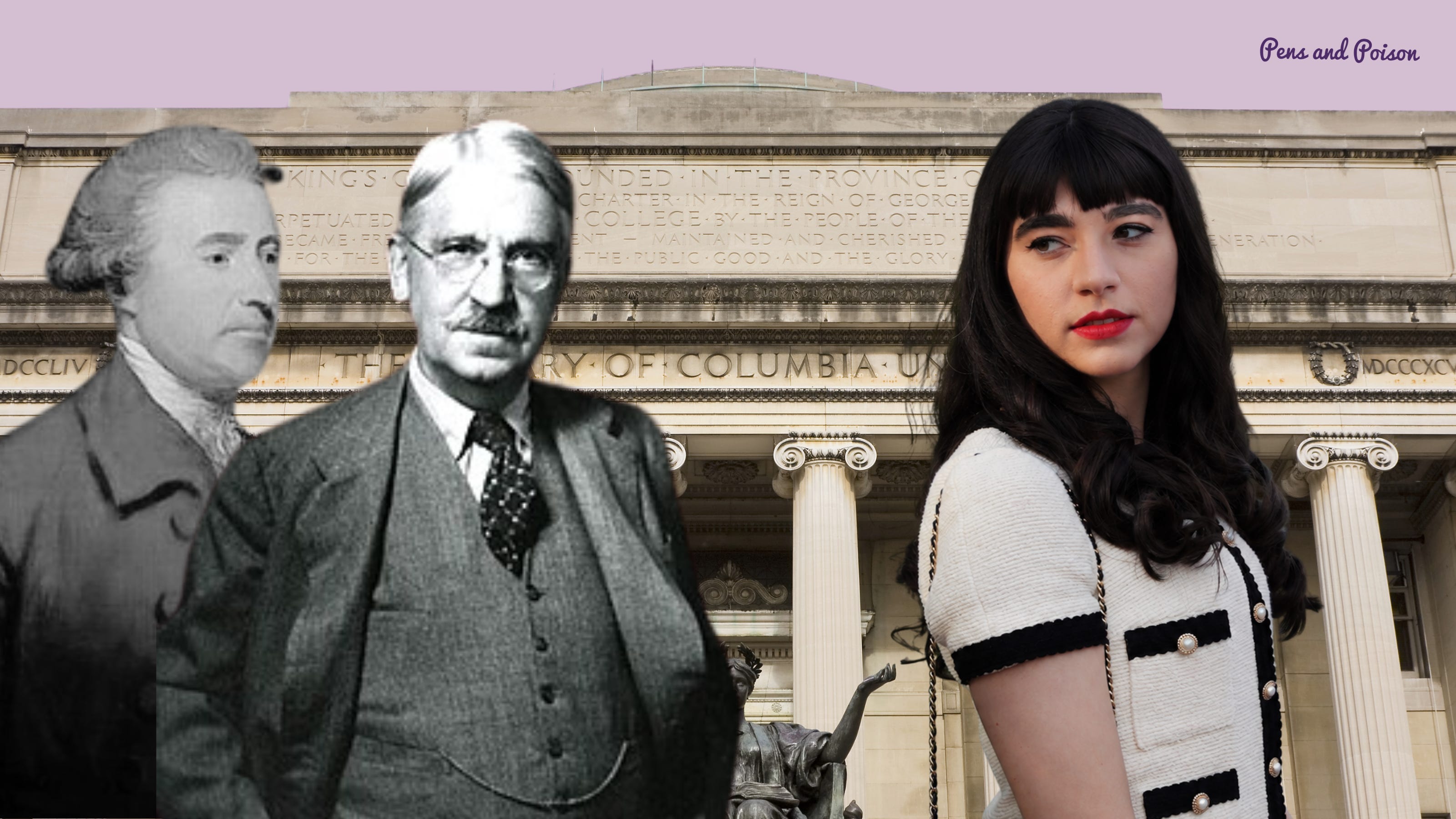
You might know me from social media as that girl who fights wokeness in literature, but in 2015, I came into college as a liberal.
Educated at one of the nation’s premier private schools alongside Malia Obama and Rahm Emanuel’s kids, I was steeped in the intellectual tradition of the great progressive educational philosopher John Dewey. A renowned American pragmatist, Dewey believed that the primary purpose of education was to inspire social reform; armed with this conviction, he collaborated with the University of Chicago to found the Lab School, one of the most progressive private high schools in the country.
To say that my foundational education was progressive is an understatement—as early as second grade, my classmates and I were bombarded with climate change documentaries and readings in civil rights. My seventh-grade humanities class, in fact, spent the year discussing “Social Justice in a Democratic Society”—the official name of our middle school English seminar—and that same year—back in 2009—the school cancelled classes for a week to shepherd us into “Diversity Day” workshops. My eighth-grade English teacher—sporting a mullet and an array of beaded necklaces—looked like she’d walked right out of Woodstock, and my high school history teacher complained in our school newspaper several years ago that “neoliberal influence” had caused the school to lose sight of Dewey’s original “radical” mission. The “real” John Dewey, he writes, would have been just like “Bernie Sanders, Elizabeth Warren, Brandon Johnson or AOC.”
All of this is to say that my school was “woke” beyond proportion even decades before the word had formally become part of our lingo—and that, educated by Dewey’s disciples before continuing my education at Columbia University, progressivism was all that I had ever known.
It’s not that I was ever a staunch Social Justice Warrior or that I’ve ever voluntarily introduced myself to anyone as “she/her.” I was just liberal in the old-fashioned sense: I cherished intellectualism, women’s rights, equality, and—most importantly—freedom. Swayed by these values, I voted for Hillary Clinton in 2016, prancing out of the booth with a cheeky “I Voted” sticker on my chest.
At 19, in fact, I’d often get into arguments with my grandmother, a retired Soviet chemistry professor, who insisted that a vote for Donald Trump would lead our country in the right direction.
I remember feeling bewildered that my biggest role model, a woman who had lived through and escaped the oppressive regime of the Soviet Union—where neighbors snitched on one another to the KGB and the press kowtowed to the whims of Joseph Stalin—would support a candidate whom John Oliver and Trevor Noah told me would erect an American Third Reich.
We were Jewish, after all.
During the several months leading up to the 2016 election, I attributed my grandmother’s scorn of the Democratic Party to her senility—after all, she had always taught me the value of diverse perspectives and embodied the highest ideals of feminism as the former chair of her department back in the Soviet Union. But even more importantly, she had taught me that we should never take our American freedoms for granted.
So I was rightfully perplexed by her allegiance to Donald Trump. Trump did not understand the value of freedom, I would always argue. Trump did not have values.
Yet on Wednesday, November 9th, 2016, walking into an exam for my Abnormal Psychology lecture at Barnard, Columbia’s all-girls sister school, I was surprised to find that the morning’s most abnormal behavior patterns were not nestled in the exam questions but plastered on the faces of my classmates, many of whom burst into the classroom bawling, insisting that they were unable to sit for the exam because of the election results.
The professor acquiesced and moved the exam to the following week.
I was rightfully taken aback. What were these girls even crying over? No one had died. Barack Obama would still be president for the next several months. We would have a dullard for a president for the next four years, sure, but did these girls really think that they—members of the privileged elite whose parents were paying $80,000 per year for them to attend one of the best universities in the world—would be personally affected by the reign of Donald Trump?
What was more astonishing was that my classmates—girls who supposedly represented the apex of female empowerment—did not at all embody the feminist strength that my grandmother once taught me. Incapable of sitting through a 45-minute exam because they had read on their phones that the world was ending, my classmates weren’t strong or independent—they were weak.
Back across the street at Columbia, I expected to be met with a dose of sanity—liberal-minded people like me who, although critical of Trump, would spend the day brainstorming solutions to keep democracy alive instead of narcissistically upending everyone else’s lives to make space for their mental health crises. Instead, a fever had set upon campus. These students, either melodramatically sulking to class or barricading themselves in their dorm rooms, genuinely believed that Trump’s presidency would be the end of liberal democracy.
Expecting to have a candid conversation with my peers about the future of America, I was instead branded a misogynist for daring to ask why everyone seemed so upset that afternoon.
Over the next several months, the menacing spirit of November 9th permeated classrooms, infecting the rhetoric of my professors. In a course called “Masterpieces of Western Literature,” for one, I was told that it was “incorrect to argue that a patriarchal structure can benefit society’s women.” On the flip side, I received an A in the same class for a paper that argued against prevailing gender norms in Ancient Greek society.
It wasn’t just one class. In a Shakespeare seminar the following year, my professor—believing that Titania and Bottom’s “relationship” in A Midsummer Night’s Dream was an example of “queer desire”—took points off of my exam because I disagreed with her “queer” reading about the play. When I later turned in a paper proposing that Twelfth Night was a play about transgenderism, I was greeted with an A+ grade.
Later, in my senior thesis program, I was called a misogynist for daring to cite the contrarian scholar Camille Paglia—before being ejected from the program entirely. My thesis advisor—with whom I have since cut ties over his despicable pro-Hamas rhetoric—believed that Paglia was not a scholar to be taken seriously and sent me an ominous article from The New York Times that seemed to disprove Paglia’s take on Sylvia Plath’s poem “Daddy.” The implication was, of course, that I was not free to explore the angle of the poem I was most interested in because it ran against the grain of the prevailing feminist scholarship that shrouds Plath’s work.
In other words, there was no consistent standard for what constituted “good scholarship.” A scholarly essay from Paglia—who holds a PhD from Yale University—was not taken seriously by faculty at Columbia University, while a random article from a bad journalist at The New York Times became the gold standard of literary critique simply because it said the “right” things. The same department that had rewarded me for advancing fashionable ideological readings penalized me for citing scholars whose conclusions fell outside the accepted orthodoxy.
And while I can only personally attest to such incidents at Columbia University, they reflect a much broader transformation in elite higher education, which is now increasingly defined by growing hostility toward dissent.
Indeed, I soon noticed a pattern across my English classes: my classmates and professors alike were allergic to disagreement. Parroting talking points about the death of democracy while brandishing The Communist Manifesto like a pitchfork, they refused to hear out the experiences of a young woman—me—whose parents had suffered actual oppression because of that same disturbing book. Teaching Edward Said, academia’s premier critic of the State of Israel, those same professors warned us about the resurgence of Nazism while refusing to acknowledge Israel’s role in helping so many Jews find safe homes in the wake of Hitler’s reign. Inspired by Said’s delusional “literary” essays, my classmates would claim that Jane Austen would have been complicit in imperialist expansion and that T.S. Eliot’s poems were “trash” because he was a conservative—all while refusing to engage with the actual writings of these literary greats.
The plague was not confined to English classrooms—it shaped the ideologies embedded in our school newspaper and informed the viewpoints of my literary magazine’s editorial team, which began prioritizing submissions from underrepresented demographics regardless of quality, because, as our secretary put it, “If they’re writing about oppressed minorities, it has to be good.”
How did liberalism, once the label for all things good and free, transform these publications into Joseph Stalin’s Pravda?
Back in high school, I had been taught the importance of liberalism in all its forms, and I still staunchly believe today that liberalism is the way forward when it comes to free inquiry in our society. But what the so-called progressive left embodies on college campuses today is far from the liberalism I’ve always known; instead, it is the same regressive energy that took over the Soviet Union in the 1920s. It is the same spirit that informs the politics of Darializa Chevalier and Claire Valdez—both of whom picked up their radicalism at Columbia University—and is responsible for the socialist fever that has taken over New York City over the past year. It is the same antithesis to open discourse that Dewey himself—with all his progressive tendencies—would have gawked at had he witnessed just how intolerant the educational sphere he helped shape has become.
Graduating from Columbia, I was left not with the open-minded experience I was promised in my acceptance letter but with a new acceptance letter to the Republican Party, now the more tolerant of our two major political factions. And while strands of the podcast bro right have their own racism and intolerance problems, the more moderate right—the new embodiment of classical liberalism and tolerance—offers hope for a society built on freedom and open discourse. There is, after all, undeniably more intellectual diversity on the political right than on the political left.
Over the past decade, we’ve witnessed major American institutions replicate what I observed that somber November 9th morning on the campus of Columbia University: a narcissistic tendency to blow all dissenting viewpoints out of proportion and a refusal to engage in open discourse. If Columbia taught me one thing, it’s that the intellectual (anti-intellectual?) left does not stand for freedom of expression but is concerned solely with shutting down dissenting viewpoints. This absence of free speech was exactly why my family had fled the Soviet Union back in the early 90s, and it’s the same reason that my grandmother had been so wary of Hillary Clinton back in 2016.
Today, I realize that my grandmother was never for Donald Trump at all but against the loss of freedom in our society. Having lived through the Soviet Union, she recognized the earliest symptoms of a culture that no longer tolerated dissent long before I could, and though it would take years for me to understand what she had seen immediately, I understand today that we must ask ourselves whether any given political cause can ever justify the abandonment of open inquiry. Because when challenging socialist doctrines gets you called a Nazi and a bigot, we lose the sorts of freedoms my grandmother predicted we’d lose back in 2016—the sorts of freedoms I want to fight for today.
To me, therefore, conservatism does not necessarily represent the caprice and turbulence of MAGA Republicanism but a hope for the return to a tradition that once forged our free and open society. The American right has abandoned many of these values, too, but through a return to the tradition of classical liberalism and open inquiry, we can recover the values that New York City and Columbia University have already abandoned. That’s what conservatism has always meant, after all—conserving the tried-and-true values that contribute to a flourishing society. Conserving the values that my grandmother once crossed an ocean to find, and the freedoms that make our liberal democracy worth preserving.
Enjoyed this post? You can Buy Me a Coffee so that I’ll be awake for the next one. If you are a starving artist, you can also just follow me on Instagram, YouTube, or “X.”
In my dream world, political parties do not control, or even attempt to control, our thoughts.
In my dream world, citizens flatly reject attempts to indoctrinate them and their children into any belief system.
The USA was founded on the Enlightenment philosophy of individual rights and responsibility. If only that was still the case...
Excellent testimony. Noticed the leftists trying to stear your beliefs. Typical. When you discover truth it is profound.