


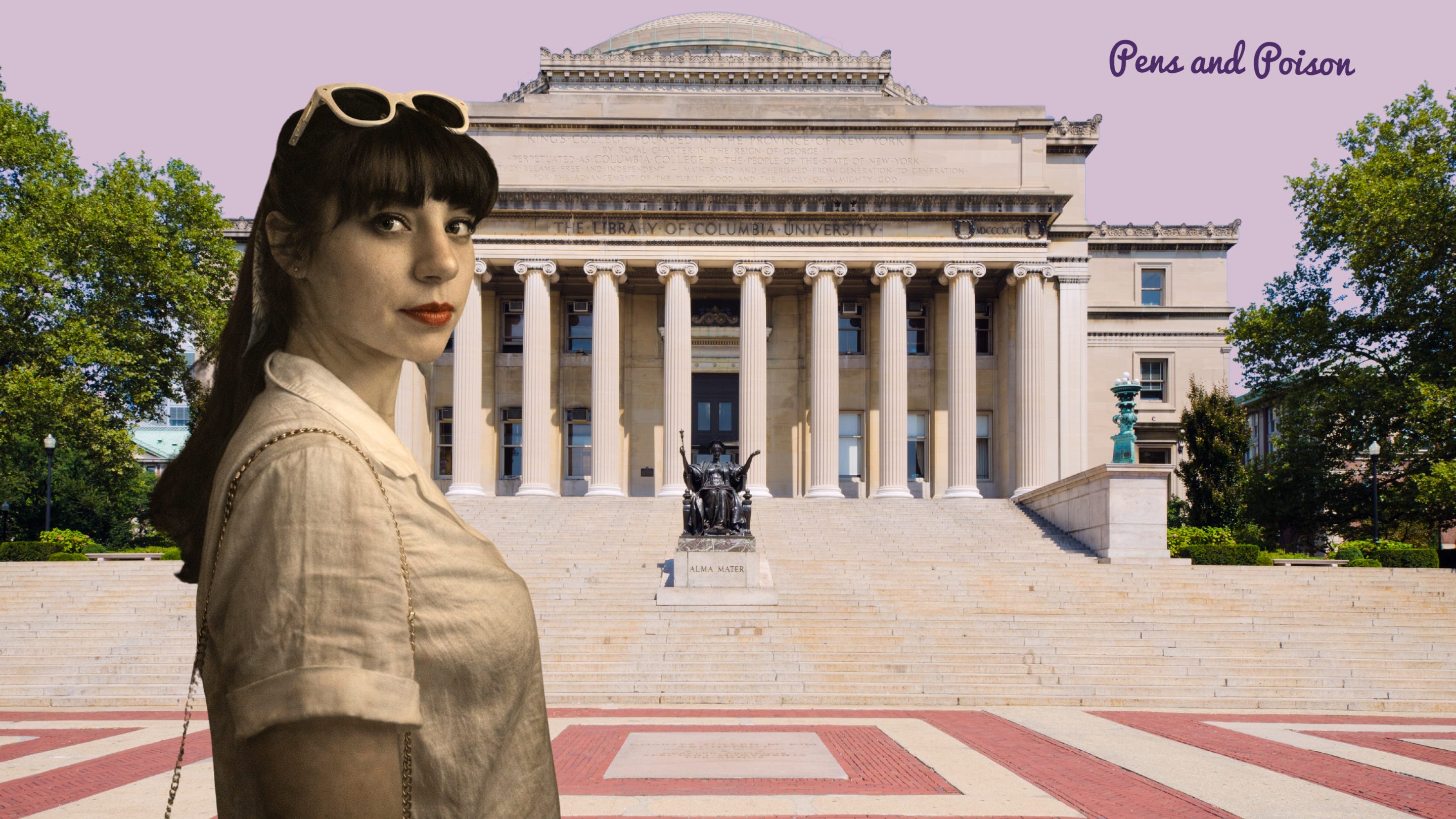
When I first moved to New York City, my entire world went up in flames.
I was starry-eyed, ambitious, and eighteen. I had just achieved my lifelong dream of studying English literature at one of the best universities in the world—an Ivy League school famous for paying homage to the great intellectual achievements of Western civilization—and I couldn’t wait to spend the next four years of my life immersed in discussions of Homeric epics, Shakespearean monologues, and modernist poetry at Columbia University.
I went to a STEM-oriented private high school. My classmates, versed in math, chemistry, and economics, had spent the past four years preparing for careers in banking, medicine, and engineering—the so-called “lucrative” jobs of our time. Their wealthy parents had set them on these more “stable” paths for good reason, yet in an unusual twist of events, my immigrant family was much more lenient with me—and I’d always been encouraged to chase my dreams.
For me, those were studying literature and becoming a famous writer.
It’s not that I was wholly impractical. I still applied myself in math and science classes and bandied about business and law as alternative career paths. In college, I enrolled in psychology and economics courses to give myself a backup plan, but I knew from the start that my heart was never set on any of my Plan Bs. I was going to be a writer no matter what it took—and not just a writer but an academic versed in the great humanistic tradition of studying literature.
And how cool would it be if, in the vein of David Foster Wallace or Toni Morrison, I could one day teach my own novels to the next generation of great thinkers?
Being an academic would also be my fast-track to writerly proficiency. The only way to become a great writer, after all, was to read great literature—and by devoting myself to the academy, I could no doubt make my own contribution to a longstanding tradition of verbal storytelling.
In my view, after all, literature and tradition were inseparable. I had inherited this line of thought from my literary idol, the modernist poet T.S. Eliot, who believed that literary creation could be possible only by establishing a centuries-long dialogue with the masters of the past. Perhaps the American modernist poets had always wanted to “make it new,” in the words of Ezra Pound, but there could be no “new” without the old.
Eliot was quite the Burkean, and it is no accident that Edmund Burke went down in history for not only insisting that we ought to respect the tradition of our forefathers but also for suggesting that aesthetic experience was uniquely bound up with beauty and the sublime.
And that was what literature had always meant to me—and why I wanted to study it so badly: it was the closest thing we had to a physical manifestation of beauty in the human soul.
To me, then, the study of literature was by nature a traditional pursuit—a discipline that believed in the preservation of beautiful things. It was a course of study that allowed us to probe the depths of our psyches and examine the questions that make us all human.
You can imagine my astonishment, then, when I learned that by some twisted perversion of fate, literature had become virtually synonymous with radical leftism in the contemporary literary academy.
I wouldn’t quite put my finger on it for another year or two, but even on the first day of freshman orientation in college, I felt that something was off.
The year was 2015. A plane had just crashed in England, and Trevor Noah had just taken over The Daily Show. Tensions were mounting in Germany with an intensifying Syrian refugee crisis, and the country still knew Donald Trump primarily as a billionaire real estate mogul. The GOP debates were coming up at the end of the week, and the newest buzzword on campus was “political correctness.”
That was how things stood on that balmy morning in late August. No one had yet heard the term “woke” in the context that we understand it today—but unbeknownst to 18-year-old Liza, Columbia University was leagues more “woke” than the rest of our society.
Sandwiched between Columbia’s two famous libraries—the now-defunct Low Library and the infamous Butler Library where we all cried our eyes out before exams—we sat in a circle on a patch of grass. There were about fifteen of us—nervous freshmen from all over the world who had come to New York City in the hopes of becoming the future’s greatest minds—and we would be completing orientation activities with each other for the rest of the week.
These were supposed to be our first set of college friends.
I don’t remember a single person from my orientation group, but I can tell you that the orientation leader—a huffy junior from Connecticut—was not very pleased with me throughout my first week on campus.
I remember locking eyes with her right after she’d read off instructions for our first “icebreaker” activity: we were supposed to go around in the circle and state our name, where we were from, our intended major, and our pronouns.
Pronouns?
Picking at my chapped lower lip with my front teeth, I immediately felt some sort of imposter syndrome. Had I, a prospective English major with a deep love for grammar and the written word, forgotten what a pronoun was?
It didn’t make sense in this context.
I began to run through the parts of speech, second-guessing everything I had ever learned in school. Verbs were action words. Adjectives were descriptive details. Prepositions denoted time, place, or location. Pronouns… Pronouns…
Pronouns were words that replaced nouns in order to avoid needless repetition in spoken or written text. I wasn’t going crazy—we’d had even gone over pronouns in French class: tu, il, elle, nous, vous.
Were we learning languages all of a sudden?
As my classmates went around declaring their hometowns and prospective majors, my mind was racing. I had no idea what I was supposed to say.
It seemed that everyone was stating the third-person singular pronouns—subject and object—that corresponded to their sex.
But why?
There I was in my mascara and my baby blue halter dress, rummaging through my dainty purse for one of the small water bottles I had filched from the dining hall—and I was being asked to confirm whether I was a woman.
“I’m Liza,” I stammered. “I’m from Chicago, and I’ll be majoring in English. My pronouns…” I stared off into the distance, turning violet as fifteen pairs of giant eyes glared at me in expectation. “My pronouns are she and her.”
That, my friends, was the first and last time I would ever voluntarily report my “pronouns.”
But back then I was still trying to blend in.
I brushed it off until our next orientation meeting—the last activity I would attend before claiming I had a fever and playing hooky for the rest of the week’s activities.
We were piled into an old classroom in Columbia’s famous Hamilton Hall (the same building that was taken over by pro-Palestine protestors in 2024). Our orientation leader had divided the whiteboard in front of us into seven columns, asking us all to come up and place sticky notes containing each of our “identifiers” under each corresponding column: sex, gender, socioeconomic status, race, ethnicity, sexual orientation, and ability.
Eighteen-year-old Liza—having never heard of “ability” before—wrote “normal” on her Post-It and pinned it proudly up on the whiteboard.
I was pulled aside at the end of the activity and given a stern lecture on “ableism.”
No matter, I thought. Classes would start soon—and I was going to meet my more traditionally minded counterparts in the English department.
But on the first day of my freshman English department seminar, we were given the writings of the so-called literary critic Edward Said.
The chapter in question—from his famous book Culture and Imperialism—was on Jane Austen’s Mansfield Park.
That was strange, I thought. Why were we reading criticism of a book without first having read the book itself?
I had read Mansfield Park in high school, so I could at least follow Said’s entire argument: that Mansfield Park was a novel about colonialism and imperialism.
Had we read the same novel—or, like many of the other students here reading critique before primary source text, had Said simply made up an idea without once ever having touched the actual book?
That evening, we were asked to produce a paragraph response to the Said chapter to prepare for our discussion that coming Thursday.
“The argument that Mansfield Park can only be understood from a colonial standpoint seems entirely farfetched,” I wrote. “Fanny’s entrance into her home as a metaphor for some colonizing force at work is too great a stretch.”
The professor was not very impressed. I had not sufficiently understood Said’s argument, in her eyes, and besides—it didn’t matter whether Mansfield Park was about imperialism or not—what mattered was that Jane Austen was complicit in British imperialist expansion.
Huh?
Before I knew it, I was being fed the writings of Edward Said in virtually every English seminar; the professors who hadn’t yet fallen prey to the Said fever flooded our reading lists with excerpts from Karl Marx and Judith Butler—theorists who defined the English curricula but who seemed to have little—if anything—to do with literature itself.
With every seminar I took, the overall aim of the Columbia University English department became clearer and clearer: these professors collectively wished to use literature as a force of resistance against “illiberal forces” to make our society a more just world for all.
But to me—someone who grew up with parents who’d fled the Soviet Union—Marxism wasn’t synonymous with liberalism in the least.
Sure, there was nothing wrong with trying to make our world more just and equitable—and there were so many great writers who had worked toward that aim—Shelley, Ibsen, Orwell, to name a few. But the promotion of social justice was simply one possible outcome of engagement with literature—not its sole aim.
But if you asked anyone in my department, literature was inseparable from resistance and justice.
How had I, then, come to such a radically different conclusion?
I began to look at trends across reading lists in my English classes. There was always an abundance of literary theory—yet few actual literary works. We had been handed literary theory on the first day of classes without having first read any literature itself.
English departments had slowly replaced literature with literary theory—and so slyly, at that, that no one seemed to have noticed.
The fact was that in the Columbia English department, the “Western canon” was “racist” and “Eurocentric”—and if a text had not come from a multicultural bisexual woman, it was seldom introduced in our classrooms. Sure, we had a Shakespeare seminar, but not without a professor or two demanding that Shakespeare was gay or actually a woman—or teaching his plays through the lens of “queer desire.”
By the time I hit grad school, literature itself had fallen entirely to the wayside. It was assumed that everyone had already read all of the important classics during their undergraduate years, and all that was left was to study them through the lenses of different theories. The one required course for all students in my master’s cohort featured all theory and no literature—in a degree program for English literature.
I had come to Columbia years ago to study English because I loved tradition and beauty. To me, literature is an extension of a broader thousand-year tradition of telling stories, and at Columbia University—a campus whose neoclassical library bears the names of the Western literary greats—I had expected to find so many other old-school lovers of the humanities who clung to beauty and tradition with their entire souls. Instead, I was met with students and professors alike who only wanted to destroy everything I’ve ever loved, calling it “English literature” in the process.
But true scholars of the humanities know that literature is about understanding beauty, culture, art, and society—those special facets that make us uniquely human—rather than about radical leftist activism. We call this the humanistic tradition—and it is this tradition that has been abandoned in English departments across the world today.
I know I’m not alone in approaching the study of literature in this unique way. I came to Columbia to become part of a longstanding tradition, and tradition does not disappear simply because our institutions have abandoned it. Traditions live on, and it only takes a believer or two to revive them completely.
In returning to aesthetics and beauty, we can do our part in saving literature and restoring it to its rightful place in the humanistic tradition. Because after all, literature is our best bet for understanding not only the world around us but our own selves.
Enjoyed this post? You can Buy Me a Coffee so that I’ll be awake for the next one. If you are a starving artist, you can also just follow me on Instagram or “X.”
See Professors and the Pornography of Power:
https://chicagoboyz.net/archives/56415.html
...in which I quote Jonathan Haidt:
"Today’s identity politics . . . teaches the exact opposite of what we think a liberal arts education should be. When I was at Yale in the 1980s, I was given so many tools for understanding the world. By the time I graduated, I could think about things as a utilitarian or as a Kantian, as a Freudian or a behaviorist, as a computer scientist or as a humanist. I was given many lenses to apply to any given question or problem.
But what do we do now? Many students are given just one lens—power. Here’s your lens, kid. Look at everything through this lens. Everything is about power. Every situation is analyzed in terms of the bad people acting to preserve their power and privilege over the good people. This is not an education. This is induction into a cult. It’s a fundamentalist religion. It’s a paranoid worldview that separates people from each other and sends them down the road to alienation, anxiety and intellectual impotence"
I want to believe that the pendulum is going to swing back because beautiful prose is beautiful prose, and while passing fads (like overdone wokeness in university English departments) may cloud that perspective, it's not possible to erase the truth about the literary canon. I will defend the relevance of Henry James to anyone, anywhere, at any time. And defending literature's past does *not* mean we don't also welcome new works by a variety of voices. This is not a zero-sum game!