


A version of this article originally appeared in Fair for All.
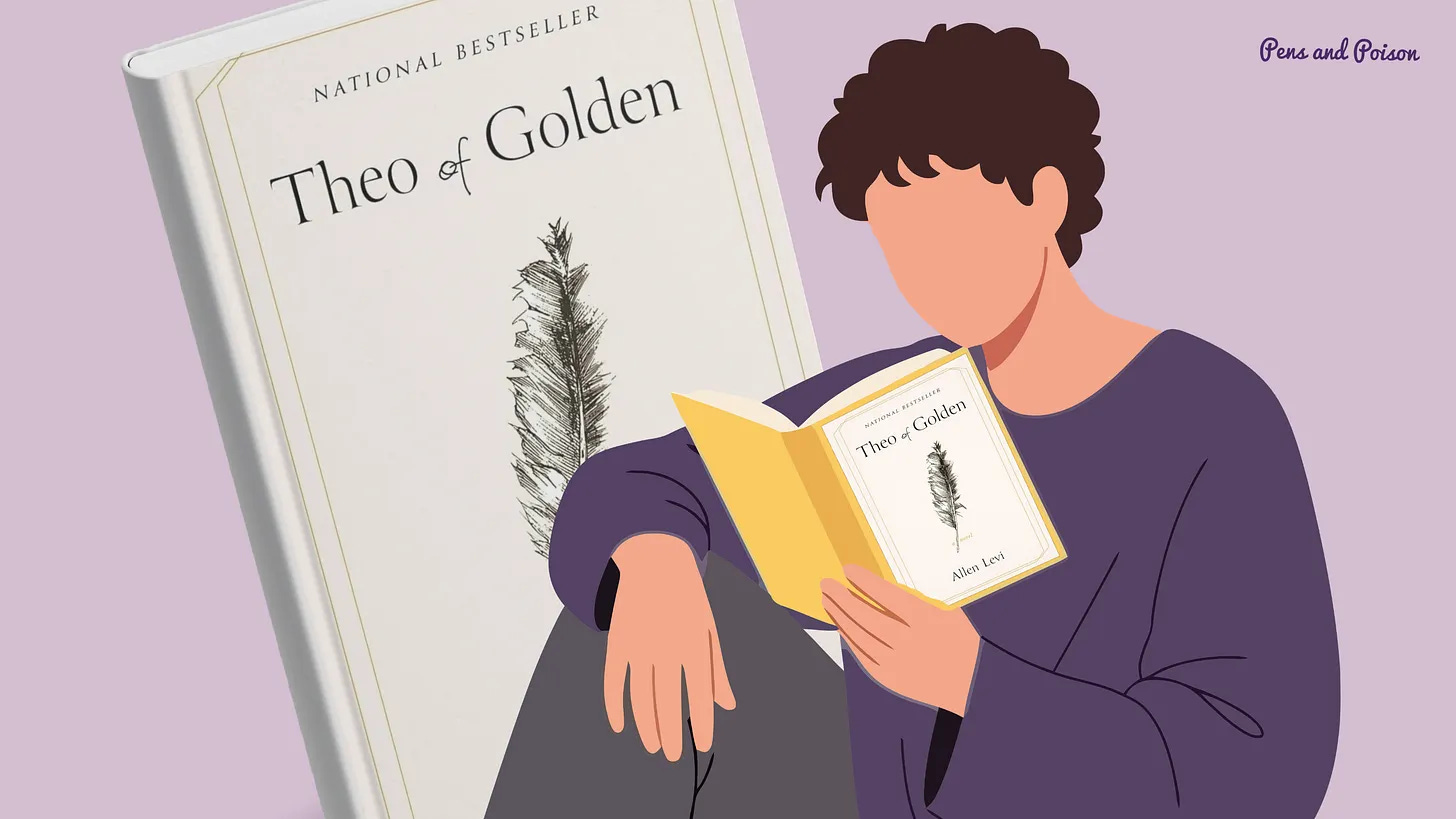
Allen Levi’s Theo of Golden is this summer’s go-to read for BookTokkers and academics alike—and it broke every rule in contemporary publishing.
Last month, The Wall Street Journal ran a feature on Levi’s unconventional journey to literary fame following the publication of his bestselling novel Theo of Golden. While I tend to gloss over most contemporary fiction news (which often pertains, as The Wall Street Journal admits, to BDSM or vampires), this particular story immediately captured my attention: since its publication three years ago, Theo of Golden has sold 2.5 million copies—and it was originally self-published.
That fact alone should give every editor in New York City pause: if a novel capable of reaching millions of readers could not initially find a home in the traditional publishing industry, then literary professionals have erroneous assumptions about what readers desperately crave today.
Upon its initial release, in fact, Theo of Golden sold three thousand copies—a more than respectable number for a self-published title—and continued to reach indie fiction lovers across the country until Simon & Schuster finally recognized what readers knew long ago: our culture is in desperate need of serious literary fiction.
As someone who has spent the past few years analyzing trends in the publishing industry, I can only chuckle at the reaction of Levi’s literary agent, who felt like she was “walking into the woods and discovering a unicorn.”
No hate for Theo of Golden, which abounds with beautiful sentences and complex ideas, but the irony is, of course, that the book only appears to be a unicorn because the publishing industry has spent decades engineering a literary landscape in which slow, introspective, and profound books have become exceedingly difficult to find.
The rise of BookTok culture—a TikTok book community characterized by algorithm-driven content and bite-size recommendations—has increasingly conditioned readers to expect stories that deliver immediate gratification rather than those that require sustained intellectual engagement. Several “BookTokers,” in fact, admit to reading only dialogue in novels while skipping over “slower” scenes, creating a reading culture where books are almost literally reduced to screenplays. Publishers, in turn, cater to the BookTok community, and the cycle continues.
In other words, Theo of Golden has only earned its claim to uniqueness precisely because the publishing industry systematically turns away all other books like it.
Every year, the publishing industry churns out hundreds of new fiction titles that all sound the same. Teeming with short sentences and declarative phrases delivered by detached, ironic narrators, these books no longer require readers to consider what a work of fiction means. The value of a book has been reduced to its ability to provide quick, digestible entertainment rather than to challenge its reader.
The result is an entire literary ecosystem that has surrendered its capacity for reflection—and a broader culture that has lost its ability to think critically about our world.
Let’s look at some examples from recent literary fiction bestsellers, starting with Sally Rooney’s Normal People.
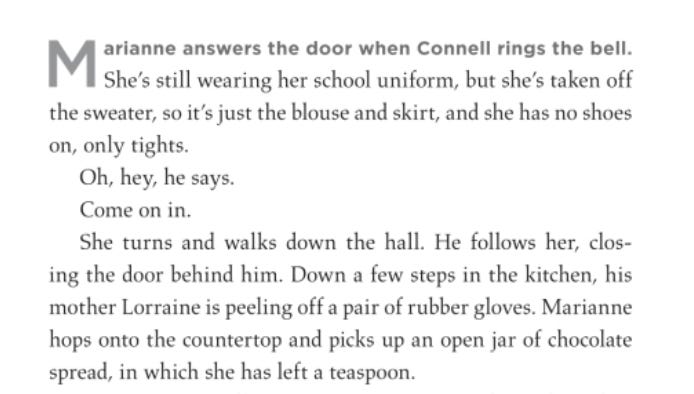
Rooney’s sentences are simple to a fault. With a didactic and juvenile cadence akin to the sentences one might find in a picture book, her prose contains no words or ideas that a third grader would not understand, and—in fact—seems targeted precisely at a small child learning how to read. Her average sentence—at twelve words in length—communicates only the bare minimum information required to advance the plot, creating an entire novel that is remarkably easy to consume but rarely challenges the reader’s imagination.
One could excuse the publishing industry if it were just Rooney writing in this infantile style, but such literary minimalism has infested nearly every single literary fiction title that lines our shelves today.
Let’s take a look at another bestselling example—Caro Claire Burke’s Yesteryear, the literary rave of the past few months.
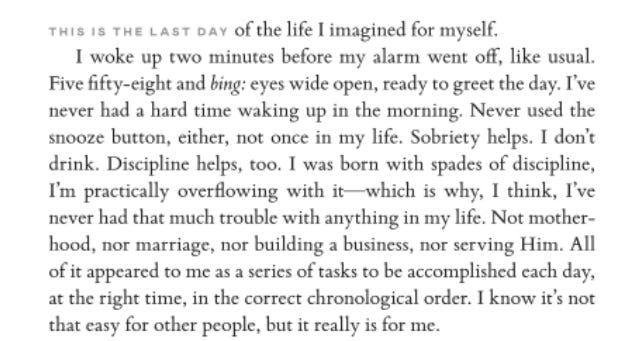
Burke’s prose follows much the same pattern as Rooney’s: short, declarative sentences move the reader rapidly from one assertion to the next, with the narrator explaining every aspect of her personality—she is disciplined, sober, organized, and successful—before readers have the opportunity to draw their own conclusions. We can describe Burke’s prose as utilitarian, its overtly literal sentences devoid of metaphor or syntactic variation. The result is a novel that is easy to consume but difficult to contemplate.
One final example to bring my point home—Taylor Jenkins Reid’s The Seven Husbands of Evelyn Hugo.
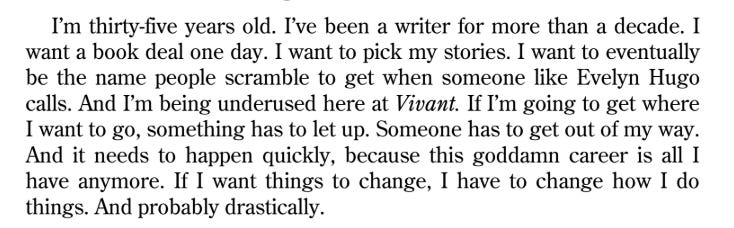
Reid’s prose is stripped entirely of literary texture. She begins almost every sentence in this paragraph with the words “I” or “and,” employing a total of two commas over eleven sentences. Driven by parataxis (“I want / I want / I want”), her sentences are embarrassingly literal, conveying information with the efficiency of a corporate email. The narrator announces every desire and motivation outright, eliminating subtext and discovery—the very qualities that have traditionally distinguished literature from Facebook status updates. Taken as a whole, her prose efficiently communicates information but possesses little musicality or stylistic distinction.
Let’s contrast these examples with the opening of Levi’s Theo of Golden:
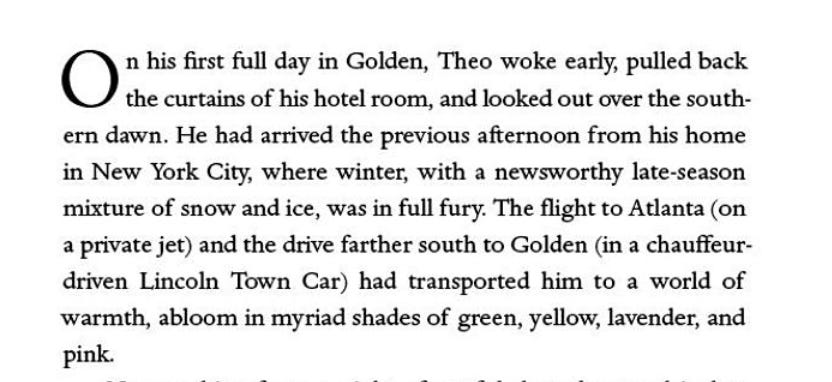
The difference is almost immediately apparent. Where Rooney’s prose reports, Levi’s evokes; where Burke explains, Levi reveals. Theo of Golden demonstrates that language is not simply a vehicle for plot but an art form in its own right: every sentence becomes an opportunity to create beauty. While most contemporary literary fiction thus treats language as a transparent delivery system for plot and ideology, Levi trusts his readers to slow down and savor the cadence of a well-crafted sentence—and the meaning of his ideas as a whole.
Theo of Golden therefore stands as a direct antithesis to the prevailing wisdom of the contemporary publishing industry, challenging the broader orthodoxy that readers want fiction that reads like a movie script.
But if readers are clearly willing to embrace the thematic and stylistic complexity of Theo of Golden, why, then, does the publishing industry keep pushing out didactic, juvenile, and minimalist literature?
The fact is that the stylistic similarities among the novels we examined above are not accidental—they reflect an editorial philosophy that increasingly equates literary quality with accessibility.
Because editors increasingly acquire books that can be pitched in a single sentence—and then adapted for television and recommended on social media—minimalism has become not only the norm but a hard requirement in the contemporary publishing world, with publishing professionals routinely claiming that any sentence over fifteen words causes readers to “concentrate too hard.” Such language suggests that the publishing industry has not only become convinced that readers of contemporary fiction do not have the attention spans to digest long, flowery sentences but also that the industry itself has shaped the tastes of its own readers.
Operating in this paradigm, writers are frequently told to avoid “poetic prose and metaphors,” with one agent offering the following advice on her blog:
Often times [sic] the writers will focus on sounding “literary” and write meandering, prosy or metaphor laden sentences. While it is a style choice, it’s not usually a successful one… Flowery prose and metaphor often detract from your writing. You can often make more impact using fewer, but stronger words.
Thus the “literary” voice, which this agent defines through “flowery prose and metaphor,” becomes not only the less desirable writing style but an active faux pas. Writers who take after Fitzgerald’s ornamental phraseology or Nabokov’s metaphor-laden prose face constant rejection, while writers who produce literal and legible writing see their books line our shelves. Over time, these editorial preferences have helped create a reading culture in which readers are told they no longer have the patience for long, intellectually demanding books.
But the irony is that readers are rarely given the opportunity to encounter them in the first place.
The publishing industry might have convinced us all that we don’t have the attention spans for long, intellectually demanding books anymore, but the success of Theo of Golden offers hope for a civilization that has increasingly abandoned its capacity for reflection.
Publishing shapes our culture far more than we like to admit. The very books championed by our publishing professionals become the books that we not only read and discuss but also aspire to write ourselves. If year after year, therefore, the publishing industry rewards simpler, faster, and more disposable fiction, then readers inevitably become accustomed to “fast-paced” books that require no afterthought. If, on the other hand, publishers start championing ambitious, intellectually rich novels again, then there is every reason to believe readers would rise to meet them.
As our literature loses its capacity to challenge readers, an entire generation of thinkers becomes less comfortable with complexity—but we can restore critical thinking to our culture by daring to publish difficult books again.
Perhaps, then, the real lesson of Theo of Golden is not that readers suddenly rediscovered serious literary fiction but that they never stopped wanting it. The publishing industry simply stopped believing they did.
So maybe it’s time for the publishing industry to take notes from Theo—and to believe in its readers again.
Enjoyed this post? You can Buy Me a Coffee so that I’ll be awake for the next one. If you are a starving artist, you can also just follow me on Instagram, YouTube, or “X.”
It’s kind of amazing how backwards traditional publishing is. People naturally gravitate *toward* difficult books because we’re hardwired to find moderate adversity more enjoyable. The pleasure of reading is developing our imagination through effort, not skimming through short sentences.
‘The result is a novel that is easy to consume but difficult to contemplate.’
That’s a bar.