


Which translation of Dostoyevsky should I read?
Well… none of them.
To this day, I have no good answer to the most common question I get from fans. Sure, there are “good” translations, and “bad” translations, but I’ve never come across a translation that fully satisfies me. Even the best translations make sacrifices, and many lines—especially in Dostoyevsky—are fundamentally untranslatable. That said, some translations are much better than others, and it’s important to find a “good” translation if you want to fully engage with the scope of Dostoyevsky’s psychological commentary.
During my time studying translation theory at Columbia, I’ve looked at over a dozen Dostoyevsky translations, and while choosing a translation might be a matter of personal taste, a “good” translation will certainly enhance your reading experience—while a “bad” translation can ruin it entirely.
But what sets a “good” translation apart from a “bad” translation?
Most people think that a “good” translation is simply the most accurate one, and while “good” translations often do stay true to their source material, an “accurate” translation on its own does not necessarily yield a pleasant reading experience. Many “literal” translations, in fact, turn out choppy, awkward, or fundamentally unreadable. A “good” translation, on the other hand, will always flow naturally in the target language of translation.
We can therefore define a “good” translation not as a reproduction of the original text but as a rewriting that preserves the spirit of the original while allowing it to live naturally in a new language. In other words, a good translation reads fluently in the target language while capturing the overall meaning and tone of the original text.
Most translators accomplish only one of these two things.
Let’s take a look at some examples—starting with translations from Oliver Ready, Pevear & Volokhonsky, Michael R. Katz, and Constance Garnett.
Crime and Punishment
We’ll use the opening of Crime and Punishment as our first case study.
I’ve included the original Russian text for us below—while you don’t have to know how to read it, pay attention to Dostoyevsky’s comma placement, which we’ll examine shortly:

We’ll use the Russian verb «нанимать» (“to rent”) to exemplify the difficulty of Russian translation: in order to accurately translate this verb, one must understand the nature of Russian verb forms. In Russian, verbs are frequently organized into aspectual pairings—perfective and imperfective—to distinguish a completed action from an ongoing or habitual one. The verb «нанимать» appears here in the imperfective aspect, suggesting that Raskolnikov’s room rental is an ongoing rather than a one-time process—a plot point that will become relevant later in the text.
If you studied French or Spanish in high school, all of this will sound familiar: you’ll remember learning about the “perfect” and the “imperfect” tenses in these two languages. While the Russian perfective and imperfective forms are different grammatically from, say, the French passé composé and the imparfait, we can draw a parallel between these two forms, which makes it easier to translate this passage into French than into English.
If I wanted to say in French, for instance, that Raskolnikov rented his room yesterday, I would use the perfective verb «нанять» in Russian; if I wanted to say, on the other hand, that Raskolnikov rented his room once upon a time, I would use the imperfective verb «нанимать». In French, therefore, the choice is simple: one would translate the verb «нанимать» as “louait” (imparfait) as opposed to “a loué” (passé composé); indeed, this is the only “correct” translation in French, for the use of the form “a loué” completely alters the meaning of the entire passage. Notice, however, that in English, the same verb form—“rented”—accounts for both the idea that Raskolnikov rented his room yesterday and that he rented his room once upon a time.
Luckily, in English, we have another tense that exists neither in French nor in Russian: the continuous past. We can therefore also say that Raskolnikov “was renting” his room over a period of time.
Both “rented” and “was renting” are therefore acceptable translations in English, but each produces a slightly different meaning. If we want to emphasize Raskolnikov’s ongoing struggle with his rent (as we should), then we’ll want to employ “was renting” rather than “rented” in our translation.
Looking at different translations of Crime and Punishment, we’ll see this verb rendered both in the past and the past continuous tenses—both as “rented” and “was renting.” Let’s compare Oliver Ready’s translation for Penguin to the Pevear and Volokhonsky translation:


Oliver Ready gives us “was renting,” while Pevear and Volokhonsky give us “rented.” Notice, however, that “was renting” not only reads slightly more smoothly in English but also more accurately captures the imperfective aspect of the original Russian. Ready, therefore, creates a fluid English translation while also capturing the meaning of the original Russian. In this case, therefore, I would pick Ready over P&V any day.
Then there’s the problem of readability.
You’ll notice that the original Russian sentence contains several subclauses. Because these clauses are quite short, however, any attempt to mimic the Russian syntax in English creates a choppy reading experience—such as in Ready, P&V, and the following translation from Michael R. Katz:

Such attempts to closely mirror Russian syntax in translation often lead English readers to conclude that Dostoevsky is a poor stylist. While it is true that Dostoyevsky does not quite attain the linguistic perfection we see in Tolstoy, he is far from a bad writer: these subclauses, in fact, read far less “choppily” in Russian than they do in English, and it is simply the fault of several of his translators that he’s managed to be so poorly regarded as a writer in the English-speaking world.
Here’s what Constance Garnett, for instance, does in her translation:

Out of the four translations we’ve examined, Garnett’s yields by far the cleanest English version. She reduces the number of choppy clauses while still retaining the overall meaning of the original, producing, in many ways, the superior English translation.
The biggest issue with the Garnett translation, however, is her verb choice for «нанимать», which she changes from “rented” to “lodged” to preserve the fluidity of her sentence. Those of us who have read Crime and Punishment know, of course, that it is precisely this detail that sets his mad plan into motion. Omitting this nuance therefore deemphasizes Dostoyevsky’s clever foreshadowing of Raskolnikov’s struggles and draws the reader’s attention away from the novel’s inciting incident.
So while I typically like Garnett’s translations for their readability, she certainly commits a translation faux pas with this particular sentence, creating an opening that deviates in meaning from the original text.
But just how important is such “accuracy” in meaning?
Well, it depends on the passage—but I’d argue that even more important than meaning is tone and spirit.
Garnett gets a bad rap for “anglicizing” certain passages, but because she writes in a Victorian-style voice, she most accurately captures the spirit of Dostoyevsky’s time rather than over-modernizing (my biggest pet peeves with many newer translations).
It is precisely this ability to capture the spirit of the original text that defines a “good” translation. And it is precisely in their inability to capture the spirit of the original text where the beloved Pevear and Volokhonsky often fall short.
To this day, I have no idea how this translation duo was not only hired by a major publishing house but also gained the respect they enjoy today in literary circles. I’ve studied dozens of Dostoevsky translations, and I truly believe that they are some of the worst Dostoyevsky translators out there. As I understand it, Pevear doesn’t speak Russian very well, and Volokhonsky writes poorly in English, so much of the spirit of Dostoyevsky gets lost in an inefficient game of broken telephone. Volokhonsky supposedly translates the Russian for Pevear into poorly written English, and Pevear cleans it up to sound more “literary.” The issue with this model is that Pevear does not possess a deep understanding of the original text and misses many of Dostoyevsky’s linguistic nuances—especially the irony in many of Dostoyevsky’s observations about human nature.
As a result, P&V not only manage to write a series of choppy sentences but also end up sacrificing the original meaning of the text; because their translations are more “literal,” however—and because so many people are convinced that 1:1 translations are the “best” sorts of translations—they are praised right and left by many readers who don’t really understand that a good translation must be not only linguistically but also spiritually accurate.
Pevear and Volokhonsky fail on both counts, and their shoddy translations reveal their poor grasp of the Russian language and their misapprehension of the overall meaning of Dostoyevsky’s ideas.
Notes from the Underground
Let’s take a look at their translation of an example passage from Notes from the Underground.
Below is the original Russian text:
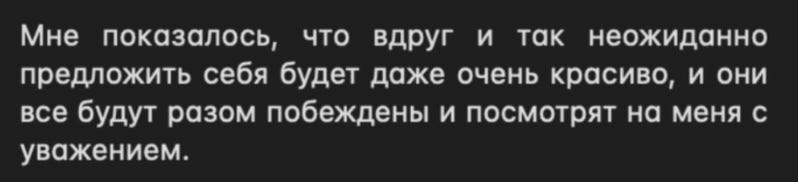
Pevear and Volokhonsky translate this passage in the following way:

In order to understand what is so appalling about this translation, we must first understand what’s happening at this stage in the novel.
If you’ve read Notes, you’ll recall the dinner party of the Underground Man’s former classmate Zverkov. The passage I’ve excerpted comes from a scene leading up to the party and represents a key psychological turning point for the Underground Man, who spontaneously decides to invite himself to Zverkov’s party even though he senses that he is unwanted.
While Pevear and Volokhonsky manage to capture the Underground Man’s rashness (“suddenly and unexpectedly”), their translation of the next few words completely undermines the complexity of the Underground Man’s psychology.
In Russian, the phrase «очень красиво» in this context is perhaps closest to “very polite” or “very fine” or even “very dignified,” implying that the Underground Man becomes suddenly aware of the social customs of his frenemies and is mocking the overall practice of pretense and decorum in many social circles. The word «красиво» on its own, however, can also mean “beautiful” or “handsome,” and we use this word typically when referring to physical appearance. That Pevear and Volokhonsky render this word as “handsome” in this context suggests a general lack of Russian fluency: translating «очень красиво» as “very handsome” is not only a mistake but an ignorant stylistic choice that completely derails the point of the scene. We no longer sense that the Underground Man wishes to mock the social customs of his peers—we understand, instead, that the Underground Man is a vain attention-seeker, which strays from the point of the original Russian text. In Dostoyevsky’s Russian, the Underground Man comes off as cruel and spiteful; in P&V’s English, he simply sounds self-absorbed and shallow (not to mention that the English “handsome” in this context sounds more facetious rather than sardonic).
Let’s compare Pevear and Volokhonsky’s translation to Constance Garnett’s:
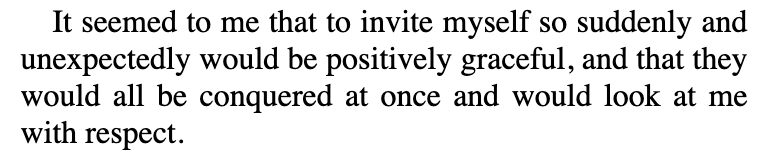
Garnett does a much better job of capturing the spirit of the Russian original and bringing the Underground Man’s scorn to light. The “positively graceful” translation of «очень красиво» mirrors the tone of the original Russian and conveys the Underground Man’s disdain for social customs. The latter half of the sentence—especially “they would all be conquered at once”—accurately captures the grandiosity of the Russian «побеждены», which is much closer to “conquered” than “won over.” While “won over” isn’t an incorrect translation, the Russian word choice here is purposefully over-the-top: “conquered,” therefore, captures its spirit much more accurately than “won over.” Readers of Garnett, therefore, immediately understand that rather than trying to make friends, the Underground Man wants to move mountains in a Napoleonic fashion to conquer the respect of his former classmates—and he will stop at nothing to get there.
Suffice it to say that Pevear and Volokhonsky butcher one of Notes’ most pivotal lines by altering its fundamental meaning. I can only surmise that non-native Russian speakers fabricated the P&V craze—I don’t think it’s possible for any native Russian speaker to read P&V and derive any sort of satisfaction from their translations.
But while some failures of translation can be avoided with a skilled translator, others are inevitable: Dostoyevsky’s linguistic depth and psychological nuance are often fundamentally untranslatable.
White Nights
Here’s a great example from White Nights.

This is the famous closing of Dostoyevsky’s most well-known novella. As far as I’m aware, there are only five English translations of White Nights—Constance Garnett’s classic translation, Ronald Meyer’s translation for Penguin (which, for whatever reason, is not widely available in the U.S. and caters to the Indian market), O.N. Shartse’s translation (which pops up on Goodreads but does not seem to be available anywhere), Alan Myers’ translation for Oxford, and a new translation by Roger Cockrell for Alma Classics.
I have not yet had a chance to take a look at Cockrell’s new translation because I couldn’t find a single eBook version of it, and O.N. Shartse’s translation seems to be a fever dream, so we only have three translations to compare. Nevertheless, let’s take a look at each:



If I were translating this line, I would translate it something like this:

You’ll notice less variation across these four translations than in the previous examples—but don’t think that that means this line is “easier” to translate. If anything, none of these translations—mine included—do justice to the original Russian, and therein lies the genius of Dostoyevsky.
In Russian, the word for “bliss” («блаженство») is perhaps closer to beatitude, but «блаженство» is also frequently used in reference to “holy fool” characters (which appear frequently in Dostoyevsky’s work); the word is also used to communicate delusion. What this suggests is that the Dreamer is aware of the delusion inherent in his bliss—yet he cannot let go of it because the feeling makes him rapturously happy. The message of the final line, then, is not simply about bliss or happiness but about the madness of indulging such all-consuming thoughts. No translation can convey the sum of these ideas in a single English word: “bliss” simply doesn’t do «блаженство» justice, and “beatitude,” is slightly too heavy while lacking the despair embedded in Dostoyevsky’s original sentence.
The next line is even trickier to translate. The Russian sentence uses a word («человеческую») that we might translate as “man” but that also means “human” or “humanity.” What that implies is that the Dreamer isn’t talking about just his own bliss but a feeling we all share as a human race—he refers not only to the whole of an individual man’s life but to the entirety of human existence. In this way, the Russian line carries a universality that the English lacks, emphasizing the divine gravity of the Dreamer’s happiness.
Through this last line, we therefore understand that the novella is not about love or happiness but about indulging delusion—and the universality of such an error. So while English readers walk away from White Nights with the image of bliss, Russian readers walk away with the weight of humanity’s foibles on their shoulders.
Perhaps that’s why I love Russian literature so much: it not only grapples with the gravity of the human experience but also comments on the universality of human nature—the hallmark of a great literary work.
So which Dostoyevsky translation should you read?
None of them. But you can learn Russian online for free.
(Though if you are not up to the task, I suppose Garnett will have to do.)
Enjoyed this post? You can Buy Me a Coffee so that I’ll be awake for the next one. If you are a starving artist, you can also just follow me on Instagram or “X.”
I can see that a lot of work went into this post (which is great, thank you), but the conclusion is, in my opinion, disastrous. It’s demotivating and also not true.
I agree that there is no such thing as the perfect translation. It’s simply not possible to translate everything word for word as Dostoevsky intended, because the structures of English and Russian are different. I’m a native Russian speaker, and I recently reread Crime and Punishment in English (the Katz translation) for my blog. It was a great translation, but very few things were lost not because of a bad translation but just because of the language differences. A translator can’t invent words that don’t exist, so in a way they create their own piece of art through translation. And as a native Russian speaker, I can promise you that it doesn’t affect your reading experience nearly as much as Lisa wants you to think.
And if you are not a Russian literature scholar, a linguist, or a language enthusiast, if you are just a CASUAL reader, then ANY translation will work for you. There is no need to learn Russian unless you genuinely want to. The plot and the ideas will not be lost in translation.
My own advice is tho to check the first few pages available online in different translations and choose the one that feels most suitable for your (!!!) taste.
Moreover, even if you learn Russian to a C1–C2 level, you still won’t read Dostoevsky as easily as Lisa suggests.
First of all, the language Dostoevsky uses is 19th-century Russian, and many expressions from that time are outdated and no longer used in modern Russian. So even if you speak Russian, you will still need to sit with a dictionary and Google to look up things you’ve never heard of (каторга, серебряник, целковый, шинель, доходный дом etc). Not all Russian speakers know the meaning of some words because they are no longer used!
Second, Dostoevsky is not only about language but also about political and social context. If you don’t understand who the nihilists were and why Russian youth in the 1860s became radicalized, then Crime and Punishment will be harder to fully understand (and again, it has nothing to do with translation!)
To sum up, please read Russian literature without obsessing over “the best” translation, and don’t give up on Russian literature just because you don’t speak Russian. Спасибо!
Love P&P, but on this topic, I'll have to respectfully offer an opposing opinion.
I love the P&V experience. I don't care for the Garnett experience.
I know bashing P&V is the fashion these days, but this Russian Translation Discourse™ reminds me of NIV -- or even KJV! -- readers bashing the Message Bible back in the early 2000s. I don't think it's controversial to say that different translations appeal to different personalities. In my case, I find Garnett's translations a total slog. I find P&V thrilling.
I'll never learn Russian to the level where I could read the original... but I do feel confident saying that the spirit of Dostoevsky must surely be thrilling and breathless and revelatory and even a little choppy. I get that experience in P&V. Garnett, to me, is clean and sophisticated -- but boring.
So if the goal is to get more people into Dostoevsky, and if P&V are doing so in a way that brings something of the original experience to a certain section of receptive readers, aren't they -- and anyone else who tries to bring the spirit of FD to different reader-personalities -- allies?
Also -- just like with Bible translations -- if translating is treachery, then the best answer is, 'Por q no los dos?' Mixing & matching translations is a better route to a full experience than holding one up as superior above all the rest.