



Literary interpretation is one of the most powerful tools we have as intellectuals. It’s also one of the most dangerous.
Since sending out my novels to beta readers, I’ve noticed a curious recurring pattern. About a third of my readers just “get” my books, walking away contemplating the precise set of “big questions”—the importance of morality, the role of Beauty in our lives, and the pitfalls of artistic obsession—that I explore throughout my stories.
Another third of readers will come up with their own interpretations, perhaps focusing too much on plot details or missing the novel’s “takeaway,” yet providing thoughtful commentary nonetheless. These readers, often possessing divergent or even opposing personal values, will spark the very sorts of conversations I love in literary circles about what the author really meant or what his characters were really thinking. These exchanges reveal the power of the novel in yielding a broad swath of valid readings, highlighting the unique phenomenon of interpretive plurality, wherein a single novel will land differently based on individual reader background.
Yet another third of readers will completely miss the mark.
It’s not that these readers are any less competent than the first two groups—many of them, in fact, might be relatively perceptive. But they often come into a work of literature with preordained expectations, importing their own worldviews into a text that has little to do with the ideas most familiar to them.
Take a look, for instance, at the variety of reader responses to the question of “main themes” in my most recent novel, Blue Snow:
Reader A: “The theme of passion versus stability is very prominent.”
Reader B: “The tension and trade-off between passion and stability.”
Reader C: “Love and maturity.”
Reader D: “Living with sin vs. ridding yourself of it, the effects of sin and morality on real life.”
Reader E: “Attraction to “bad” men; … the shame that often surrounds sexual urges; how we only ever desire the things we don’t already have, or can’t have.”
The first two readers hit the nail on the head. The central conflict of the novel is, in fact, the age-old tension between passion and stability—the same conflict in Emily Brontë’s Wuthering Heights and Leo Tolstoy’s Anna Karenina.
The second two readers, on the other hand, understand the message through a slightly different interpretive lens. Reader C, for instance, conflates passion and love, but nevertheless is not incorrect: one could certainly read the novel and conclude that the affair I depict was driven by love rather than more carnal passion. Similarly, Reader D interprets passion vs. stability through a narrower lens, focusing on the novel’s discussions of sin and thereby elevating one aspect of the story into its central theme. She is not wrong either, and I appreciate both of these readers for revealing the wider array of narrative possibilities within my own work—one of the most valuable aspects of literary interpretation.
Yet Reader E completely misses the mark, believing the novel to be about “attraction to ‘bad’ men.” On the contrary, the protagonist’s love interest is not dangerous or morally corrupt but excessively moral, hiding behind ethical scruples in order to avoid the responsibilities of a stable partnership. In fact, at one point, he tells the protagonist, “We can’t do it… I won’t be that guy. I just won’t be. It’s not me—I’m not going to break apart a marriage… I have to be holy.” This passage alone undermines Reader E’s interpretation: far from embodying the archetype of the reckless or morally transgressive “bad boy,” the love interest is driven by an almost comical commitment to moral purity.
Likewise, the novel’s sexual conflict is not about shame itself, but about the repercussions of removing moral boundaries from intimacy and replacing them with hedonism. Reader E’s claim that the novel is about “how we only ever desire the things we don’t already have” does not once appear in the text. In other words, this reader does not interpret the novel as much as he imports his own psychological framework into it, projecting assumptions about desire and sexuality that the text itself never advances. That is not to say that this reader did not engage meaningfully with the text but that he perhaps subconsciously wanted the novel to be about something else.
Luckily for the outside world, my novel currently sits unpublished on my laptop. Misinterpretations of its core themes do no ill to the world beyond providing a mild annoyance to me, its author. But imagine now if Reader E were to pick up a novel by Hemingway or Nabokov. No one can prove that he is wrong without consulting either author, both of whom are no longer with us. And while his critique is often not driven by malice but a simple misapplication of values, once it is circulated in the academy, it nevertheless runs the danger of becoming gospel.
This is how literary interpretation gets corrupted on a larger scale—and how cherished classics about morality and beauty and love and death become about imperialism and class consciousness. Because if you take that segment of readers who didn’t “get” a book at all—and then put them in an ivory tower and call them literature “experts,” then an entire tradition of art and beauty becomes about power and politics—and all because a vocal minority of people start promoting their own viewpoints into a text instead of asking what the author actually meant.
Vladimir Nabokov warned us of this phenomenon in his 1962 experimental novel Pale Fire.
At the core of Pale Fire is a poem in four cantos by the fictional poet John Shade. While a bit cheeky, the poem itself is a standalone literary accomplishment, with memorable excerpts such as the catchy “A system of cells interlinked within/ Cells interlinked within cells interlinked” that famously appears in Denis Villeneuve’s 2017 film Blade Runner 2049. Unlike many of its abstruse contemporaries, the poem is not difficult to parse—in fact, its narrative format makes its themes abundantly clear. In simplest terms, the poem is about coming to terms with death and exploring the possibility of an afterlife.
Nabokov, however, turns that reality on its head by presenting us with a series of footnotes penned by the fictional Professor Charles Kinbote, who purports to comment on the poem by elucidating the circumstances of the life of his “friend” Shade. Nevertheless, it becomes almost immediately apparent that Professor Kinbote willfully hijacks Shade’s poem by importing his own worldviews, claiming that the poem is not about death but about the history of the land of Zembla, his fictional home country for which he harbors a preexisting obsession. While it is unclear just how much of Kinbote’s narrative is invented to advance his own agenda, what is certain is that Kinbote invents meaning: “Gradually,” he writes, “it dawned upon me that this poem was about Zembla.” In reality, of course, Shade’s poem has nothing to do with Zembla at all.
On a broader scale, Nabokov draws our attention to the dangers of literary misinterpretation. Kinbote might be more cuckoo than the average English professor, but not by much—after all, Kinbote does exactly what English professors like to do today: take a universal project (literature) that deals with universal human themes (e.g. death, love, loss, etc.) and turn it into an agenda about particulars (e.g. isolate political grievances or power struggles). Today, in the literary academy, many critics project theoretical frameworks onto a given text rather than deriving meaning from it; as a result, literary interpretation begins to resemble Kinbote’s fantastical commentary.
Nabokov’s perspicacity is incredible: just thirty years later, a real-life Kinbote would enter the literary stage and permanently alter literary interpretation with his similarly fantastical readings of cherished literary texts.
The resemblance of this literary critic to Kinbote is uncanny. Like Kinbote, he came to America from a faraway country to become an English professor. Like Kinbote, he is obsessed with rewriting the history of his land. And like Kinbote, he hijacks an entire work of literature to promote his warped interpretations.
I am talking, of course, of the infamous Columbia University literary critic Edward Said.
Said was born in Mandatory Palestine in 1935. His parents were Arab Christians, and his father earned American citizenship after serving in the American Expeditionary Forces during World War I. He moved to America to attend the prestigious boarding school Northfield Mount Hermon, propelling him immediately into America’s elite class, and later studied English at Princeton and Harvard. He joined the faculty of the Columbia University English department in 1963, where he taught until his death in 2003.
Said is perhaps singlehandedly responsible for the narrative that Israel is a settler-colonist state, that Jews are the new Nazis (Jews—not Israelis) and that Arabs have a greater claim to the historic land of Palestine than the Jews. Given his obsession with colonialism and Palestine, it is remarkable that he became a professor of English literature in the first place, but a quick overview of his contributions to the literary sphere make it clear that his aim was precisely to hijack literature as a whole in order to draw attention to perceived wrongdoings in his beloved Palestine—and he succeeded royally.
I have written elsewhere about Said’s role in the notorious 2024 “tentifada” protests that originated at Columbia University, and it is no accident that the leaders of these protests were students from the Columbia English department. Today, students of literature are taught Said for breakfast, reading a wide array of books through the interpretative lens of post-colonial theory—Said’s school of thought that analyzes literature through the lasting power dynamics between “colonizers and the colonized.” Said’s prime example throughout his work is, of course, Israel and Palestine, but he also frequently comments on the way in which European hegemony informed the creation of the literary canon and, more specifically, the importance of British imperialism in the development and interpretation of certain literary texts.
The most famous example of the latter comes from his book Culture and Imperialism in a chapter called “Jane Austen and Empire.”
If your first reaction is, “What the hell does Jane Austen have to do with empire?” then you are not alone in sniffing out Said’s Kinbotean bullshit.
If you haven’t read Mansfield Park or need a refresher, here’s a quick rundown of the novel. Our young protagonist, Fanny Price, is sent to live with her wealthier relatives in a house called Mansfield Park, where she meets her four mischievous cousins. Several years later, when Sir Thomas, the patriarch of the estate, departs for his Antigua plantation, the young people of Mansfield take advantage of his absence by putting on a somewhat immoral play, which grants them the opportunity to covertly flirt with one another. Fanny then rejects the advances of one of her suitors, believing him to be immoral, and ends up marrying her cousin Edmund (as one did in 1814). The novel is fundamentally about moral discipline, self-control, and virtue—not only as those ideas were understood in Jane Austen’s time, but also in our own. Fanny rejects her suitor Henry, for instance, because he is an adulterer—values that align with our contemporary understanding of morality.
But Said willfully ignores those values and Austen’s overall message, importing his own theoretical framework rather than deriving one from the text itself. Ultimately, Mansfield Park is about the triumph of moral character and the dangers of moral collapse. For Said, however,
“the novel steadily, if unobtrusively, opens up a broad expanse of domestic imperialist culture without which Britain’s subsequent acquisition of territory would not have been possible.”
What does Mansfield Park have to do with “Britain’s subsequent acquisition of territory,” you may ask? According to Said, Mansfield Park participates in ideological preparation for empire: “To hold and rule Mansfield Park is to hold and rule an imperial estate in close, not to say inevitable association with it.”
In this way, Said, equates the Mansfield estate with the microcosm of “empire,” deriving a large theoretical claim from extremely thin textual evidence. He explicitly frames the novel in terms of imperial ideology, claiming that Austen “connects the actualities of British power overseas to the domestic imbroglio within the Bertram estate.” The irony is that Austen’s novel itself barely discusses empire at all. In fact, Said treats one single reference to Antigua—clearly a mere plot device to get the patriarch out of the house and set the stage (pun intended) for the salacious play—as the novel’s key interpretive framework:
“Sir Thomas’s property in the Caribbean would have had to be a sugar plantation maintained by slave labor… these are not dead historical facts but… evident historical realities.”
Said is not wrong in observing that the likeliest source of Sir Thomas’s wealth is slave labor, but to suggest that “empire” explains the moral structure of the novel is almost comical. In fact, Said’s entire claim—that Mansfield Park is a novel about British imperialism—rests almost entirely on the following exchange:
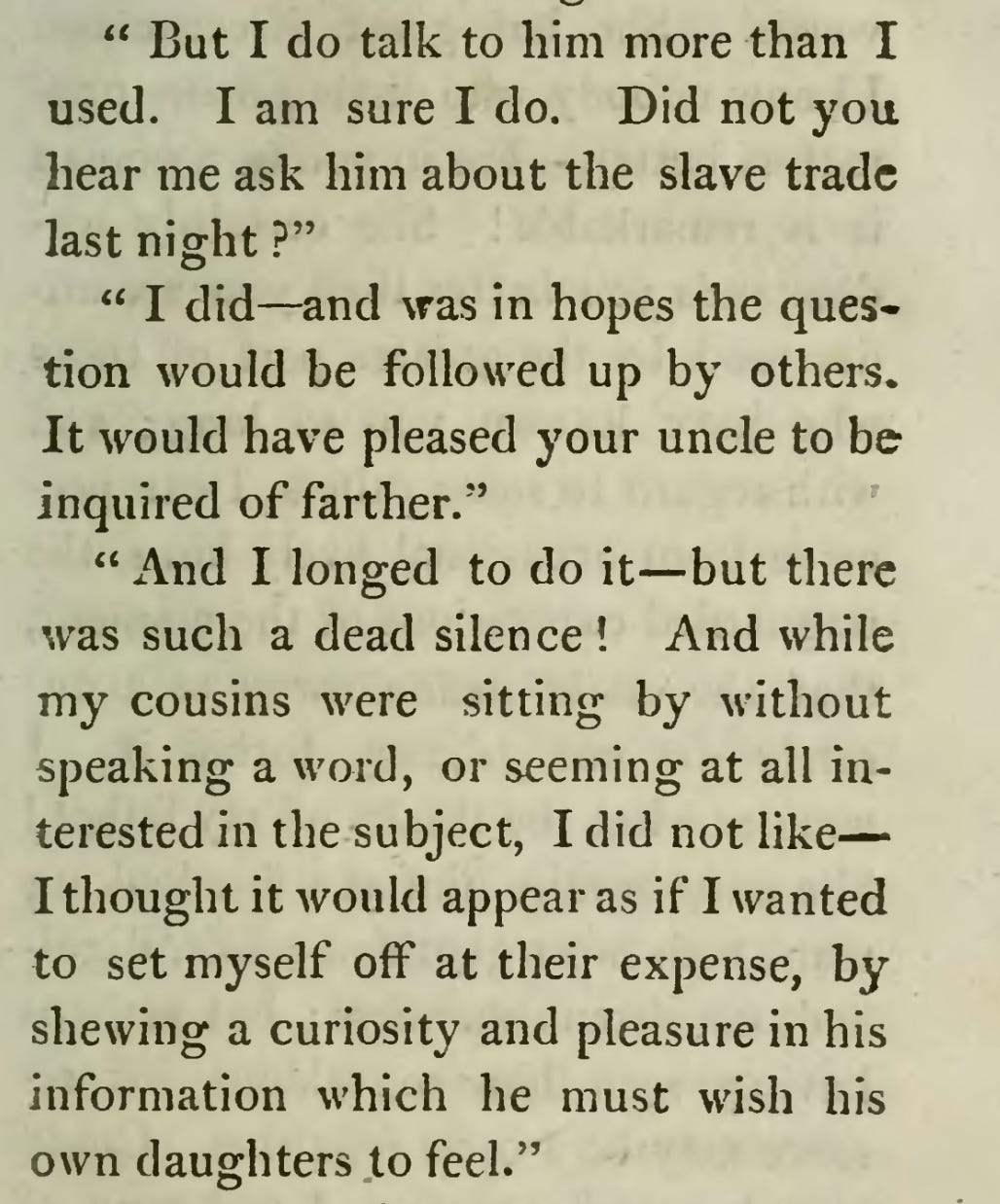
In the novel, the slave trade is mentioned exactly once—and in passing. And while it may be reasonable to assume that Sir Thomas owns slaves on his Caribbean plantation, direct mention of these slaves is never once made; the plantation never appears, and Antigua is mentioned only briefly. The plot revolves not around colonial economics but moral education, marriage choices, social responsibility, and character—none of which have anything to do with colonial politics.
Furthermore, because Sir Thomas’s trip to Antigua mainly serves structural narrative purposes, it is reasonable to assume that Austen wasn’t thinking about “empire” when she sent Sir Thomas to a plantation—she just needed an excuse to get him out of the house.
For Said, however, Austen unconsciously legitimizes “empire” by creating a culture that revolves around “imperial rule”:
“European culture often… validated its own preferences while also advocating those preferences in conjunction with distant imperial rule.”
To discuss “imperial rule” in the context of Mansfield Park is even more off the mark than the misinterpretation of Blue Snow I highlighted earlier. In fact, Said himself admits that his entire argument is predicated on reading what is not present rather than what is:
“We have to see them in the main as resisting or avoiding that other setting… whose formal inclusiveness, historical honesty, and prophetic suggestiveness cannot completely hide.”
In other words, according to Said, the novel is about empire precisely because it avoids mention of it.
That’s a major critical leap.
Worse still is his argument that the drama in the Mansfield estate mirrors that of the colonial plantation. According to Said,
“What sustains this life materially is the Bertram estate in Antigua, which is not doing well. Austen takes pains to show us two apparently disparate but actually convergent processes: the growth of Fanny’s importance to the Bertrams’ economy, including Antigua, and Fanny’s own steadfastness in the face of numerous challenges.”
He describes the household intrigues as an “economy,” arguing that Fanny’s rise within Mansfield occurs alongside its economic structure, and that, therefore, the domestic moral order and the colonial system are fundamentally intertwined. Mansfield itself, in fact, takes on an “inevitable association” with “an imperial estate.”
For Said, then, Fanny’s success is linked to “empire.” When Mansfield Park becomes morally stable at the end of the novel, Said implies that this occurs because the estate’s stability rests on its colonial structure. Thus the domestic English order and the colonial plantation become, if not virtually indistinguishable, then at least structurally connected.
But in the actual novel, Fanny’s rise has absolutely nothing to do with “empire” and more to do with moral steadiness, humility, and judgement. At the center of the novel is Austen’s suggestion that moral character matters more than wealth or status, a claim that is so astronomically removed from “empire” that one is invited to wonder whether Said ever actually read Austen’s entire book. Claiming that Mansfield Park is about “empire” is similar to insisting that Crime and Punishment is about Russian housing policy because Raskolnikov is unable to make rent for his room—technically relevant background information but wildly removed from the core premise of the book.
Said’s ramblings about colonialism in Mansfield Park—and the ensuing “postcolonial consciousness” in the mind of the reader—is no different from Kinbote’s insane musings about Zembla in relation to John Shade’s Pale Fire. And while Nabokov’s Kinbote—fictional as he is—cannot do damage to a real-life writer, Said certainly can—and did. Today, students of English literature walk away from Mansfield Park taking it to be a novel about empire and the postcolonial consciousness. It was in this way that Mansfield Park was taught to me in my freshman English seminar at Columbia, and it was this very essay that was assigned to me—and dozens of other eighteen-year-olds who don’t know better—during my very first week of college. The tragedy is that we did not discuss virtue, responsibility, immorality, or authority in the context of Austen’s novel but jumped straight into Said’s postcolonial critique. It is thus that I suspect many of my classmates will remember Mansfield Park for the rest of their lives.
I use Mansfield Park and Edward Said as simply one example of the dangers of literary interpretation, but the examples are limitless. Under this quack system of interpretation, Hamlet’s “to be or not to be” becomes a speech not about suicide but about “oppression.” The Great Gatsby becomes a novel not about desire and the American Dream but about “the complexities of gender and sexuality.” These interpretations are not confined to the academy but make their way to the mainstream, infesting the minds of many young readers—such as in the case of the Hamlet lecture about oppression, which received over one million views on Instagram.
And when a small group of ideologues hijack literary interpretation, an entire civilization suffers.
So what is to be done? For one, we must return to the text itself and to authorial intent as a starting point. Literary interpretation should begin not with the critic’s theory but with the words on the page. In other words, derive your own interpretations rather than blindly trusting “authorities.” After all, Kinbote, too, was a professor—and someone gave that Hamlet lecturer a microphone.
It turns out that Nabokov was a very wise dude.
Enjoyed this post? You can Buy Me a Coffee so that I’ll be awake for the next one. If you are a starving artist, you can also just follow me on Instagram or “X.”
I recently read Susan Sontag’s “Against Interpretation” and found it refreshing. And yes, Sontag and Said had their problems with each other!
Liza, I enjoyed this very much. I recently read again the introduction to Pale Fire; it made me laugh so many times. Great connection between Charles K. of Zembla and Edward S. of Columbia. One being harmless and one not.