


From my takedown of Sally Rooney to my assault on Netflix’s East of Eden, I’ve written many heated polemics lately, so today, it’s time for a change of pace.
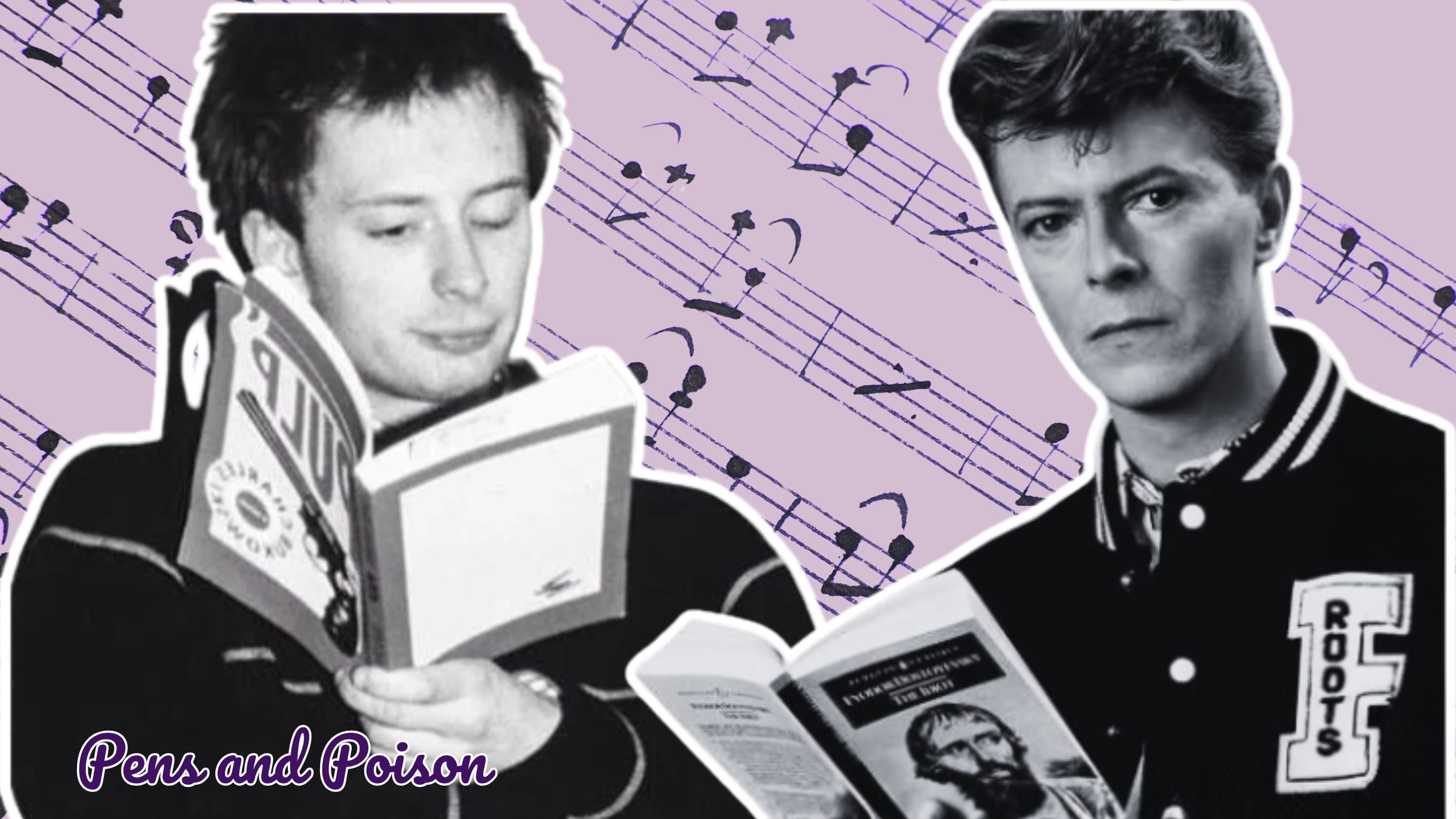
While I enjoy attacking our culture as much as the next guy, I’ve been out of town this past week to plan my upcoming wedding, so, for better or for worse, I haven’t been tracking the Zeitgeist as closely as I usually do. Instead, in crafting my wedding playlist, I’ve had a chance to marvel at the sort of art our culture used to produce, and today, I’d love to introduce you to some of my favorite classic songs inspired by classic literature.
As it turns out, the pop stars of yore were as literate as they were musically inclined.
1) “Wuthering Heights” by Kate Bush - Wuthering Heights by Emily Brontë
We start with a song that blew up on social media at the beginning of this year with the release of Emerald Fennell’s “Wuthering Heights.” While the film had very little to do with Emily Brontë’s novel of the same name, it prompted an entire generation of young people not only to dive into Brontë’s great novel but also to discover a far superior Wuthering Heights adaptation: Kate Bush’s genre-bending smash hit “Wuthering Heights.” The song trended on TikTok for several months before we all moved on to our Odyssey phases in June, but I still play it on repeat to this day.
I actually first discovered Bush’s “Wuthering Heights” when I stumbled on Celtic singer Hayley Westenra’s cover in high school.
From there, I started listening to Bush’s version of the song and fell in love with the singer’s ethereal voice. Listening to Bush croon “It’s me, Cathy!” you can almost picture Catherine Earnshaw’s ghost, her eyes filled with manic longing, haunting the grounds of Wuthering Heights.
“Wuthering Heights” is not Bush’s only literature-inspired song. “Flower of the Mountain,” for instance, incorporates passages directly from Molly’s soliloquy in Ulysses.
Now that’s what I call a Renaissance woman.
2) “Venus in Furs” by The Velvet Underground - Venus in Furs by Leopold von Sacher-Masoch
I could write you an entire essay about Leopold von Sacher-Masoch’s Venus in Furs, and maybe I will someday, but the novel’s claim to fame has less to do with its literary merit (it’s not a very good novel) than its subject matter: Sacher-Masoch’s Venus in Furs is literature’s first obvious depiction of masochism.
Sacher-Masoch always wanted to be taken seriously as a literary author, and, during his lifetime, he was well regarded as an homme de lettres—a humanistic thinker who set out to immortalize his worldview through a series of novellas he planned to call The Legacy of Cain. Unfortunately, however, the author abandoned the cycle before he could complete it, and, before he knew it, his name became attached to an unfortunate nineteenth-century neologism—masochism.
If you’re looking for erotica à la Fifty Shades, I suggest you look elsewhere because Venus in Furs is far more disturbing than it is titillating. Chronicling the gradual unraveling of an impossible relationship, the book’s thesis can be summed up in the following admonitory note:
Woman, as nature has created her, and man at present is educating her, is man’s enemy. She can only be his slave or his despot, but never his companion. This she can become only when she has the same rights as he and is his equal in education and work.
In other words, the novel was meant to be a commentary on gender parity rather than on sex—the French philosopher Gilles Deleuze once wrote that Sacher-Masoch has a peculiar way of “desexualising love”—but, unfortunately, we only remember it today for its bizarre depiction of sexual attraction.
As for the Velvet Underground song, the critic Erich Kuersten describes it best:
There is no intro or buildup to the song; the track starts as if you opened a door to a decadent Marrakesh S&M/opium den, a blast of air-conditioned Middle Eastern menace with a plodding beat that’s the missing link between “Bolero” and Led Zeppelin’s version of “When the Levee Breaks”.
Great song.
3) “Sympathy for the Devil” by The Rolling Stones - The Master and Margarita by Mikhail Bulgakov
There was a time in human history when the American political left unequivocally condemned the Soviet Union and acknowledged that the Russian Revolution might have been orchestrated by Satanic forces. That acknowledgement appears in The Rolling Stones’ “Sympathy for the Devil,” a song inspired by the Devil’s visit to Soviet Russia in Mikhail Bulgakov’s The Master and Margarita.
Several of the lyrics reference Bulgakov’s great novel, including “Made damn sure that Pilate/Washed his hands and sealed his fate.” Pilate, of course, appears as a character in The Master and Margarita.
Beneath the song’s upbeat, almost carnivalesque rhythm, you’ll find a sinister set of lyrics chronicling the Devil’s participation in some of human history’s greatest atrocities. The twist, of course, is that the singer of these lyrics is the Devil himself.
4) “Aladdin Sane” by David Bowie - Vile Bodies by Evelyn Waugh
If you’re a Bowie fan, you probably know that the singer’s 1974 album Diamond Dogs was originally meant to be a direct adaptation of George Orwell’s 1984—before Orwell’s widow vetoed the idea entirely. Bowie was forced instead to draw on William S. Burroughs’ apocalyptic universe in Naked Lunch, and the album grew somewhat more sinister (and, perhaps, more brilliant). Nevertheless, three of its later tracks—“We Are the Dead,” “1984,” and “Big Brother”—were originally part of Bowie’s larger vision for his 1984 concept album.
Diamond Dogs might be my favorite Bowie album, but there’s a lesser-known literature-inspired song in the Bowie oeuvre: “Aladdin Sane,” which draws on Evelyn Waugh’s Vile Bodies.
The story goes that Bowie wrote “Aladdin Sane” on a trip back home to the UK after reading Waugh’s Vile Bodies. I had never heard of this early Waugh novel before discovering the story behind “Aladdin Sane,” but a week later, I had a copy in my possession and got to reading. The book is nowhere near as profound as Brideshead Revisited, but it follows a group of decadent young aristocrats known as the “Bright Young Things,” who appear in Bowie’s lyrics: “Passionate bright young things.”
Featuring a jazzy piano solo, the song is, quite fittingly, one of Bowie’s more avant-garde creations.
5) “Both Sides Now” by Joni Mitchell - Henderson the Rain King by Saul Bellow
I’ll admit, I have yet to read Bellow’s Henderson the Rain King, but it’s been on my list ever since I learned that it inspired Joni Mitchell’s “Both Sides Now.” In an interview with the L.A. Times, Mitchell states,
I was reading Saul Bellow’s “Henderson the Rain King” on a plane and early in the book Henderson the Rain King is also up in a plane. He’s on his way to Africa and he looks down and sees these clouds. I put down the book, looked out the window and saw clouds too, and I immediately started writing the song. I had no idea that the song would become as popular as it did.
“Both Sides Now” has a special place in my heart because of its poetic lyrics:
Moons and Junes and Ferris wheels
The dizzy dancing way that you feel
As every fairy tale comes real
You can tell that Bellow inspired her song because the great Jewish-American writer has a similarly whimsical writing style.
Coincidentally, Hayley Westenra also has a cover of this song. Westenra must have great taste in music and literature.
6) “White Rabbit” by Jefferson Airplane - Alice’s Adventures in Wonderland by Lewis Carroll
This psychedelic rock song might be singlehandedly responsible for the apocryphal narrative that Lewis Carroll was on drugs while writing Alice’s Adventures in Wonderland—and, boy, is “White Rabbit” trippy. The entire piece sounds like the musical equivalent of a funhouse mirror, and the lyrics—“One pill makes you larger/And one pill makes you small”—only reinforce the general sense of distortion you get listening to this 1960s rock hit; it’s no wonder that an entire generation of hippies, nodding hazily along to “and you’ve just had some kind of mushroom,” convinced us all that Lewis Carroll was on drugs.
Well, Carroll probably wasn’t on drugs, but he did suffer from migraines, which frequently cause visual distortions. There’s a neurological disorder called Alice in Wonderland syndrome, named after his titular character; I experience it a few times a year whenever I get migraines, and it makes everything in my field of vision look smaller than it actually is—as if I’m looking at a crowd of Lilliputians. One can imagine that Carroll’s wonderland might have been inspired by the peculiar features of his rare disorder.
7) “2 + 2 = 5” by Radiohead - 1984 by George Orwell
Radiohead is probably my favorite artist after David Bowie, but I never realized that this track from Hail to the Thief was a direct allusion to the following passage from 1984:
In the end the Party would announce that two and two made five, and you would have to believe it. It was inevitable that they should make that claim sooner or later: the logic of their position demanded it. Not merely the validity of experience, but the very existence of external reality, was tacitly denied by their philosophy.
Listening to Radiohead’s song—especially to Thom Yorke repeatedly belting “You have not been paying attention”—makes you feel like you’re trapped in Winston’s world. And, indeed, as Radiohead tells us earlier in the song, “There is no way out.”
8) “Girl Loves Me” by David Bowie - A Clockwork Orange by Anthony Burgess
I wasn’t going to put two different Bowie songs on here, but David Bowie is my all-time favorite artist, so he deserves two slots in a Liza Libes post.
When I first listened to “Girl Loves Me” on Bowie’s final album, I thought that the singer was spouting gibberish (which wouldn’t be too out of character for him), but as soon as I could make out the word “malchik”—Russian for “boy”—I immediately rushed to the Internet to see if Bowie was singing in Russian. It turned out that he wasn’t singing in Russian but in Nadsat—Burgess’s fictional slang from A Clockwork Orange.
The rest of the song’s abstruse words are in Polari, a British sociolect associated with gay subcultures.
Bowie takes the cake for creativity.
9) “Soma” by The Strokes - Brave New World by Aldous Huxley
I’ve been a fan of The Strokes for quite some time, but I must have listened to “Soma” a good twenty times before realizing that its title directly references the drug of the same name from Brave New World, my favorite dystopian novel.
“Soma is what they would take,” the song begins, “when hard times opened their eyes.”
In Huxley’s novel, of course, the citizens of World State eagerly line up to get their hands on Soma, a happiness-inducing drug that suppresses “unwelcome” emotions.
I guess Huxley predicted the SSRI epidemic.
10) “Don’t Stand So Close to Me” by The Police - Lolita by Vladimir Nabokov
This song by The Police is truly a classic, and though it wasn’t directly inspired by Nabokov’s most famous novel, it covers the same subject matter and features the famous line “that book by Nabokov,” which prompted an entire generation to serially mispronounce the great Russian author’s last name.
“It’s Na-BO-kov,” Hermione Granger might have told you, “not Nah-bo-KOV.”
Great literature is everywhere, and I hope I’ve convinced you to check out some of the novels I mentioned in today’s post. Here’s a recap in case you’d like to add them to your reading list:
Wuthering Heights by Emily Brontë
Ulysses by James Joyce
Venus in Furs by Leopold von Sacher-Masoch
The Master and Margarita by Mikhail Bulgakov
Vile Bodies by Evelyn Waugh
Nineteen Eighty-Four by George Orwell
Naked Lunch by William S. Burroughs
Henderson the Rain King by Saul Bellow
Alice’s Adventures in Wonderland by Lewis Carroll
A Clockwork Orange by Anthony Burgess
Brave New World by Aldous Huxley
Lolita by Vladimir Nabokov
Know any other songs inspired by classic literature? Drop them in the comments!
Enjoyed this post? You can Buy Me a Coffee so that I’ll be awake for the next one. If you are a starving artist, you can also just follow me on Instagram, YouTube, or “X.”
"Tales of Brave Ulysses" by Cream.
And come to think of it, wasn't there a pop song about a Cyclops called "Dedicated To The One-Eye Love"?
On the heavier side of the musical spectrum, Mastodon’s album, Leviathan, is a full concept album based on Moby Dick. The opening track, Blood and Thunder is as Ahabian as it gets.