


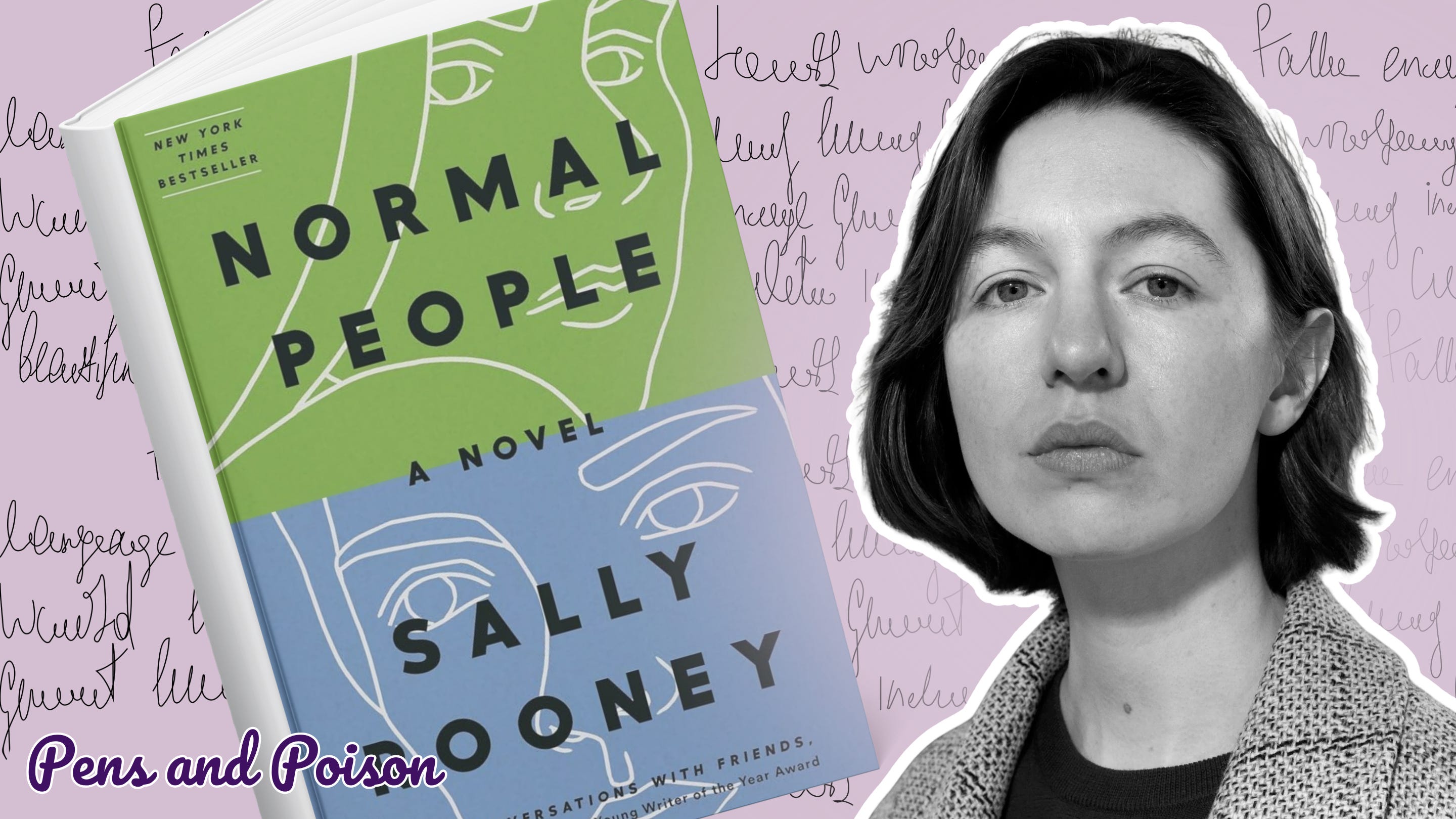
Sally Rooney deserves to be taken off shelves, but not for the reasons you might think.
This past week, in full agreement with radical Marxist activist Sally Rooney, British publisher Faber & Faber—once home to literary giants such as T. S. Eliot, W. H. Auden, and Sylvia Plath—announced its decision to withdraw Rooney’s novels from British bookshop shelves. As to be expected, the news caused quite a stir amongst our leftist friends on X, who began parroting the usual talking points about book banning and censorship and how Zionists control the U.K. But as Hen Mazzig has rightfully observed, Rooney’s books are not being pulled, as the left has claimed, because of her views on Palestine—they are being pulled because “she has explicitly said that her profits would be donated to a proscribed terrorist organization.”
According to a report from The Telegraph, Rooney has been donating royalties to Palestine Action, a radical leftist “action network” with alleged ties to Iran. A designated terrorist group both in the U.K. and the U.S., Palestine Action has posed a significant threat to U.K. national security and, in 2025, moved to actively sabotage British military operations in Brize Norton, the largest station of the Royal Air Force.
But whether you agree with the U.K. terrorism ban or not, there’s a better argument at play here: Rooney deserves a taste of her own medicine. The Irish author, after all, is no stranger to literary boycotts, having orchestrated one of her own against Israeli voices and Jewish authors in the aftermath of October 7th. It would be hypocritical to defend her on the grounds of freedom of expression—she has been the prime advocate for censorship in the literary world for several years now.
The case of Sally Rooney, therefore, does not qualify as an attack on “free speech,” nor is it some sort of covert operation meant to silence pro-Palestinian voices. Ms. Rooney is free to hold whatever views she’d like, publicly or privately, but at a certain point, she must face the consequences of her own actions.
But all of that aside, Rooney’s books are just really, really bad.
Believe me, I’m no proponent of literary censorship, but I hope to convince you today that Rooney’s books are not only poorly written but are also devoid of all humanity—and are therefore not worth your time.
Because in my eyes, an author who strips her words of the human soul is no author at all.
To illustrate my point, let’s take a look at Sally Rooney’s Normal People—perhaps the worst novel of the past decade.
I have previously said that Normal People is Fifty Shades of Grey for overeducated college grads, and though my remark was made somewhat facetiously, I stand by it unapologetically. Move Fifty Shades to Ireland, replace the billionaire entrepreneur with a working-class intellectual, and throw in a few conversations about Marxism, and the result is Normal People by Sally Rooney—a novel about a socially awkward young woman who desires to be dominated by emotionally unavailable men.
The only difference, in fact, between the two novels is that no one is out here claiming that Fifty Shades of Grey is some sort of profound meditation on the human condition. Sally Rooney, on the other hand, has duped the entire universe into believing that her Fifty Shades of Grey retelling—spruced up with discussions of class consciousness and the occasional surface-level literary reference—is some sort of masterwork.
But Normal People is nothing more than Anastasia Steele with a Trinity College education—and just enough Marxist theory to make its readers feel intellectually superior for enjoying it.
To illustrate my point, I’d like to show you a passage from Normal People and one from Fifty Shades of Grey.
He takes hold of her hair, not pulling it, just holding it in his hand.
Whenever I want, really? he says.
You can do anything you want with me.
He makes a noise in his throat, leans into her a little harder. That’s nice, he says.
Her voice sounds hoarse now. Do you like me saying that? she says.
Yeah, a lot.
Will you tell me I belong to you?
What do you mean? he says.
She says nothing, just breathes hard into the quilt and feels her own breath
on her face. He pauses now, waiting for her to say something.
Will you hit me? she says.
For a few seconds she hears nothing, not even his breath.
No, he says.
I peek up at him, and he’s frowning, a bleak look in his eye. He runs both hands through his hair.
“How did you feel while I was hitting you and after?”
“I didn’t like it. I’d rather you didn’t do it again.”
“You weren’t meant to like it.”
“Why do you like it?” I stare up at him.
My question surprises him.
“You really want to know?”
“Oh, trust me, I’m fascinated.” And I can’t quite keep the sarcasm out
of my voice.
He narrows his eyes again.
“Careful,” he warns.
I blanch.
“Are you going to hit me again?” I challenge.
“No, not tonight.”
If I hadn’t told you that these excerpts came from two completely different novels written in two completely different genres by two completely different people, you might have reasonably concluded that these two passages came from the same book. But no—one is from Sally Rooney, and the other is from Fifty Shades of Grey, and I’m guessing that you couldn’t even tell me which is which. Both passages feature sparse sentences, flat dialogue, and minimal description—and both culminate in virtually the same exchange expressed in almost identical language.
Sally Rooney is not much more talented than E.L. James—and James might even be a better writer because someone taught her how to use punctuation marks in school.
But because Sally Rooney’s novel dresses up BDSM as some sort of philosophical idea, she has managed to convince the entire literary establishment to take her bad romance erotica seriously.
Consider the following passage, where Marianne and Connell discuss Marianne’s sexual perversions over cigarettes and coffee:
Are you serious? says Connell.
Well, he likes to beat me up. Just during sex, that is. Not during arguments.
She laughs, a stupid laugh that doesn’t suit her. Connell’s visual field shudders violently for a second, like the beginning of a gigantic migraine, and he lifts a hand to his forehead. He realises he is scared. Around Marianne he often feels somehow innocent, though really he’s a lot more sexually experienced than she is.
And you’re into that, are you? he says.
She shrugs. Her cigarette is burning out in the ashtray. She picks it up quickly and drags on it before stubbing it out.
I don’t know, she says. I don’t know if I really like it.
Why do you let him do it, then?
It was my idea.
Connell picks up his cup and takes a large mouthful of very hot coffee, wanting to do something efficient with his hands. When he replaces the cup it splashes up and spills over into the saucer.
What do you mean? he says.
It was my idea, that I wanted to submit to him. It’s difficult to explain.
Well, go on and try if you want. I’m interested.
She laughs again now. It’s going to make you feel very awkward, she says.
Okay.
She looks at him, maybe to see if he’s joking, and then she lifts her chin at an angle, and he knows she won’t back down from telling him about it, because that would be giving in to something she doesn’t believe about herself.
It’s not that I get off on being degraded as such, she says. I just like to know that I would degrade myself for someone if they wanted me to. Does that make sense? I don’t know if it does, I’ve been thinking about it. It’s about the dynamic, more than what actually happens. Anyway I suggested it to him, that I could try being more submissive. And it turns out he likes to beat me up.
Connell starts coughing. Marianne picks a small wooden coffee-stirrer out of a jar on the table and starts twisting it in her fingers. He waits for the coughing to subside and then says: What does he do to you?
Oh, I don’t know, she says. He hits me with a belt sometimes. He likes
choking me, things like that.
Right.
I mean, I don’t enjoy it. But then, you’re not really submitting to someone if you only submit to things you enjoy.
Have you always had these ideas? Connell says.
Throughout this entire passage, Rooney does not once offer any original insight into the relationship between love and submission, nor does she use Marianne and Connell’s exchange to explore larger questions about the nature of intimacy. Instead, through flat and perfunctory dialogue, she tells us outright that Marianne likes submissive sex because of childhood trauma (very original) and that Connell is disturbed by these predilections, continually equating psychological damage with psychological depth.
But it turns out that if you add coffee and cigarettes to any scene, you can pass off even the most trite ideas as profound revelations about the nature of human existence.
Even more egregious is Rooney’s continual attempt to tackle human relationships in the least “human” terms possible. She continually delivers information about her characters’ emotions without causing the reader to experience them, writing, for one, “He realises he is scared” to illustrate fear without bothering to figure out how to evoke fear. Rooney’s writing, therefore, is not only terse but lazy: rarely does she ground her characters and their actions in external experiences.
Indeed, Rooney’s scenes frequently remain completely abstract, such as in this passage here:
After Marianne left school in April, Connell entered a period of low spirits. Teachers spoke to him about it. The guidance counsellor told Lorraine she was ‘concerned’. People in school were probably talking about it too, he didn’t know. He couldn’t summon up the energy to act normal. At lunch he sat in the same place as always, eating sad mouthfuls of food, not listening to his friends when they spoke. Sometimes he wouldn’t notice even when they called his name, and they would have to throw something at him or clip him on the head to get his attention. Everyone must have known there was something wrong with him. He felt a debilitating shame about the kind of person he’d turned out to be, and he missed the way Marianne had made him feel, and he missed her company. He called her phone all the time, he sent her text messages every day, but she never replied. His mother said he was barred from visiting her house, though he didn’t think he would have tried that anyway.
For a while he tried to get over it by drinking too much and having anxious, upsetting sex with other girls. At a house party in May he slept with Barry Kenny’s sister Sinead, who was twenty-three and had a degree in Speech and Language Therapy. Afterwards he felt so bad he threw up, and he had to tell Sinead he was drunk even though he wasn’t really. There was no one he could talk to about that. He was excruciatingly lonely. He had recurring dreams about being with Marianne again, holding her peacefully the way he used to when they were tired, and speaking with her in low voices. Then he’d remember what had happened, and wake up feeling so depressed he couldn’t move a single muscle in his body
At no point in these descriptions do we ever get anything remotely close to figurative language or even a beautiful sentence. In fact, the most inventive description in this whole passage might be “sad mouthfuls of food,” which is a pretty “sad” example of a good description, to borrow a vocabulary word from Rooney. There’s no human emotion in any of these phrases—in fact, her reporting reads like it was clipped from a newspaper article: banal and sterile, with no attempt to capture the essence of the human spirit. We’re told that Connell entered a “period of low spirits” and is “so depressed he couldn’t move a single muscle in his body,” but we don’t feel that he’s depressed because we never get inside his head. Rooney’s prose often “tells” rather than “shows,” and while I’ve been a frequent proponent of the occasional moment of “telling,” a skillful author balances “telling” with adequate imagery and emotion.
I’m a writer, and I’ll tell you that the easiest part of novel-writing is creating stream-of-consciousness rants—after all, such writing is really just a replication of your inner voice. Similarly, you can master dialogue by paying attention to day-to-day conversations or by watching movies, but describing the physical world requires an entirely different level of literary craftsmanship that Rooney cannot and does not even bother to aspire to. Any kindergartener can write abstract sentences like hers, such as the ones from this scene here:
There were others at the beginning. Some friends of Elaine’s went with them from Berlin to Prague, and they met a few of Niall’s Engineering classmates in Bratislava before they crossed over to Vienna on the train. Hostels were cheap, and the cities they visited had a pleasantly temporary feeling about them. Nothing Connell did there seemed to stay with him. The whole trip felt like a series of short films, screened only once, and afterwards he had a sense of what they were about but no exact memories of the plot. He remembers seeing things out the windows of taxis.
Can you picture anything that happens here? We’re told that there’s a train and a hostel and cities, but we don’t know a single thing about what the trains look like, what the hostel smells like, or what Connell’s experience of these cities feels like. Comparing this experience to a film is not only ludicrous but offensive to short films, which typically contain visuals!
Then we get the laziest description of all: “He remembers seeing things out the windows of taxis.”
You can argue that the point of this entire scene is that Connell doesn’t remember anything about his trip, but that doesn’t excuse Rooney from providing the reader with even a few sparse details. After all, memories rarely disappear in their entirety, and were Rooney’s aim to convey the limitations of the human mind, she might have left in a detail or two or made the slightest effort to reproduce the ephemerality of memory through elevated language. Instead, she describes the absence of memory by giving the reader an absence of description.
That’s called lazy writing.
And even in passages where the intent is not to draw a complete blank, her language remains stunningly abstract:
Lately she and Connell have been seeing a lot of each other. In Dublin they can walk down long stately streets together for the first time, confident that nobody they pass knows or cares who they are. Marianne lives alone in a one-bedroom apartment belonging to her grandmother, and in the evenings she and Connell sit in her living room drinking wine together. He complains to her, seemingly without reservation, about how hard it is to make friends in Trinity. The other day he lay on her couch and rolled the dregs of wine around in his glass and said: People here are such snobs. Even if they liked me I honestly wouldn’t want to be friends with them. He put his glass down and looked at Marianne. That’s why it’s easy for you, by the way, he said. Because you’re from a rich family, that’s why people like you. She frowned and nodded, and then Connell started laughing. I’m messing with you, he said. Their eyes met. She wanted to laugh, but she didn’t know if the joke was on her.
There’s not a single image over the course of this entire paragraph. We don’t know what Dublin’s streets look like, how Marianne’s apartment is organized, or even what sort of wine they’re drinking. Every scene reads like a rant plucked directly out of a middle schooler’s diary. As a friend put it to me in a text, “I’m bored out of my mind because it’s just abstract dialogue spurts floating with no context. How about describe the room or the bed or something?”
But it’s clear that Sally Rooney has no interest in anything other than “abstract dialogue spurts floating with no context”—and, of course, haphazard observations about capitalism—such as in this exchange here:
This is probably three times the size of my house, he said. Would you say?
She felt foolish for not realising what he had been thinking about.
Probably, she said. I haven’t seen upstairs, obviously.
Four bedrooms.
Jesus.
Just lying empty, no one living in it, he said. Why don’t they give them away if they can’t sell them? I’m not being thick with you, I’m genuinely asking.
She shrugged. She didn’t actually understand why.
It’s something to do with capitalism, she said.
Yeah. Everything is, that’s the problem, isn’t it?
She nodded. He looked over at her, as if coming out of a dream.
Are you cold? he said. You look like you’re freezing.
She smiled, rubbed at her nose. He unzipped his black puffer jacket and put it over her shoulders. They were standing very close. She would have lain on the ground and let him walk over her body if he wanted, he knew that.
Well, at least Rooney got one thing right. Her characters don’t understand a thing about how capitalism actually works.
In fact, were it not for her repetitive, surface-level observations about BDSM and capitalism—the literary establishment’s two favorite topics—it’s possible this poorly written novel would have never gotten published in the first place. But Rooney gets away with writing stilted, unnatural dialogue just because her characters constantly come out with uninspired platitudes about capitalism:
It’s time you’ll never get back, Marianne adds. I mean, the time is real.
The money is also real.
Well, but the time is more real. Time consists of physics, money is just a social construct.
Yes, but I’m still alive at work, says Joanna. It’s still me, I’m still having experiences. You’re not working, okay, but the time is passing for you too.
You’ll never get it back either.
But I can decide what I do with it.
To that I would venture that your decision-making is also a social construct.
Marianne laughs. She wanders out of the freezer aisle and towards the snacks.
I don’t buy into the morality of work, she says. Some work maybe, but you’re just moving paper around an office, you’re not contributing to the human effort.
I didn’t say anything about morality.
Marianne lifts a packet of dried fruit and examines it, but it contains raisins so she puts it back down and picks up another.
Do you think I judge you for being so idle? says Joanna.
Deep down I think you do. You judge Peggy.
Peggy has an idle mind, which is different.
Marianne clicks her tongue as if to scold Joanna for her cruelty, but not with any great investment. She’s reading the back of a dried apple packet.
I wouldn’t want you to turn into Peggy, says Joanna. I like you the way you are.
Oh, Peggy’s not that bad. I’m going to the supermarket checkout now so I’m going to hang up.
Okay. You can call tomorrow after the thing if you feel like talking.
Thanks, says Marianne. You’re a good friend. Bye.
There was a great opportunity here to introduce an interesting conversation about capitalism or morality—or even the idea that “decision-making is also a social construct”—but because Rooney lacks the brain cells to push her thoughts in depth, her characters can only ever graze at the surface of big ideas before reprising their stilted discussion of trivialities.
Indeed, “stilted” is the best word for every sentence Rooney has ever penned—especially when it comes to dialogue. Think about the last phone call you had with your friend—or any phone call you’ve ever placed in your life. Have you ever once experienced anything remotely similar to “I’m going to the supermarket checkout now so I’m going to hang up.” That’s not how people talk to each other—and absolutely no human being has ever ended a phone call with, “You’re a good friend. Bye.”
If you’re going to write an entire novel that’s basically just dialogue, you have to at least be good at dialogue!
But the worst part of this book is its final page, which summarizes the point of the entire story in a formulaic conclusion paragraph that feels like it was written for a ninth-grade English class:
She closes her eyes. He probably won’t come back, she thinks. Or he will, differently. What they have now they can never have back again. But for her the pain of loneliness will be nothing to the pain that she used to feel, of being unworthy. He brought her goodness like a gift and now it belongs to her. Meanwhile his life opens out before him in all directions at once. They’ve done a lot of good for each other. Really, she thinks, really. People can really change one another. You should go, she says. I’ll always be here. You know that.
I’m not kidding: Normal People literally ends by stating its exact themes and resolution point outright. The reason, of course, that Rooney has to do this is because at no point does her resolution ever feel earned—she needs to tell us about Marianne’s relationship to self-worth because she’s failed to make us understand that change through Marianne’s actions.
And though many great novels end with a concrete message, rarely is that message delivered to us outright. Consider, for instance, the closing paragraph of Saul Bellow’s Herzog, the last novel I finished:
Perhaps he’d stop writing letters. Yes, that was what was coming, in fact. The knowledge that he was done with these letters. Whatever had come over him during these last months, the spell, really seemed to be passing, really going. He set down his hat, with the roses and day lilies, on the half-painted piano, and went into his study, carrying the wine bottles in one hand like a pair of Indian clubs. Walking over notes and papers, he lay down on his Recamier couch. As he stretched out, he took a long breath, and then he lay, looking at the mesh of the screen, pulled loose by vines, and listening to the steady scratching of Mrs. Tuttle’s broom. He wanted to tell her to sprinkle the floor. She was raising too much dust. In a few minutes he would call down to her, “Damp it down, Mrs. Tuttle. There’s water in the sink.” But not just yet. At this time he had no messages for anyone. Nothing. Not a single word.
Bellow is not just a superior writer to Rooney on the sentence level—though from this single paragraph it’s clear that Bellow’s command of the English language is about a thousand times better than Rooney’s. What makes the ending to Herzog so brilliant is that we’re given a clear resolution without being hit over the head with its point. Throughout the novel, Herzog expresses his insecurities through the act of writing letters; by the end of the book, we’re told he’s resolved to stop writing them, but we’re not told that Herzog is no longer insecure. We’re left as readers to consider the implications of what we’ve just read and to draw our own conclusions about Bellow’s intended message.
In Normal People, on the other hand, we’re left wondering absolutely nothing by the time we reach that final page. The novel offers no deeper message, no universal truth; it remains hyper-specific to Marianne and Connell, with no relevance to anyone who’s never developed a BDSM fetish following years of familial abuse. For a novel about human relationships, it reads as stunningly inhumane, depicting the journeys of two particular characters without once offering a clear insight into the machinations of the human mind.
But beyond its lack of a grand narrative, the novel doesn’t make us feel anything. A novel about relationships, after all, should make us laugh, smile, or even shed a tear. Rooney, however, delivers observations about human beings in a style that one might find in a medical brief—sterile and robotic, journalistic and observational. In sanitizing her characters’ emotions, she compels us all to feel anesthetized.
But, as I wrote last week, such is the state of the contemporary literary world, and as one of its most celebrated representatives, Sally Rooney certainly does a great job of making us feel lobotomized.
We can talk about the scandal of censorship of free speech, but the scandal here runs deeper: in creating the sort of literary culture that venerates emotional restraint, Rooney has deprived us of something far more important than freedom of expression.
In creating Normal People, Rooney has erased the human soul.
Enjoyed this post? You can Buy Me a Coffee so that I’ll be awake for the next one. If you are a starving artist, you can also just follow me on Instagram, YouTube, or “X.”
For the love of baby Jesus, can writers please stop putting their entire book in the present tense? Most godawful trend (among many godawful trends) in modern novels.
Meh. I've read worse. Much worse. Like Martyr! and that terrible Help Wanted.