



The publishing industry has a censorship problem.
Ever since I’ve started querying my novels, I’ve gotten lots of feedback on what you can and cannot do in a literary novel. I’ve been told that my openings are too slow, that my characters are too philosophical, and even that my opening chapter is “too commercial” for literary fiction.
In a word, the publishing industry has taken to policing the sh*t out of my art, and as a staunch defender of free speech, I’ve lost nights of sleep wondering whether I’ll ever be able to write the novel I want to write while also enjoying literary acclaim.
I know for a fact that I’m not alone in feeling this way. Every day, I receive countless messages from Pens and Poison readers who feel that the publishing industry no longer upholds the tenets of artistic freedom, and I know I speak on behalf of all creatives in the world when I say that I fear for the future of literature in our society.
No writer should ever have to find themselves thinking “Am I allowed to write this?” more often than “Is this any good?” but, unfortunately, because the publishing industry has imposed such strict rules on our literature, most writers attempting to score traditional publishing deals find themselves increasingly preoccupied with the former question at the expense of the latter.
All across the country, MFA workshops are teaching students that there’s a “correct” way to write literature. As a result, the publishing industry increasingly conforms to a dominant mode of artistic craft, convincing an entire generation of aspiring writers that “good literature” must be written in a certain style.
But this sort of thinking is the very antithesis to the passion that once produced great literature. After all, great writers didn’t become great by following set prescriptions—they became great by breaking all the rules.
So here are twelve literary opinions that would get me kicked out of an MFA program—and the rules I’ve dared to break with each.
1. Literature Should Be Philosophical
The literary establishment today cares more about “pacing” than about slow, philosophical moments.
I’ve had a literary agent admit that my philosophical digressions are “brilliant” but suggest that they be trimmed to promote faster pacing.

But slow philosophical moments have always been at the heart of great literature—just ask Dostoyevsky. The idea that philosophical digressions should be cut to “tighten pacing” is a result of a culture that has lost its ability to think critically—and a literary establishment that cares more about adapting books to the big screen than it does about promoting philosophical thought.
2. Great Literature Speaks to Morality
From Sally Rooney’s one-dimensional characters stewing in political ennui to Ben Lerner’s autofictional stand-ins, the publishing industry likes to churn out writing that fundamentally resists meaning. But these books will almost certainly fade into oblivion because good literature should carry a lasting moral message.
The reason we still read Anna Karenina today, for instance, is not only that Tolstoy is a master of Russian prose but also because the novel teaches us about right and wrong. We root for Levin not because he is “relatable,” as today’s literary agents insist characters be, but because he undergoes a redemption arc. Similarly, we watch Anna’s life gradually unravel because she has traded loyalty, love, and duty for empty pleasure. In the end, she commits suicide because, in the absence of children and family, her life has lost all meaning.
In a world in which many contemporary novels mistake ambiguity for depth, it is almost heretical to insist that literature ought to mean something or to appeal to objective morality. But great literature has always been about morality and meaning—even if the publishing industry believes the very opposite.
3. Tell, Don’t Show
“Show don’t tell” is a dumb rule.
Every single great writer has told things up until about 30 years ago, when MFA programs collectively decided that our attention spans are too short for telling.
But take a look at the opening of Hemingway’s The Sun Also Rises.
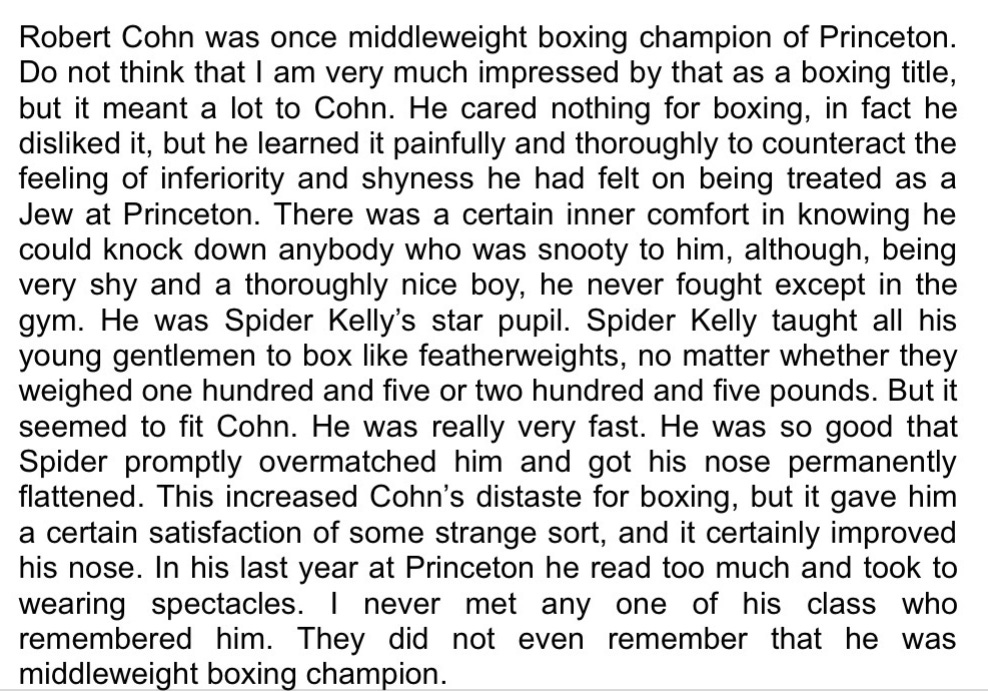
There is absolutely zero showing in this paragraph. We are told literally every single detail about Robert Cohn instead of being “shown” them through a scene.
This is great writing.
That’s not to say you can’t show—of course you can—but I can’t tell you how many times I’ve been told by agents to convert my beautiful prose passages into “scenes with dialogue” (they are all obsessed with dialogue). It’s become a faux pas to explain à la Hemingway, but real writers know that there is room for both showing and telling in great literature.
Let’s bring back telling!
4. “Accessible” Isn’t Always Better
A recent Threads post argued that “shorter chunked paragraphs” and “approachable prose” should be “industry standard.”
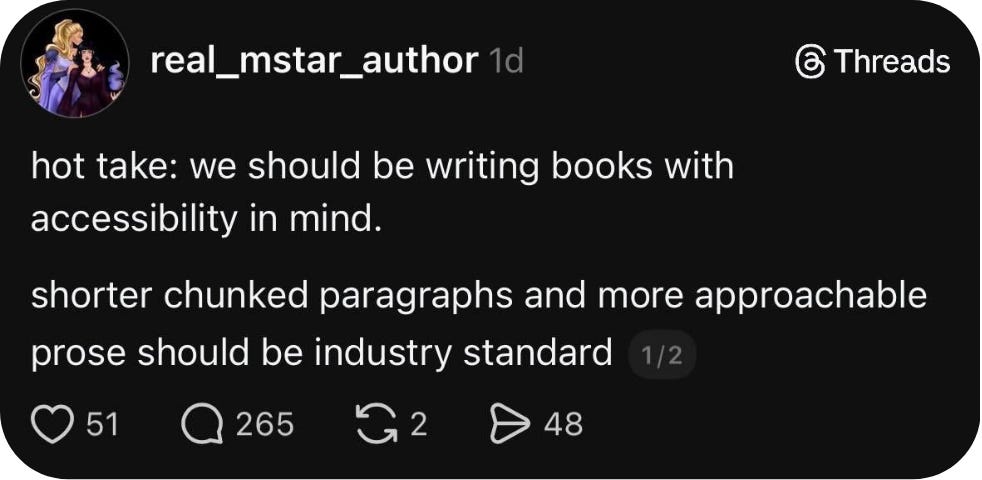
Well, congratulations, real_mstar_author! Your deranged literary fantasy already exists: we have dumbed down books to absurdity to the point where they all read like this:
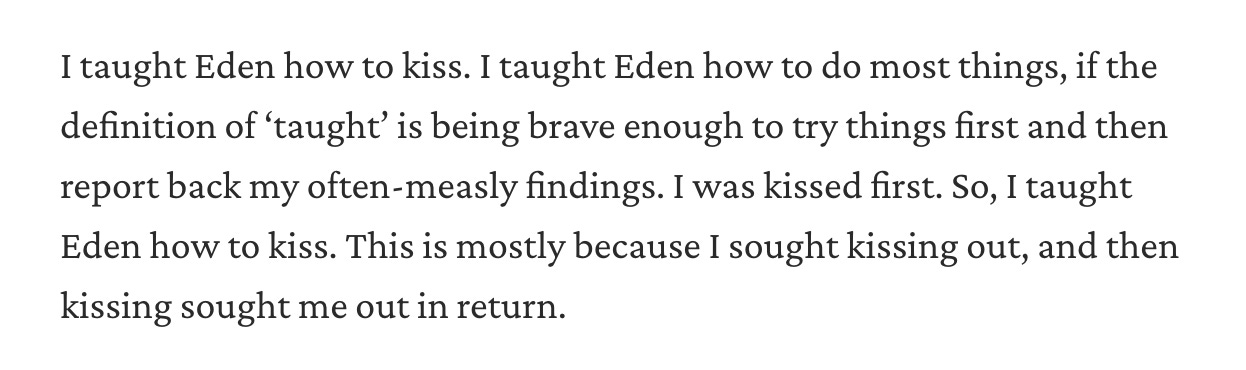
In case you needed another reason to lose faith in our society, this is an actual opening paragraph from a debut literary novel set to be published by Hachette next spring, and it sounds like the text message you wrote to your ex during your sophomore year of college after one too many glasses of wine.
I’ve had enough of this juvenile prose in the name of “accessibility.” Great literature exists to challenge us—not to tell us what we already know.
5. Beautiful Prose Matters
On a related note, beautiful prose matters!
In case you’re wondering why this opinion is even remotely controversial, take a look at this advice to writers from Brooklyn College MFA professor Joshua Henkin:


Cut out your most beautiful sentence if it’s getting in the way of your story! Not just a beautiful sentence—the most beautiful one!
The literary establishment has declared such a war on beauty that writing poetically has now become a negative.
Sally Rooney’s Normal People provides an apt case in point:
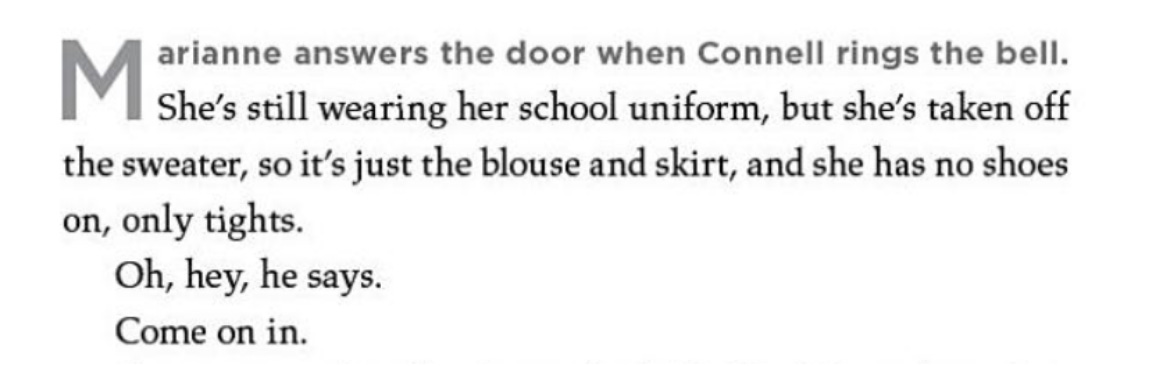
Rooney’s prose reads like something you might encounter in an instruction manual—or a picture book for toddlers. But even more chilling is the fact that we as a society celebrate Rooney’s writing because we’ve come under the collective delusion that simpler is always better.
Literary agents today, in fact, will flat out tell writers to cut out “literary” prose, warning them against submitting supposedly meandering, prosy, or metaphor-laden sentences.
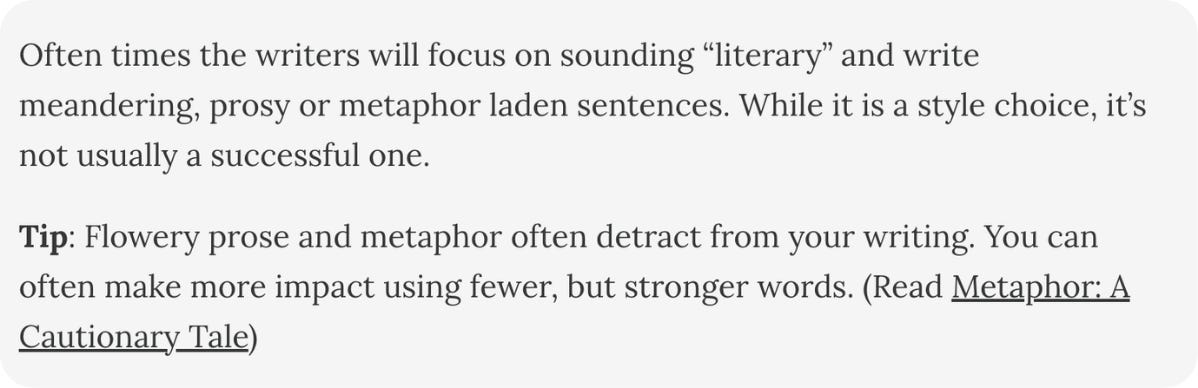
Imagine telling a writer that metaphors detract from writing! Such advice is the logical conclusion of a society that no longer values beauty and believes that literature should serve purely utilitarian ends.
But great literature should be lyrical and beautiful—and sometimes the beautiful sentence needs to stay even if it slows down the “pacing” by just a second.
6. Characters Don’t Need to Be “Relatable”
Literary agents constantly tell me that they can’t “emotionally connect” to my characters.

I wrote about this issue in a recent Pens and Poison essay, and I can’t stress enough how detrimental it is to our literature to believe that characters are only worthwhile if they are “relatable.” Such a philosophy stems from a culture obsessed with its own self—and results in a literary ecosystem whose characters all start to look, think, and act the same.
Great literature contains characters of all shapes and sizes—and sometimes the greatest characters are the ones we relate to the least.
Just ask Humbert Humbert.
7. Write What You Don’t Know
Today, you will be cancelled if you write a character who’s not from your own background.
Just ask this literary agent, who takes issue with certain writers portraying “the perspective of a historically marginalized group”:

I love to write characters who share my experiences as much as the next guy, but there’s also value to writing characters who are unlike you.
Great writers should dare to write what they don’t know—it’s called “fiction,” after all.
8. Long Sentences Are Better Than Short Ones
The literary establishment today will tell you to cut out long sentences because they make us “concentrate too hard.”

I sometimes wonder whether I’m not making this all up as part of some deranged dream, but I’m linking the source for you here.
We’ve apparently reached the point in our society where we can only handle picture-book-length sentences, but great literature has always contained long sentences—Henry James’s average sentence length is about 40 words long—because long sentences teach us how to think.
9. Long Books Are Better Than Short Ones
If you’re a debut author looking to get a novel published, there is a hard 100,000-word limit—with no exceptions.
I was even told by a literary agent that my 100,000-word book (approximately 300 pages) was too long—and that editors won’t even read it!

Another agent told me that 100,000 words is too long for a Gen Z audience.
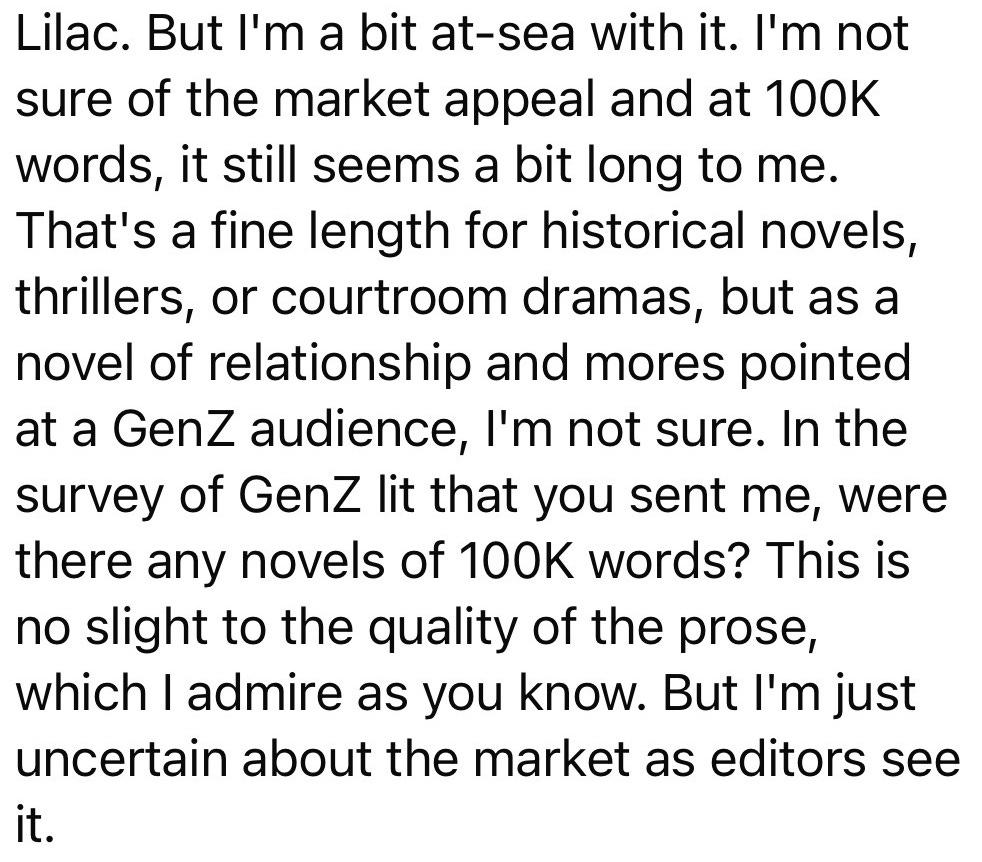
I appreciate shorter novels and novellas as much as the next guy, but long books are long for a reason—they give us the room to develop characters and to create a masterful work of art.
Just imagine The Brothers Karamazov at 300 pages—the main action wouldn’t have even made the cut!
10. Digressions Are Important
Literary agents hate backstory and “unnecessary details.”

I genuinely wish—for the sake of all great writers out there—that I was making this all up, but apparently, backstory has become emblematic of weak writing rather than an intentional stylistic choice.
It seems that literary agents have collectively decided that anything they’re too lazy to read is simply a mark of bad writing—or writing that’s “not submission ready”—but I challenge these agents to pick up any work of great literature.
I will direct you once again to The Brothers Karamazov—the greatest novel ever written—which overflows with backstory.
11. Slow Openings Are Wonderful
Literary agents claim that “first pages are not the place for slow build-ups.”

“Make sure,” she tells us, “you’re starting the story where the conflict or emotional tension begins.”
If that isn’t policing art and demanding that all literature conform to a set formula, then I don’t know what is.
Great literature doesn’t always start in the middle of the conflict—nor would any great author ever have tolerated the idea that “first pages are not the place for slow build-ups.”
Imagine telling Steinbeck to “make sure” to start his story “where the conflict or emotional tension begins.”
We would have never gotten the following gorgeous opening of East of Eden.
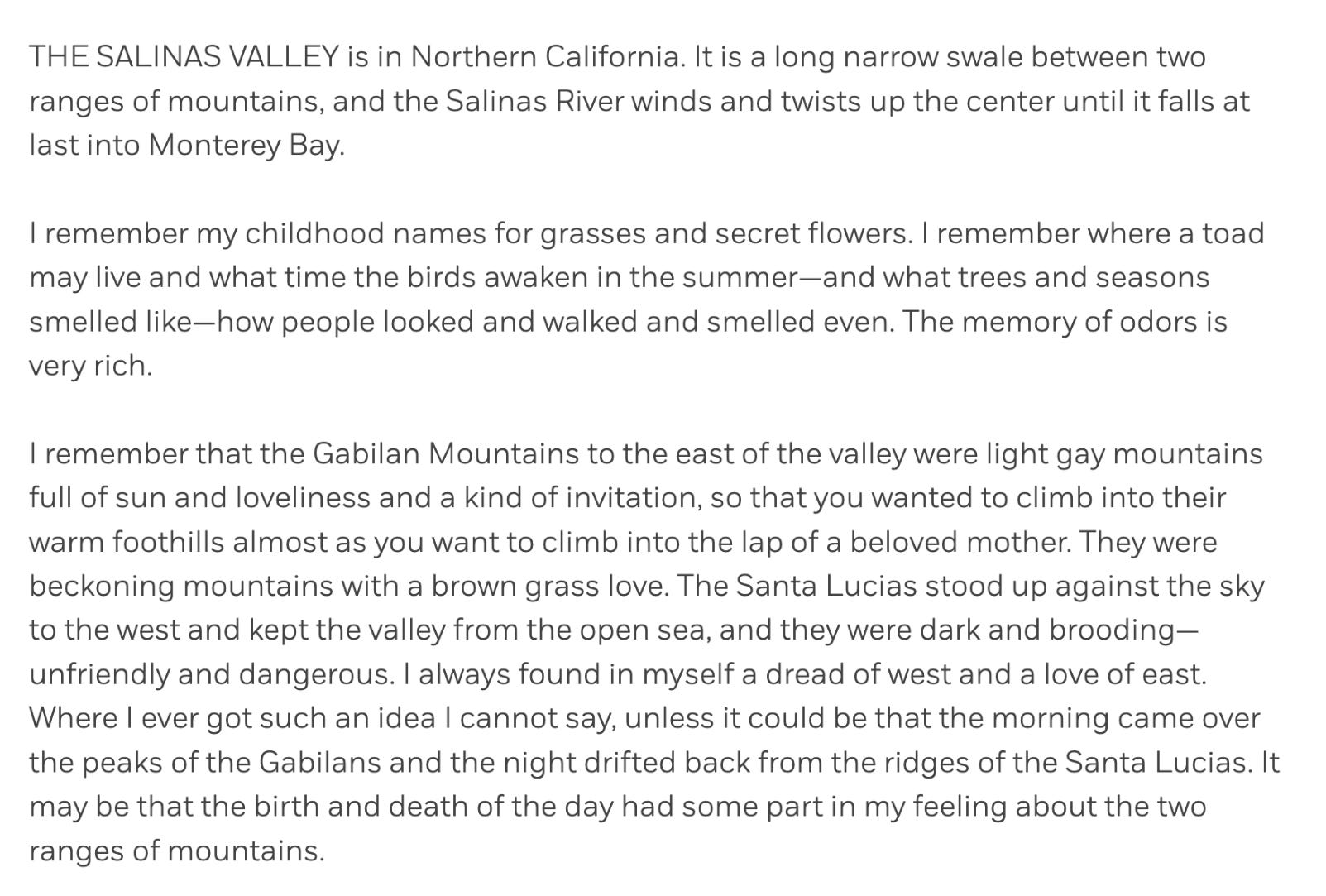
Steinbeck’s great novel begins with a complete absence of conflict—and that’s why, by the time Cathy Ames emerges on the stage, our reading experience is so much more enthralling—and so much more sinister.
The slow build-up that this agent won’t even consider is precisely the reason that East of Eden has earned its status as one of the 20th century’s most monumental works of literature.
Slow build-ups create great literature.
12. Literature Should Take Risks
Combine all of these rules, and contemporary “literature” all starts to sound exactly the same.
MFA programs have collectively waged a war against great literature, but I’m here to wage a war on MFA programs until we bring back artistic freedom.
Great literature should take risks—it always has. And only when we restore risk-taking to the publishing industry will we see great literature back on our shelves.
In the meantime, I’ll keep breaking all the rules.
Enjoyed this post? You can Buy Me a Coffee so that I’ll be awake for the next one. If you are a starving artist, you can also just follow me on Instagram, YouTube, or “X.”
I stopped picking up novels on the "new releases" table when I realized that they all had the stench of a writer's retreat / workshop. Once you notice the pattern, you see it everywhere. All the characters are just-so, and every story feels like the same story wearing a different skin.
And if that's true, after you've read one version, why read another?
A few words of encouragement to you, Lisa, and all other artists...never forget that the Renaissance followed centuries of dark times. And much of what happened in Firenze is due to one family. Don't give up. You are building a family, an army...and we won't have to wait centuries.