


“There are only two conceptions of human ethics,” declares ruthless Party interrogator Ivanov in Arthur Koestler’s Darkness at Noon. “One of them is Christian and humane… The other starts from the basic principle that a collective aim justifies all means, and not only allows, but demands, that the individual should in every way be subordinated and sacrificed to the community… The first conception could be called anti-vivisection morality, the second, vivisection morality.”
In Koestler’s 1940 novel Darkness at Noon, political dissident Nikolai Salmanovich Rubashov, a former high-ranking member of the Party, finds himself imprisoned and accused of conspiring against the state. He’s not initially sure what his sin is, but he’s told that if he confesses to treason, he might get off with a lighter sentence. As Rubashov reflects on the people he’s wronged, he begins to develop a clearer conscience that guides him through his interrogation with Ivanov.
As the interrogator enters Rubashov’s cell, he begins to mock the prisoner for his so-called Christian values and argues that his moral worldview—what he calls “anti-vivisection morality”—will not stand up in the face of historical progress. The Party, he argues, can only thrive on “vivisection morality,” an ideological system in which human experiments are justified in the name of the state.
Rubashov then stops in front of Ivanov and asks whether he remembers Raskolnikov from Crime and Punishment.
Ivanov sneers. “You are really becoming childish or senile,” he says.
If you’ve read the works of Fyodor Dostoyevsky, you’ll immediately understand the relevance of the literary allusion. Koestler’s vivisection morality represents the sort of anti-Christian, anti-humanist moral order that Dostoyevsky set out to destroy in several of his great novels.
It is this same moral order that lies at the heart of Ben Shapiro’s new film Confession—a psychological historical drama and Dostoyevskian masterpiece.
I was honored to meet Shapiro last week at The Free Press’s screening of Confession in New York, and even more honored when Bari Weiss, who moderated the post-screening discussion with Shapiro, chose my question during the open Q&A. As you might expect from yours truly, I had one pressing question: “Could you speak more about the literary works that influenced the film?”
As I’d suspected, Ben Shapiro brought up the works of Dostoyevsky and Arthur Koestler.
In many ways, Confession is a loose adaptation of Koestler’s Darkness at Noon. Indeed, from plot setup to moral infrastructure, the film draws heavily on Koestler’s famous political novel, asking whether truth can retain its meaning in a society that has abandoned God.
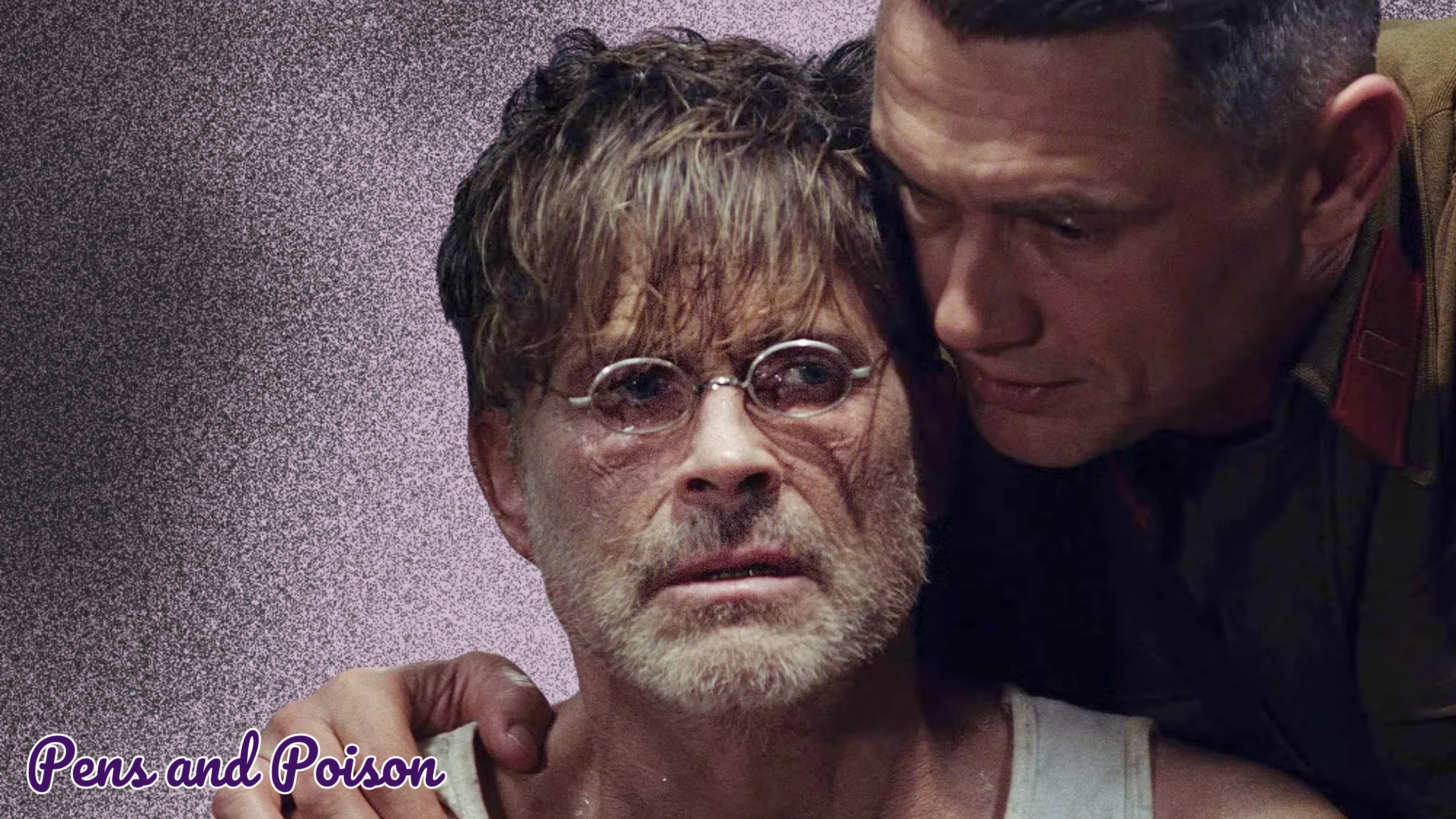
Rob Lowe plays Alexei Abramov, a former literature professor and drunkard arrested by the NKVD and taken to a bleak cell in Moscow’s Lubyanka Prison for questioning. His interrogator, Lieutenant Vladimir (played by James Franco), was once Alexei’s star pupil; embittered by years of warfare, however, Vladimir rejects many of the moral lessons embedded in the great works of literature he once explored under Alexei’s tutelage, instead praising the writings of revolutionary anarchist Mikhail Bakunin and his role in “predicting the nature of the Marxist state.” Like Ivanov, who seeks to overturn the “humanitarian fog-philosophy” that treats every individual life as sacred, Vladimir has grown jaded by his time on the front and has ceased to believe in the sanctity of the individual. “Raskolnikov,” he muses. “I never understood him. He got away with murdering the old woman and then spends hundreds of pages agonizing and then confesses.”
“It cleansed his soul,” Alexei insists.
Vladimir guffaws, a manic look in his dark eyes. He tells the professor that he’d like to turn to business and presents him with a counterrevolutionary pamphlet allegedly penned by one Father Nikolai, an Orthodox priest and acquaintance of Alexei’s from his university days.
Alexei’s task is simple: admit that Father Nikolai authored the pamphlets, and he is free to go.
Alexei, the skeptic-turned-humanist, refuses.
Shapiro’s entire film, directed by Czech filmmaker Václav Marhoul, takes place largely in the confines of two single rooms—the Lubyanka interrogation room and Alexei’s cell—and while the setting itself, with its dilapidated slate gray walls and cockroach-infested cracks, is far from rosy, the message of the film, summed up in a powerful mantra spoken by Alexei in the final seconds of the movie, could not be more optimistic: “God loves you all.”
But if the film’s message is so powerful, why, then, did so many mainstream critics take issue with the production as a whole?
While Rod Dreher of The Free Press called Ben Shapiro’s screenwriting debut a “masterpiece,” a reporter for The Daily Beast dismissed the film as a “Secret MAGA Movie.” One can imagine that Ben Shapiro’s name on any work of art would predispose the liberal media to spew an abundance of unfounded vitriol (the film has absolutely nothing to do with the MAGA movement), but there’s something else going on here, and reading the negative reviews, one begins to discern a clear pattern.
“The insistence on Dostoyevsky becomes exhausting,” writes one IMDb reviewer.
“The encounter becomes less an interrogation than a literary salon in which the names of Dostoevsky, Pushkin and Tolstoy are dropped so often that a drinking game could be devised from it,” said The Hollywood Reporter.
According to Variety, Marhoul and Shapiro’s “ponderous passion play” feels “talky and sluggish.”
In other words, contemporary film critics—and, by extension, the art world as a whole—are so unaccustomed to art that tackles big ideas that a film interrogating the meaning of life has become not just alien to modern audiences but also, in the words of The Hollywood Reporter’s Frank Scheck, “terminally tedious.”
Why, then, did I find myself so immersed in Shapiro’s script that two hours felt like a mere thirty minutes? And how did Rob Lowe’s chilling performance bring me to tears?
Earlier this year, I wrote a piece for Pens and Poison called “Why Modern Movies Feel So Empty” in which I analyzed Bugonia and Marty Supreme—two lackluster movies that were up for the 2026 Academy Awards—and concluded that both films lack a moral backbone.
“The reason that contemporary films are so terrible,” I wrote back in March, “is that they lack a belief in humanity. Today, we are scared of making movies that show human beings in a positive light because, thanks to the advent of moral relativism, we have become terrified of taking a stance on the Good, the Beautiful, and the True. As a result, art becomes ironic and ugly; movies no longer feel ‘wholesome,’ but alienating. We don’t care for contemporary film characters because we no longer see ourselves in them… Contemporary films lack substance because they’ve swapped out universals for particulars, replacing Goodness, Beauty, and Truth, with irony, alienation, and nihilism. And that is why contemporary cinema feels fundamentally unwatchable—because it is profoundly anti-human.”
Such is the state of contemporary cinema, and such is the importance of films like Confession. Shapiro’s movie is not merely a beautiful standalone work of art—it is the humanistic Renaissance we need in an artistic world that has forgotten that art must, first and foremost, help us find meaning in our lives.
And if Shapiro’s aim was to help us find such meaning, then Confession certainly delivers.
As the film progresses, we learn that Alexei has a troubled past. Plagued by the crippling fear that his brightest student will outshine him, he thwarts Vladimir’s success out of vanity and, it is hinted, venerates his vodka more than his ex-wife and son. But by the time both family members visit him in his cell, begging him to confess for their sakes, Alexei is a changed man who stays true to his principles, refusing to throw the priest under the bus.
We soon also discover just how instrumental Father Nikolai has been in the professor’s moral development: he has helped him find Christ during the darkest moments of his life and shaped him into a morally upstanding man. As a result, Alexei refuses to sacrifice truth even for the sake of his family because he rejects the premise that, in the godless world of the Soviet Union, truth has lost all meaning. He disavows the idea that individual human lives can be reduced to mathematical formulas, and, like Koestler’s Rubashov, refuses to live in a society where human beings simply participate in a grand experiment for the good of “the State” and its “revolutionary spirit.” Put simply, Alexei believes in a world order in which human beings seek something greater than themselves.
In this way, Confession is no more a MAGA film than The Brothers Karamazov is a “conservative” book—and what both works of art have in common is their commitment to truth, beauty, and goodness in a world that has increasingly abandoned those principles entirely.
This brings us to the film’s central philosophical question: is there hope for truth in a world that not only treats individual human beings as expendable but that has also abandoned God?
To answer such a question of Dostoyevskian proportions, Shapiro implores us to consider the words of the great Russian master himself.
Shapiro is no stranger to the works of Fyodor Dostoyevsky—in a video ranking the best books of all time, he cites The Brothers Karamazov as one of his favorites, and, unsurprisingly, the novel features prominently in Confession’s storyline, particularly in the film’s last third. As Vladimir grows increasingly sadistic, resorting to physical as well as psychological torture—like Ivanov, he refuses his prisoner sleep with an incandescent light—he retells The Brothers Karamazov’s famous story-within-a-story: the “poem,” as Dostoyevsky’s Ivan calls it, of the Grand Inquisitor.
As Ivan’s story goes, Jesus Christ shows up in Seville during the Spanish Inquisition. His attempt at bringing hope to his people, however, is quickly stymied by the Grand Inquisitor, who promptly shoves him into a prison cell and declares that he, the Grand Inquisitor, no longer serves God but the Devil. The masses, he explains, don’t want the freedoms promised by traditional Christian morality—they simply crave a slice of bread. In other words, the common people are willing to trade freedom for security promised to them by the state.
Because Shapiro excels at presenting Dostoyevsky’s complex moral tale in accessible terms, audience members need not be familiar with The Brothers Karamazov to appreciate its role in crafting Shapiro’s moral universe. Shapiro’s Vladimir, of course, represents the material moral order of the Grand Inquisitor, which, in Soviet Russia, has been refashioned in Marxist terms. Alexei, on the other hand, is something of a Christ-like figure who survives hardship by retaining his faith in God; in this way, he stands not only for freedom but also for hope in humanity’s capacity for salvation.
At the end of Confession, Vladimir is arrested for his failure to wrest a confession out of his former pedagogue, and Alexei is free to go. In the final minutes of the film, however, Alexei confesses that he was the one who authored the counterrevolutionary pamphlets—and is sent off to his death. As he’s once again dragged through Lubyanka Prison, he passes Vladimir, who’s being escorted in the other direction, and graces him with a vehement kiss on his forehead.
In the dark theater, I turned to my friend and whispered, “That’s a Dostoyevsky reference!”
My friend chuckled. “How do you know?”
Surely, that kiss could have meant anything, but in the film’s final sequence, my suspicions were proven correct: in the next scene, Vladimir is seen reading The Brothers Karamazov, specifically the paragraph where Christ kisses the Inquisitor on the lips, countering the cruelty of his hyper-rational world order with love. In Dostoyevsky’s novel, Alyosha, too, kisses his brother Ivan in the hopes that he will one day trade his cold rationality for unbounded love. Ivan blushes and, lacking the moral vocabulary to understand the significance of his brother’s gesture, comes out with a cheeky, “That’s plagiarism!”
The only thing missing from the film was Ivan’s outburst, which would have taken on a whole new layer of meaning in Shapiro’s masterpiece (though I fear I might have been the only person in the theater to appreciate the obscure reference).
Well, as Bari Weiss joked during the screening event, it’s as if this movie was made for me.
Ben Shapiro’s film streams on The Daily Wire. I promise that you won’t want to miss it.
Enjoyed this post? You can Buy Me a Coffee so that I’ll be awake for the next one. If you are a starving artist, you can also just follow me on Instagram, YouTube, or “X.”
The bad reviews are hilarious. I don't know that Shapiro planned to expose the review community as rubes, but he certainly did it. They all read like “we didn't understand it because we watch too many TikTok videos”.
A masterpiece about a masterpiece. Congratulations and thank you.