


You might know me as the classics bookworm. I’m always reading something with one of those unassuming Penguin covers or quoting some literary visionary from two hundred years ago. I’ve read over a thousand books in my twenty-eight short years, picking up my first “real” work of literature—Tom Sawyer—in the fourth grade, and by my sophomore year of high school, I had read almost every major Dostoyevsky novel.1 Today, I gravitate almost exclusively to classic literature when it comes to fiction.
Call me a snob, but I challenge you to find me one book published within this century that will change your life as much as Crime and Punishment. You’ll have a hard time doing so, but there is one exception—or seven, rather.
Those are the Harry Potter books.2
There was a time in my life when I would have argued that Harry Potter doesn’t count as real literature: it’s not very well-written, and, at the end of the day, it’s a children’s book. Of course it doesn’t measure up to the standards of a Dostoyevsky or a Dickens, but it’s not supposed to—in fact, Harry Potter may be doing something far more important.
And as a kid, I loved Harry Potter more than anything in the world. I don’t think it’s possible to convey the magnitude of my Harry Potter obsession, and I must have driven my parents nuts quoting the all the books and begging for all the merch. It wasn’t a passing fad either—I was glued to Harry Potter for years.
I first read The Sorcerer’s Stone in the first grade. I had this precocious friend named Patricia,3 and one day during recess, Patricia wanted to play “Harry Potter.” I was six, and the year was 2003. The latest Harry Potter book, The Order of the Phoenix, had just hit shelves, and there were only two films thus far, so this was long before Harry Potter had become a household name, especially outside of children’s literature circles. Nevertheless, Patricia had already started reading the fifth book, and I was told to get on Harry Potter so I could be Cho Chang while she was Hermione.
As soon as I started the books the following week, I quickly fell in love with Hermione myself, and after a heated fight with Patricia, we swapped roles, and I would be Hermione on that playground for years to come.4 We ran around the slides and swing sets like morons waving sticks all over the place, and somehow, we never got bored of pretending to enchant some poor ladybugs with our gibberish spells.
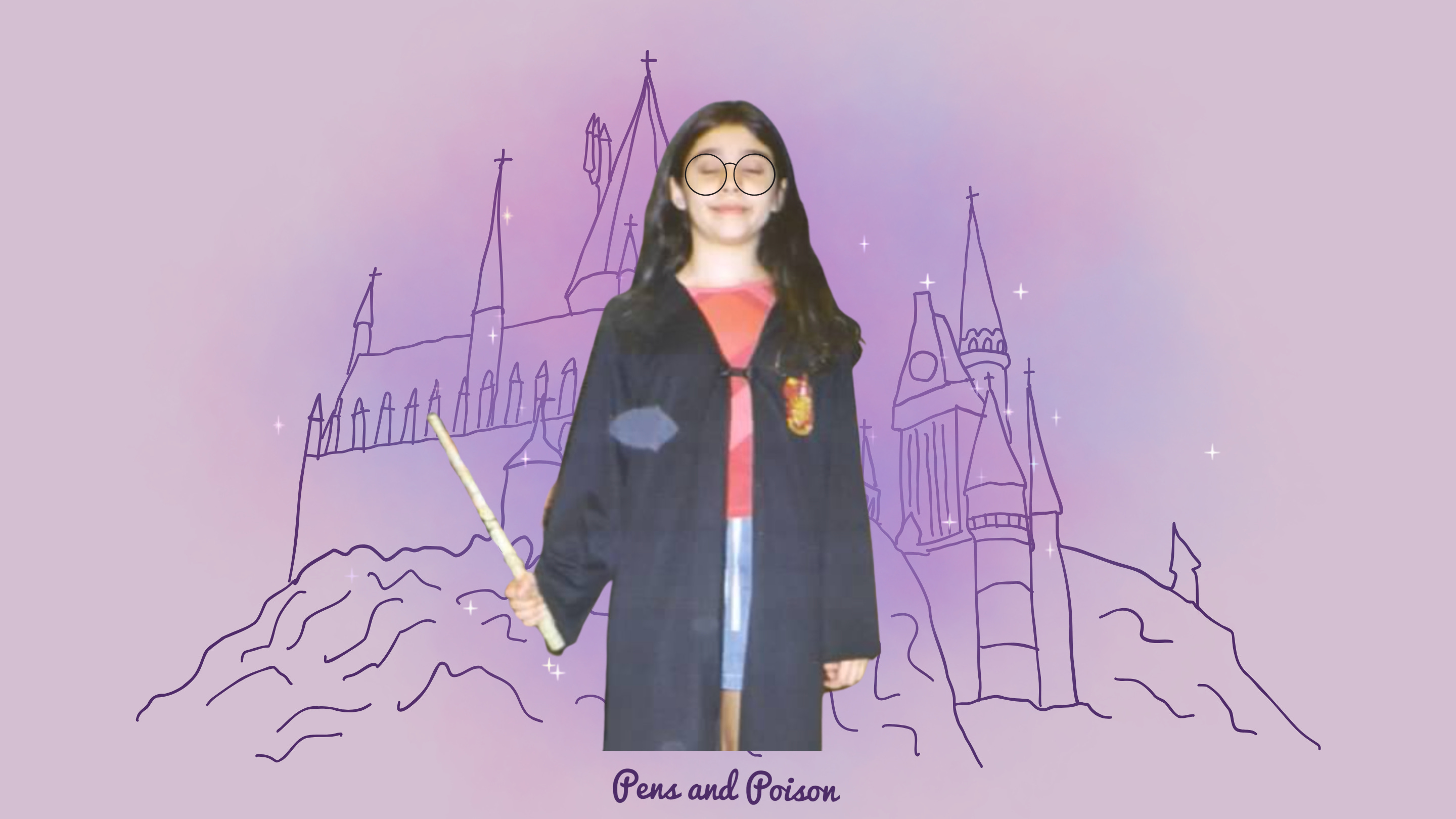
Soon, our Harry Potter games became a way of life. I had Harry Potter–themed birthdays every year until I was about thirteen, and, in keeping with my ongoing playground role, I dressed up as Hermione every year for Halloween. I still bear some eerie resemblance to Hermione even today: I always have my nose in a book, and I have no doubt that my bossiness on the tire swing informed my present aptitude for leadership. My friends routinely observe that I still dress just like Hermione, and I’m pretty sure that the bangs I wear today originally had something to do with Emma Watson’s hair for the films.
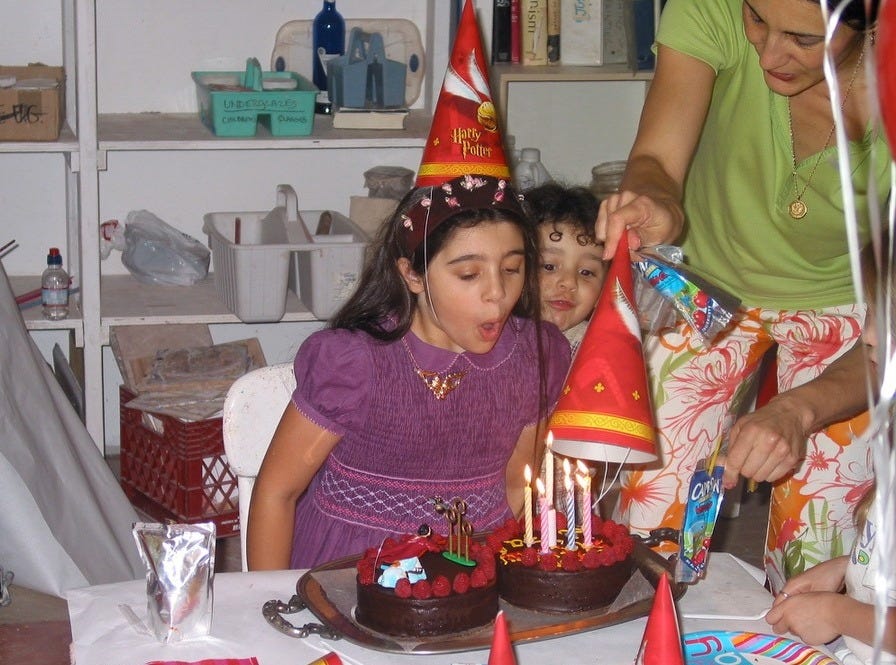
In other words, Harry Potter was everything to me.
Eventually, of course, I moved onto bigger, more serious books, but Harry Potter always stayed in my heart. And looking back, it was no accident that I loved the Harry Potter books so much, though it wasn’t because Hermione inspired me to be more brainy (though she did) or because Harry’s adventures sparked my love of reading (though they did) or even because J.K. Rowling’s own story encouraged me to take up writing (though it did).
The reason Harry Potter changed my life is because it planted the idea in my mind—even before I was fully aware of it—that good literature ought to teach us something about our own lives.
Shortly after I exited elementary school, Harry Potter blew up as a phenomenon, and I was proud to be one of its early evangelists. Not only had I nagged everyone in my third grade class to check the series out, but I had even convinced our third grade teacher to plan an entire lesson on the history of Great Britain. Soon enough, Harry Potter was on everyone’s mind for about the next decade, and Rowling had sparked a revolution in children’s literature. You can attribute its mass appeal to Rowling’s innovative plot lines or the ease with which her whimsical stories lent themselves to the big screen, but I’d argue that’s not the sole reason for Harry Potter’s popularity.
No—the reason that we all love Harry Potter is because Harry Potter, at its core, is a retelling of the same story that has captivated human beings since practically the inception of our species: the triumph of good over evil. In the same vein, Rowling is a great author not because she has a wild imagination or because she’s a master of sentences—Rowling is a great author of children’s literature because she dares to use her voice to make morality judgments.
At its core, Harry Potter explores questions that human beings have been grappling with for centuries—the extent to which power corrupts, the price of refusing to accept death, the importance of our individual choices—and dares to answer them. Sure, you can read Harry Potter as a fun story (and I was certainly reading it that way when I was six), but in retrospect, Rowling’s fantasy series did serious work in terms of guiding little Liza through life’s biggest questions—questions that mirror the development of morality systems throughout human history. We sympathize with Snape by the end of the series not because he’s made all of the right choices in his life but because he seeks the age-old virtue of redemption. We trust Hermione not because she’s smart and savvy but because she uses her intelligence in the service of loyalty and justice. We sense that Voldemort’s Horcruxes are immoral not because they break the rules of magic but because we’re told from the very first book that Voldemort’s very pursuit of immortality is fundamentally evil.
Harry Potter is a magical book because it dares to take a stance on what is good and what is evil, thereby orienting us in our own lives.
Indeed, the Harry Potter books quickly helped me make my own value judgments about the world around us. In a unit on the Holocaust in the fifth grade, I was the first in the class to point out that the Nazis’ obsession with bloodlines reminded me of that of the Death Eaters. Similarly, when learning about totalitarian control of propaganda and discourse in the seventh grade, I was quickly reminded of the Ministry of Magic’s lies to the wizarding world.
And Harry Potter doesn’t just make societal judgments—it also makes existential judgments. We side with Lily Potter because her love literally breaks the rules of magic, suggesting that love will always trump all other considerations. Similarly, we cheer on Harry because he willingly accepts his own mortality, affirming that a life governed by moral courage will always win over a life of fear. In this way, Harry Potter isn’t just a children’s series—it’s a bold chapter in the history of literature that, like all great classic works, dares to take a moral stance.
Today, in a world where English departments glorify moral relativism, the publishing industry continues to push out meaningless novels with downright nihilistic protagonists. Today, when MFA programs applaud ambiguous endings and literary agents prefer “kid-focused books with no heavy moral[s],” it has become virtually impossible to find books with a clear moral backbone. And today, in a literary market that avoids taking stances in fear of offending anyone and everyone, we need a call back to the magic of Harry Potter and to the stories that are unafraid of moral clarity. Because the real magic of Harry Potter is that it does not flatter its readers by telling them that nothing is true or that everything is subjective; instead, it challenges readers to choose loyalty over ambition, courage over fear, and love over domination.
If Harry Potter has taught me anything, it’s that great literature should be bold and unapologetic in its message. And though at times Rowling and I may not see eye to eye, I applaud her for daring to use her voice to explore love, power, death, good, and evil—the universal questions that we have all been mulling over for centuries.
Because great literature dares to ask big questions and change our lives. And for an entire generation of readers, Harry Potter did just that.
Enjoyed this post? You can Buy Me a Coffee so that I’ll be awake for the next one. If you are a starving artist, you can also just follow me on Instagram or “X.”
The only major Dostoyevsky novel I didn’t get to in high school was ironically his shortest and most accessible one—Notes from the Underground. There’s a great story here that I’ll devote a separate essay to, but TL;DR, my post-Soviet household was completely unaware that Dostoyevsky had ever written a book bearing this title because Notes was actively suppressed in the Soviet Union given its anti-utopian themes. When I was fifteen, however, I didn’t pick up on these nuances and assumed my parents simply hadn’t heard of it because it wasn’t as good. As a result, I deprioritized Notes (which was a mistake, of course—today it’s my second-favorite Dostoyevsky after Brothers K), but you live and learn.
Yes, I am aware that three out of these seven books were technically published in the previous century, but let’s not quibble over a matter of three years.
Patricia left my school after the third grade, and I never saw her again. I have no recollection of her last name and can’t remember a thing about her other than her dark curly hair and interest in Harry Potter, but if I ever find out what happened to that Patricia, I will mail her a bouquet of flowers and a handwritten note thanking her for her pivotal role in shaping my identity.
Eventually, we recruited another girl with red hair to be Ginny. I recently learned that she ended up studying English at Trinity College in Dublin, so it appears that our first-grade Harry Potter games were wildly formative.
This is exactly what Harry Potter was (and still is) to me. Thank you for putting it into words!
I just started reading the books for the first time. I’ve waited so long partially because at one point I didn’t think it counted as real literature either, but also because I tend to read what I write and that’s not what I write. However, last year, I read the Lord of the Rings for the first time, and I realized that there’s real value in reading things outside of your aesthetic. I think it has to do with the values that are behind the story, which you clearly articulate. Children and adults alike need to see stories of characters boldly taking a stand against evil. I am all in on my Harry Potter experience and I’m very excited to see what it teaches me. Thank you for your wise, discerning approach to literature.