



The best paper I ever wrote for my English classes at Columbia University was a final paper arguing that Shakespeare’s Twelfth Night was a proto-transgender text.
Well… best according to my professor, at least.
During my junior year of college, I enrolled in a Shakespeare seminar with a newer department hire taking over for renowned Shakespeare scholar James S. Shapiro. Shapiro was on leave that semester, and unbeknownst to me, I had chosen the worst possible time to dive into the works of the great Bard—under the tutelage of the worst possible professor.
The professor in question was in her early thirties and had just completed her PhD. Contrary to many other English department faculty profiles—which abound with descriptions of various mental illnesses—this professor’s profile seemed not only completely benign but surprisingly serious: her research interests included the “Renaissance / Early Modern Drama,” “Aesthetics,” the “History of Ideas,” and “Europe.” She had shoulder-length blonde hair, no apparent body piercings, and nothing else to suggest that she had sprouted from the garden of academic crazies.
So I took the chance—and was thwarted, as they say, by the hands of fate.
The first several lectures were nothing out of the ordinary: we learned about Shakespeare’s family history and the rise of drama as an art form before launching into our study of The Merchant of Venice. The professor went on about racism and xenophobia, yet because these themes do genuinely appear in the play, I didn’t initially think much of it. Similarly, our discussion of The Taming of the Shrew focused on gender roles and social class—an accurate reflection of the play’s themes.
Then things got a little weird.
Romeo and Juliet, said my professor, was a “staging of sex.”
I didn’t know what the hell that meant, but the following week, we were learning not only about how Shakespeare’s sonnets suggested that he was gay but also about how A Midsummer Night’s Dream was about queer desire.
Below are the actual notes I took during the lecture:
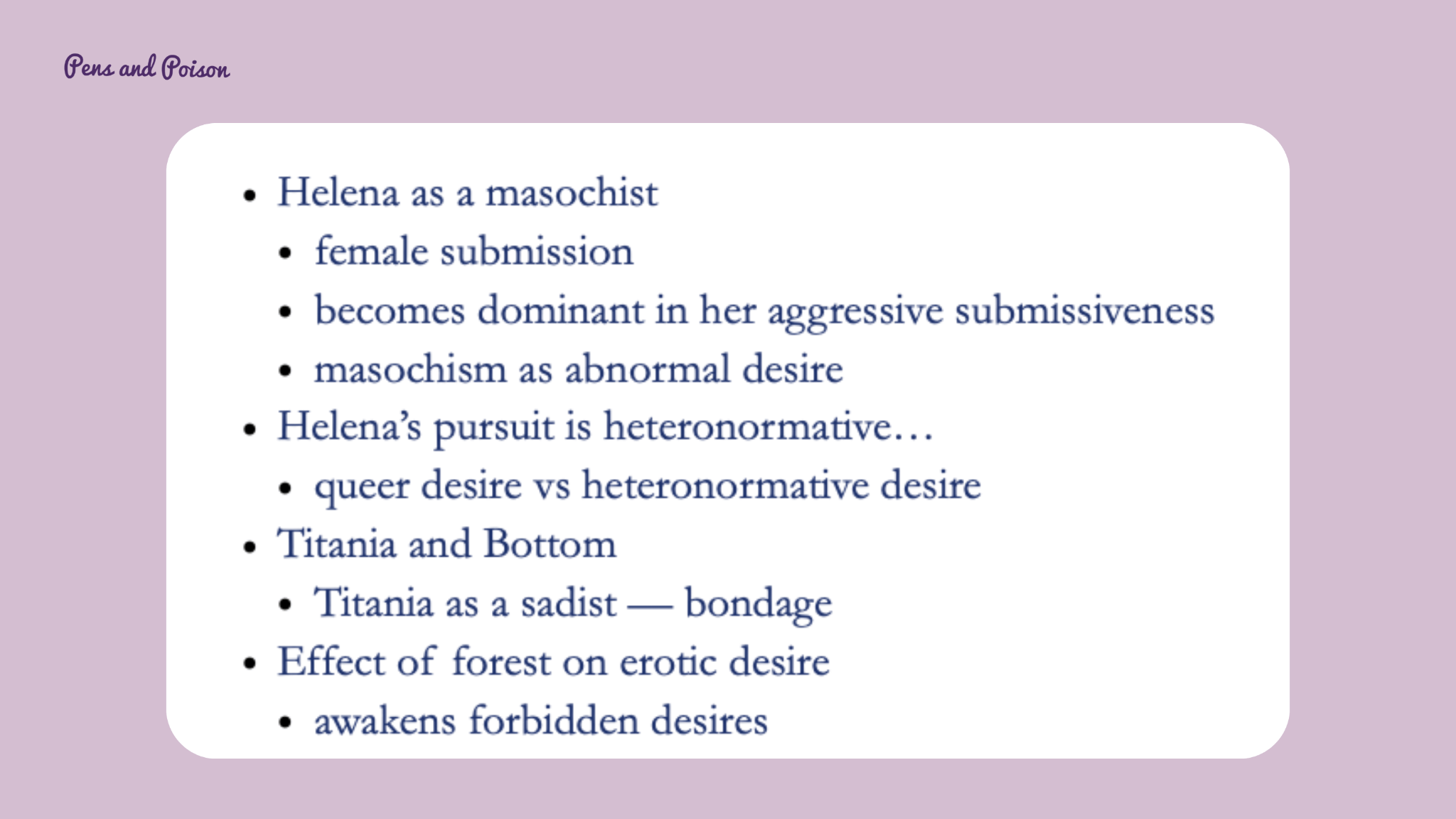
You can imagine how, from that moment on, it might have been difficult to take the class seriously.
Nevertheless, I resolved not to let my professor’s obsessions interfere with my enjoyment of Shakespeare. I studied hard for my midterm exams and had nearly committed Midsummer Night’s Dream to memory by the time I entered that classroom halfway through the semester, ready to wow the professor with my burgeoning knowledge of Shakespeare. Disregarding my professor’s BDSM fetish, I composed essays on the nature of Helena’s love for Demetrius and Titania’s famous prank on Oberon.
Several weeks later, I received the following comments on my two short midterm essays:
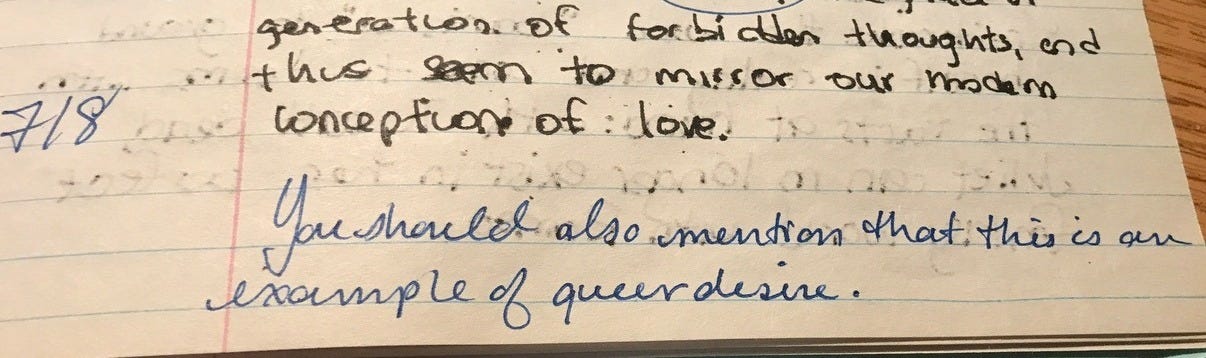
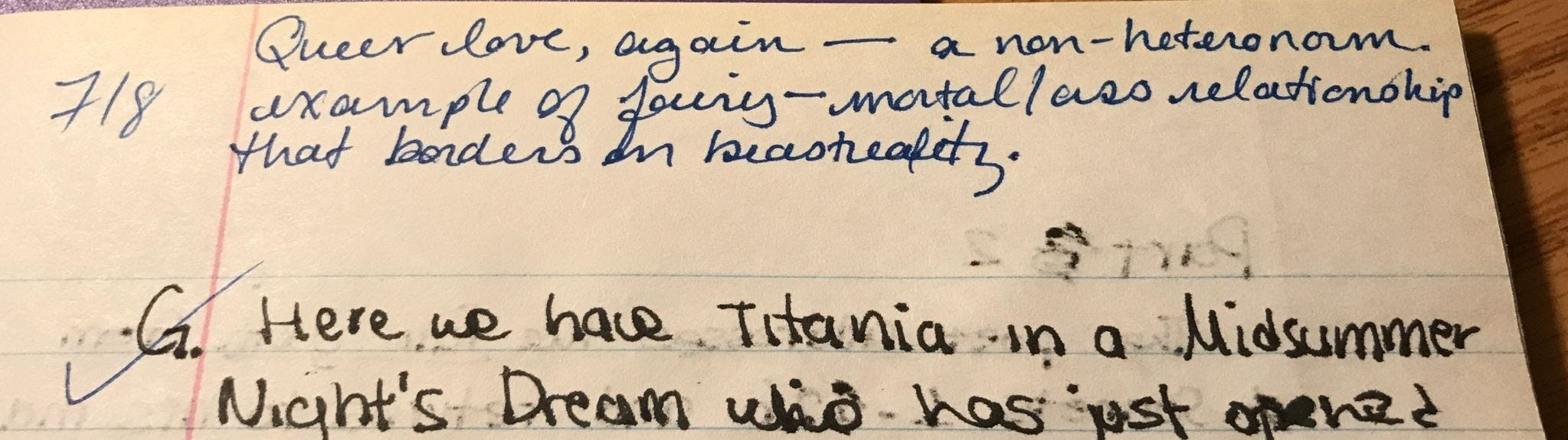
I had lost two points on an otherwise perfect exam because I had failed to mention—on two separate occasions—that A Midsummer Night’s Dream was about “queer desire.”
Embracing the absurdity of the class over the next several weeks, I wrote my final paper on the topic of Twelfth Night and transgenderism (because Viola dresses up as a man and so on).
I got an A+ not only on the paper itself but also for the entire course.
My college Shakespeare seminar has given me quite a story to tell, but it reveals a series of alarming truths about the poison that has taken over literary study in English departments across the Western world. In a word, English departments no longer teach literature proper but either a) focus on ideology or b) put a leftist spin on every work of classic literature ever to grace our civilization.
If you’d like to be entertained by further examples of radical leftist ideology in the Columbia English department, you can read some of my past essays here, but today, I’d like to explore how we got here—and why.
To answer that question, we must first understand the nature of literary study prior to the leftist takeover of the academy. And as it turns out, the idea of “the humanities” has remained largely unchanged for thousands of years.
