


For many years, MFA workshops have gaslit authors into believing that there’s a standard “formula” for writing a great novel.
What’s the conflict? What do the characters want? What are the stakes?
Answer these questions, and you’re on your way to writing the next Great American Novel.
There’s just one problem. None of these formulas will actually ever produce a great work of literature because real novels don’t have simple answers.
Imagine identifying the main “conflict” in The Brothers Karamazov or figuring out what Holden “wants.”
In other words, everything you’ve learned in your MFA program is complete bullshit.
I’ve spent most of my adult life reading novels, writing about novels, and—most importantly—writing my own novels. I’ve written three novels to date (with a fourth one on the way!), and today, I’d like to tell you about the real way to write a novel.
Throughout this post, I’ll be referencing my four novels—The Lilac Room, The Leverkühn Quartet, Blue Snow, and The Brodsky Sisters, as well as telling you a bit about my own writing process.
Now, without further ado, let’s help you write your first novel.
Before You Write…
It might be tempting to rush into writing your first novel—after all, it’s tough not to feel constantly behind—and while there’s no “wrong” time to start writing, I recommend following these three steps before you get started.
1) Read great literature.
The best way to develop your writing voice is to read as much great literature as you can—and to identify your biggest influences.
Mine are Dostoyevsky, Thomas Mann, T.S. Eliot, J.D. Salinger, and Sylvia Plath. You’ll find the spirits of each of these authors embedded in my writing.
There are no better teachers than the literary greats.
2) Skip the creative writing classes.
I firmly believe that creative writing classes do more harm than good to your writing voice because of the amount of standardization that happens in these workshops. I took one creative writing class early in my writing career at Brown, and I can’t tell you how stifled I felt as an author wasting away in those workshops every morning. When it comes to feedback, most of your peers aren’t going to know better than you, and unless you’re very lucky, the failed writer who’s now taken up a second-rate teaching position at a random college won’t teach you anything beyond the generic “MFA workshop tips” that you can obtain from a quick Google search. I was continually appalled by the generic writing exercises we were assigned at Brown, and we didn’t read a single piece of literature written before 1950.
I promise you that old books will take you much further than classes taught by writers you’ve never heard of.
3) Live a little.
Some novels were born out of a ghost story contest (Frankenstein), others from one man’s experience at sea (Moby Dick). There’s no one-size-fits-all approach when it comes to novel writing, but what most great novels have in common is that they were born from experience.
Yes—writing a novel requires living your life.
The best advice I can give, then, before you start writing, is to go out and experience the world.
It’s no secret that writers tend to be introverted—and I can’t tell you how many authors I’ve met who are total recluses and have never left their apartments. But the introverted writer who ultimately reaches literary success is the one who dared to put himself out there, translating his many experiences into beautiful words. The best way to develop a brilliant novel idea is by taking in the world around you... and by living a little bit of life.
It might seem counterintuitive, but don’t spend all your days writing—instead, live your life, explore the world, shuffle back to your desk in the early hours of the morning… and then write.
With that out of the way, let’s get into the actual process of creating a great work of literature.
The Idea
The first thing you’ll need to do is to come up with a viable idea. In my experience, this is usually the most difficult part because ideas never come to you when you’re actively trying to summon them. I’ve lived through long stretches of my life where I think that I won’t possibly think of another great novel idea, and sure enough, something always comes to me eventually, so be patient. In many cases, inspiration strikes randomly.
I’ll give you a great example. I was on the subway one afternoon in my early twenties, and two of my friends (whom I had introduced to one another) were discussing a party they’d attended the previous week. This might have been unremarkable in itself—everyone in New York is always scuttling off to one party or another—but when I learned that the soirée in question had been featured in The New York Times, I was livid.
I couldn’t understand how I hadn’t been invited.
My ire took up a substantial portion of my inner musings for the next two days or so, and I soon started to wonder why I cared so much in the first place. Was it prestige? Status? Feeling left out?
There was something to these “elite New York circles”—and I had to find out what.
Thus, The Lilac Room was born.
There’s another little tidbit about The Lilac Room that might be of interest. The novel is partially set inside a Frank Sinatra jazz bar. As I was building out the world of The Lilac Room—and its protagonist, Cassie Feuerbach, who grows obsessed with New York’s “elitist, mathematically-driven circles,” as she aptly describes them—one of my friends was daydreaming about his plans to start a Frank Sinatra jazz café one day—only the café was going to have a secret underground room that turned into a licentious cabaret of sorts.
(The literary agent I worked with briefly didn’t like the underground cabaret in the Frank Sinatra jazz bar that made its way into The Lilac Room, but he can suck it, really.)
Some of my other novels were directly influenced by great literature—combined with my own experiences, of course. The idea for The Brodsky Sisters, for one, came to me during a recent re-read of The Brothers Karamazov: I thought that it would be fun to reinterpret Dostoyevsky’s famous novel from a female Jewish perspective. Similarly, I got the idea for my novel The Leverkühn Quartet while reading Thomas Mann’s Doktor Faustus. I was captivated by the character Adrian Leverkühn and wanted to create my own tortured composer (who, in honor of Mann’s great anti-hero, is also named Adrian). My Adrian is loosely based on a tortured composer I used to know in college, and Adrian’s many compositions were inspired by my friend’s own musical creations.
I’ve had many failed ideas as well, so make sure you really like your idea before you start writing. You’ll be stuck with it for a long time.
The Characters
Once you have your idea, it’s time to sculpt the characters who will help it come alive.
Character-building is perhaps my favorite part of novel writing because, more than anything, I write to explore human psychology—and if you want to write psychologically believable novel characters, forget almost everything you’ve been taught about character development.
“What do they want?” “What’s their wound?” “What do they fear?”
You were probably taught to ask these questions in your MFA program, and if you’ve been using them to build out your characters, then congratulations—your characters probably suck.
The fact is that no human being on this planet is sitting around thinking, “I wonder what wounded me…” “I wonder what my fears are…” The world would be a lot simpler if we all knew what we wanted, but the truth is that most of us don’t know the answers to these questions—so building out your characters with this formula is going to leave you with a cast of one-dimensional characters that absolutely no one is going to remember.
So what should you do instead?
Well, the only way to write psychologically believable characters is to figure out what’s so special about real people.
Instead of reducing your character’s psychology to wants and fears, talk to as many people as you can to get a fuller picture of how each person operates. Sherman Alexie once said that all fiction writing is plagiarism, and that’s absolutely correct. Pay attention to quirky details in your day-to-day life that you can steal for your story. For instance, I once met a guy who collected hotel slippers and kept them all in a giant cardboard box. That seemed like something that Cassie would do in The Lilac Room, so the following paragraph materialized:
I changed into a bathrobe—a terry cloth getup I’d stolen during my first sojourn at the Ritz. Enchanted by the pairs of slippers that appeared each evening by my bed—the bags of tea that were replenished every morning at my desk—I’d made it my mission to pilfer as many “complimentary” goods as fit into my suitcase and had since amassed a box of unused slippers, doled out to Manhattan strangers who wandered up the winding staircase to my old apartment and called themselves my guests.
If you want to write a character who doesn’t directly resemble someone you know, then find a real person who can speak to the sort of experience you’d like to capture. For example, I’m currently writing an atheist character for The Brodsky Sisters, and I’ve been interviewing staunch atheists to learn about their worldviews.
Eventually, you’ll have such a deep understanding of people that all such MFA “character-building” questions will seem meaningless. We’re human, after all—not cartoon characters.
The Big Questions
I’ve never heard conversations about “big questions” in contemporary writing circles because the current literary milieu seems to have forgotten that literature should explore life’s big questions rather than just tell a story.
Each of my novels starts with big questions that run throughout the narrative—and I mean run throughout because no novel worth its salt will ever lose track of its philosophical themes.
My novels frequently explore questions I’ve been mulling over in my own life. The Lilac Room asks “What makes a person rare?” The Leverkühn Quartet asks “What is Beauty?” Blue Snow asks “What does it mean to live life authentically?” The Brodsky Sisters asks “What is the point of life?” By the end of each of these novels, my characters either arrive at their own conclusions or compel my readers to consider these ideas in the context of their own lives.
If you’re looking to write a great novel, then big questions should be your bread and butter. Start with a question and have your characters wrestle with it throughout—and make sure they eventually find some answers. You can have more than one question per novel, of course, and you probably should, but it’s helpful to start with one and go from there.
Many of our culture’s greatest works of literature are great precisely because they ask big questions—so don’t ever let literary agents tell you that your novels are “too philosophical.” If anything, strive to write as philosophically as possible.
The World
I’ll start this section with a quote from my favorite composer, Gustav Mahler, who makes a prominent appearance in The Leverkühn Quartet:
“The symphony must be like the world; it must embrace everything.”
Replace “symphony” with “novel,” and you have my philosophy on novel writing.
Each novel should have an immersive, recognizable world that sets the scene for the story to come.
Many novelists like to reuse the same worlds—think Faulkner’s Yoknapatawpha County or Hardy’s Wessex. For my own novels, I borrow a technique from Dickens—pick your favorite real city and give it a personal spin. Dickens did this with London, of course. My city of choice is New York.
My novels are all set in Manhattan and focus on the glamorous yet lost old world (think Gatsby). You can frequently find my characters in Art Deco–inspired rooftop bars or jazzy restaurants. I also love to use classical and jazz music to give my worlds a certain flavor.
My novels feature real places in Manhattan (I hope to send my readers on a Liza Libes literary tour around the city one day), but you’re also welcome to make up fictional places in real cities.
Whatever your world may be, make it as immersive as possible with sights, sounds, smells, and memorable artifacts. These aspects will make your world come alive.
The Research
Some novels require a lot of research; others, not so much.
Because The Leverkühn Quartet followed a classical music plot, I had to do a great deal of research on New York’s “classical music world” in order to create a believable string quartet. I also spent hours every day watching the lectures of Leonard Bernstein to build out the analysis of Mahler that appears throughout the text.
Blue Snow, on the other hand, was largely internal, so less research went into its creation—but I still brushed up on my Latin and my Dante, both of which make a prominent appearance in the book.
Because The Brodsky Sisters—my most ambitious work thus far—tackles the tension between atheism and religion, it’s required the most research of any of my novels so far, and I’ve been slowly making my way through the following reading list:
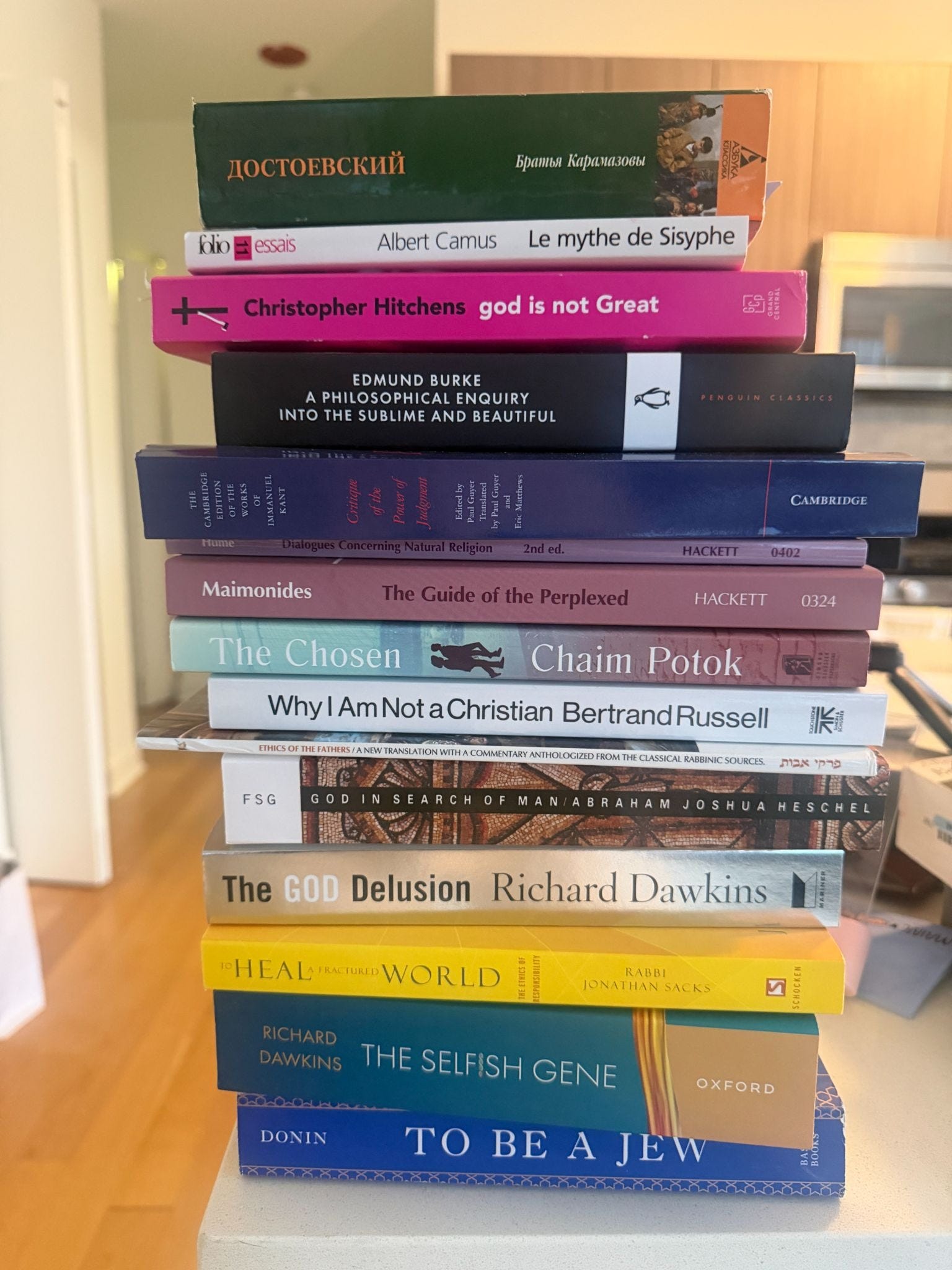
Any novel will require some basic research, but you’re welcome to do your research along the way rather than loading up on research before writing. I personally like to stagger my research and chapter-writing—I’ll read what I need to in order to craft my next chapter, and then I’ll return to my research until I have enough information to write the next one.
The Chapter Outline
Now you’re ready to start outlining your chapters!
I know some writers who don’t work with a full outline, and you don’t have to have every single chapter mapped out before you start writing.
For The Leverkühn Quartet and Blue Snow, I had every chapter meticulously planned before I started writing, but for The Lilac Room, I went into the first draft without knowing exactly where the novel was going to take me. I seem to have now struck a happy medium with The Brodsky Sisters: I have detailed outlines of 3–4 chapters ahead of my current chapter-in-progress and a general idea of the novel’s trajectory—but by no means have I worked out all of the minute details.
But whether you’re a careful planner or a more spontaneous artist, I would at least recommend having a running list of notes somewhere outside of your draft. I have a giant Brodsky Sisters master doc that I continually refer to in order to keep track of plot lines, character development, and ideas that come to me in the middle of the night.
The Muse
Before you start writing, you’ll need someone or something to guide you along the way.
For Dante, it was Beatrice. For Virginia Woolf, it was Vita Sackville-West. For James Joyce, it was Nora Barnacle. But your muse doesn’t have to be a person. It can be a piece of music, a work of art, a beautiful poem, or even a landscape.
Just bear in mind that your muse will stay with you throughout your writing process (perhaps longer than you’d like!), so make sure to pick a good one.
Who’s my muse? The ghost of Dostoyevsky.
Duh.
The First Draft
It’s time to start drafting!
Sitting down to write the draft is the most daunting part, but it doesn’t have to be.
I usually aim for a chapter a week, which means I’m churning out about 3,000 to 5,000 words every seven days. If your chapters are on the shorter side, that comes out to only 500 words a day—a paragraph or two.
In fact, if you’re writing 500 words per day, that’s only 200 days to complete a 100,000-word draft—less than a year!
Novel writing is less daunting in short chunks, and the good news is that you can always find time to hammer out 500 words a day if you put your mind to it.
Don’t worry too much about sounding perfect in the first draft—just keep writing so that you’re continually making progress. You can always come back and polish your sentences during the editing stages.
The Revisions
I’ll usually do one brief sweep of revisions after every chapter to clean up any obvious awkward phrases, but I leave all major revisions until after I’ve completed my first draft.
Once I’ve put the finishing touches on the last chapter of my first draft, I’ll go back and devote about a week to editing each chapter. At this stage, I might spend an hour or two on a single sentence until it sounds perfect; I’ll cut out extraneous details and elaborate on any scenes that need just a little bit more flavor. Finally, I’ll make sure that my themes and big ideas make sense throughout.
After this initial round of edits, I’ll typically go back and do one more sweep where I read my entire novel and clean up any outstanding plot holes or awkward phrases. At this point, I’m usually quite proud of the end product!
The End Game?
You might think that you’re done with your novel, but it’ll probably go through 17,000 more drafts before it gets published, so make sure that you’ve written the novel that you want to read rather than the novel that everyone else wants you to write because you will be reading that damn novel more than anyone else on the planet.
Even though you still have a long journey ahead of you before your novel hits the shelves, give yourself a pat on the back. You’ve written a book! That’s no small feat, and you should be quite proud.
I hope you’ve learned a little bit about writing a novel today, and I’m so excited to see where your writing journey will take you!
Best of luck on your novelistic pursuits!
Enjoyed this post? You can Buy Me a Coffee so that I’ll be awake for the next one. If you are a starving artist, you can also just follow me on Instagram, YouTube, or “X.”
Thank you so much for all of this! I am so sick of the elitist treatment and gatekeeping and snobbery in the publishing world. This is the most practical, no frills, do the work, substantive advice I've seen in a long time. Do you follow Steven Pressfield by chance?
I didn't know Mahler was your favorite composer, too. You have excellent taste.