


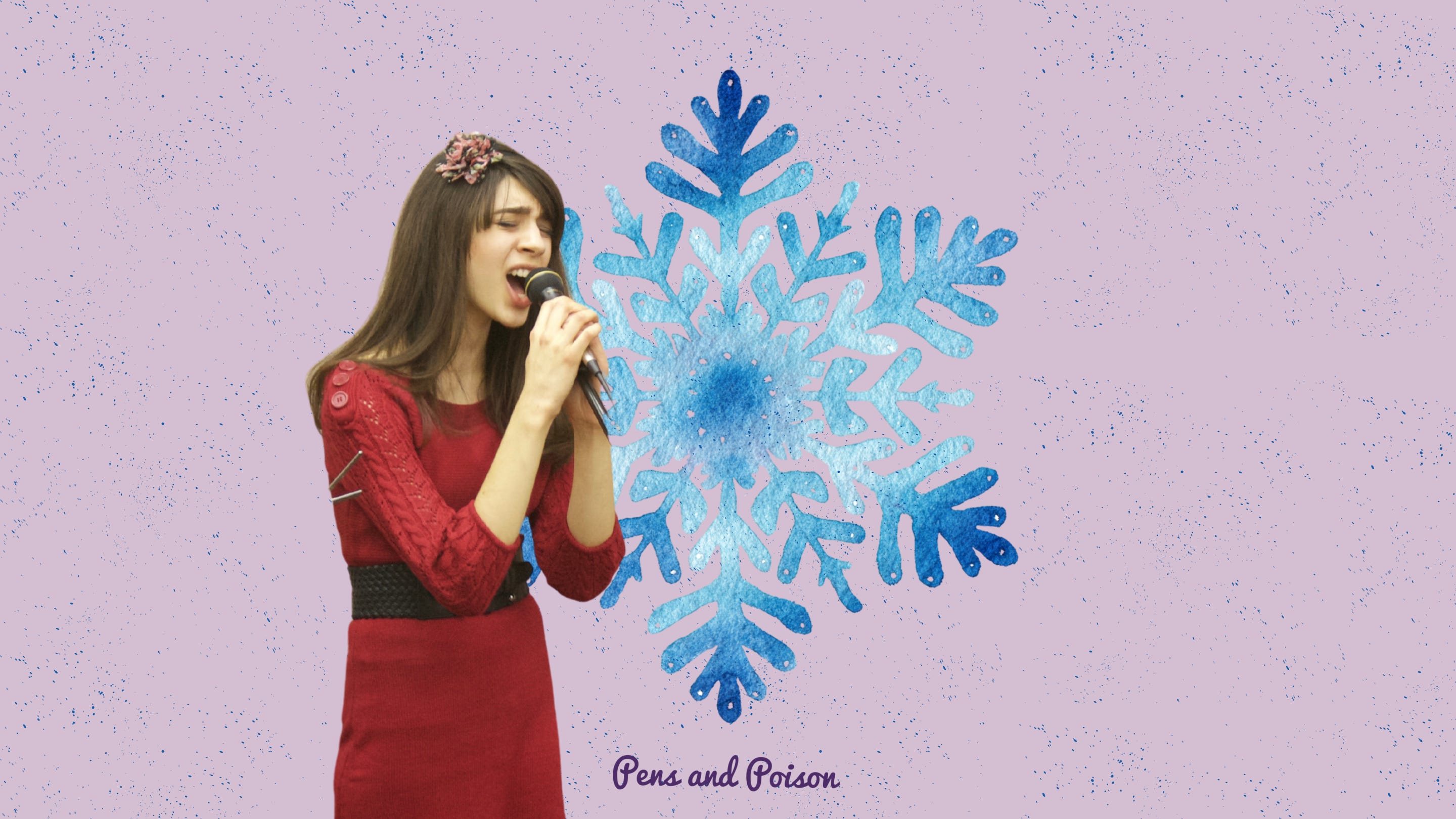
Sometime around 3 a.m. on Christmas night, I finished writing the final paragraphs of my latest novel, Blue Snow. That I already have a new novel in the works might come as a surprise to many of you who just finished beta reading my previous novel, and trust me when I say I am no less surprised. Just this past Thanksgiving, in fact, I didn’t even have the idea for Blue Snow; now, I am editing the third draft, which I am almost ready to send out to beta readers.
I suppose you can say that I have been unexpectedly visited by the muses.
I can’t wait to share Blue Snow with a select group of early readers here on Pens and Poison, but before we proceed, a caveat is in order.
(If you’d like to skip the backstory and jump straight to the beta reader sign-up form, you can scroll immediately to the “Sign Up to Beta Read” section at the bottom, where it will be waiting for you!)
The Birth of Blue Snow
If you read my first two novels, The Lilac Room and The Leverkühn Quartet, you might be somewhat thrown off by Blue Snow, which is a different beast entirely. The novel follows the successful yet emotionally unstable indie-pop star Mia Rozen, who is stuck in therapy because she can’t stop thinking about a man named Teddy. The problem, she tells her therapist, is simple: without Teddy, she can no longer write music.
Through a series of confessional therapy sessions, Mia reconstructs her past with Teddy and the events that led to the splintering of her career, coming to terms with her mistakes and sins as she decides whether she is willing to continue mining the chaos of her past for the sake of art—or whether choosing peace and adulthood will require surrendering the version of herself that made her an artist in the first place.
On the surface, the themes are somewhat similar to the themes I explored in my previous novel, The Leverkühn Quartet: female desire, the cost of artistic obsession, and the ineffable chaos of life in New York City. The execution, however, is quite different.
My first two novels—The Lilac Room and The Leverkühn Quartet—implicitly follow in the footsteps of the longstanding Western literary tradition. The Leverkühn Quartet, especially, is a retelling of Thomas Mann’s Doktor Faustus; Mann’s Faustus, in turn, is a retelling of Goethe’s Faust, which itself borrows source material from Marlowe’s Doctor Faustus; Marlowe’s Faustus is, of course, based on an age-old German legend. In Leverkühn, I consciously echo Mann, which lends the novel an early twentieth-century aura: the style is somewhat restrained, the conflicts are largely interior, and the chapters are littered with philosophical reflection.
But after about a dozen agents read the full manuscript, the consensus was clear: the book is too “philosophical” to sell, with many agents suggesting that I cut out the philosophy entirely.
The Lilac Room faced similar issues. While the “hook” itself was somewhat more commercial, the novel is fundamentally a critique of utilitarianism, and without its philosophical digressions, it loses its main message. I had two agents offer to sign me for The Lilac Room before mysteriously ghosting, with one of these agents keeping me on a hook for months before announcing that he simply didn’t know how to sell the book—he could not identify a single comp title that satisfied him because the novel does not fit into a neat box: its philosophical musings are set against the backdrop of New York corporate life, it follows a loose mystery plot in the vein of Eyes Wide Shut, and it is at once about startup culture and Nietzschean ethics.
In a word, the agent simply didn’t know what to do with it.
So one of my novels was too philosophical; the other did not fit tidily into a marketable category. That was all fine, but there was one critique I got from agents across the board that drove me the most insane: my books would not appeal to a Gen Z audience.
Now, this might not have been a problem if I were a fifty-year-old woman writing books about older women for an older crowd, but because I am Gen Z, I happen to write characters on the younger side—primarily because I do not yet know what it is like to be fifty. That said, I fundamentally reject the premise that literature must only appeal to a certain age group and find this constraint somewhat ludicrous. I recently reread Catcher in the Rye, for instance, and loved it just as much at 28 as I did when I was 18—nd I am certain that I will also love it at 78. The idea that a work of literature should be marketed for a certain age range seems to defeat the purpose of literature itself.
The best part of all of this is that I have robust demographic information from Substack and other social media that demonstrates that my audience skews older. What this means is that even if we were to market by age, it makes no sense for me to try to write a book for young people because young people are not reading my work to begin with.
The way the publishing industry works, however, is that if you write characters in their twenties, then readers must also be in their twenties because readers must always relate to the characters in question. On that note, the other critique I consistently received was that agents did not “relate” to my characters. I am not quite sure what that is supposed to mean because I don’t think that one must necessarily relate to a character in order to understand him—certainly, I do not “relate” to Rodya Raskolnikov in any meaningful way—but I soon learned that if I wanted any hope of being published, I would have to write Gen Z characters who are “relatable” to a Gen Z audience.
All of this is a rather long-winded explanation for the fact that—against all odds—I have come out with a book, as my grandmother aptly put it, “for the youth.”
Therefore, I will not pretend that I wrote this novel without the publishing industry in mind. The writing style is more conversational, the subject matter is more straightforward, and the tropes—sex, mental health, female desire, male commitment issues, pop culture—are as trendy as they get.
But despite all of this apparent kissing up to the publishing industry, I walked away from Blue Snow on that Christmas night with an unexpected epiphany: this might be the best book I’ve ever written.
Trust me when I say that I came into this novel thinking that I was going to have to write something ironic just to get published. My previous two novels came after a whirlwind of life experiences: The Lilac Room drew heavily on my work with my startup Invictus Prep, and The Leverkühn Quartet explored my frustration with the ugliness of modern art and my eternal struggle with religion. When I started Blue Snow, on the other hand, not only did I not have a specific life experience in mind—my life has been rather quiet for the past year or so—but I also had no idea what I could possibly write another novel about. I was aware of the “trendy” topics I felt I needed to address in order to get published—sex, therapy, and popstars—but those were the last topics I ever thought I’d touch in any of my writing, and I had no idea how I was going to explore them while still retaining my artistic integrity. After all, if I wanted to write a sell-out Fifty Shades of Grey novel, I could have done so ages ago.
But no—this was not going to be a sell-out novel. I was determined to make this my best novel yet.
And the more I wrote, the more I realized I could still put a little of myself into a book about Gen Z relationships. Chapter two, for instance, is sprinkled with references to Dante and Nabokov; my protagonist is best friends with an Italian poet who sets out to write his own versions of Ezra Pound’s Cantos; songwriting, I quickly learned, shared many similarities with poetry; sex and desire could be explored through the poems of Catullus. All of these ideas make their appearance in my latest novel Blue Snow, which I could not be more proud of.
So maybe I should thank publishing industry professionals and their somewhat asinine standards because without them, I would have never tried to write a Gen Z therapy novel about a popstar who’s obsessed with sex. I would have never had to step out of my comfort zone and write a book with 391 instances of the word “fucking” (though this might be pared down in later drafts). Certainly, I would have never had to turn on my creative brain and put a “Liza” spin on a set of topics I originally thought would constrain me. I would have never developed the distinct sardonic voice through which Mia narrates her therapy sessions, and I certainly wouldn’t be so excited to share my latest novel with all you today.
Sign Up To Beta Read Blue Snow
In the hopes that 2026 is finally my year, I can’t wait to query Blue Snow. But I’ll need your help to get it to the finish line.
To avoid chaos (I had enough of that while writing the book), I am opening this initial round of beta reads to paid subscribers, who will have exclusive access to the full novel as a thank you for supporting Pens and Poison.
If Blue Snow sounds interesting to you, then this might be your calling to snag that Pens and Poison subscription. I will also be sending out $25 gift cards as a thank you to all beta readers, so your $7 donation to Pens and Poison will easily pay for itself.
Thank you again for your support of Pens and Poison. I’m so excited to get Blue Snow out to everyone soon!