


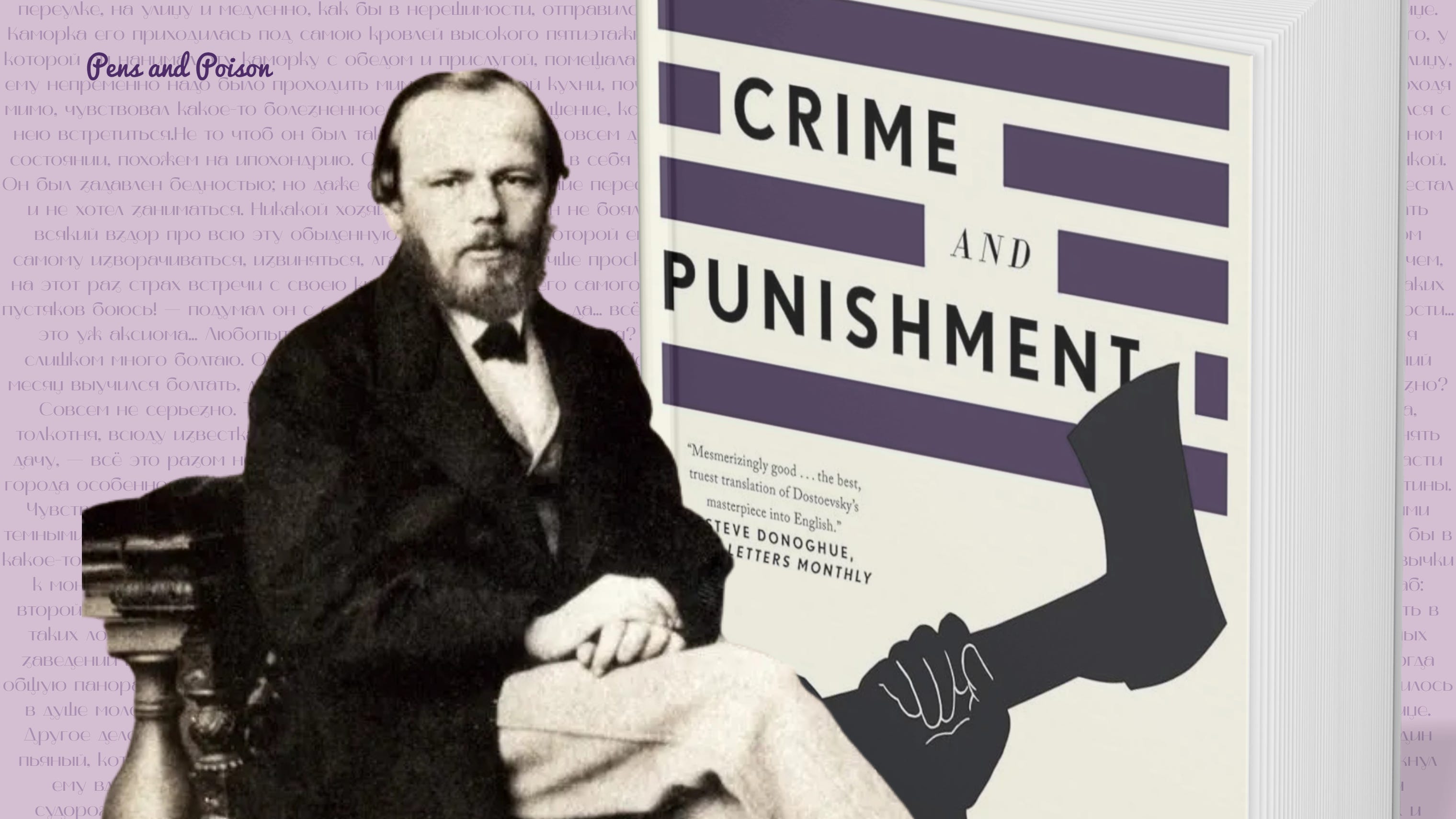
One of the most common interpretations of Crime and Punishment is also one of its greatest misreadings.
When I studied Crime and Punishment at Columbia, we focused on Raskolnikov’s abject poverty, his relationship to masculinity, and the anguish that plagues him throughout the book.1 Though these themes do make an appearance in the novel in one way or another, they don’t even scratch the surface of the central question of his most monumental work: Why does Raskolnikov commit murder?
The modern university and the contemporary literary establishment often treat Crime and Punishment as a novel about poverty, oppression, and inequality. According to this reading, Raskolnikov kills the pawnbroker because he has no other choice. Reduced to nisheta—a Russian word that suggests extreme poverty to the point of moral degradation—Raskolnikov acts out of desperation. Proponents of this reading often turn to the novel’s epilogue, where nisheta is cited as Raskolnikov’s primary motive, but curiously enough, Raskolnikov himself rejects this explanation. Earlier in the novel, in fact, he explicitly tells Sonya that his crime was not done to feed his family—and that it had nothing to do with money. Indeed, had Raskolnikov’s crime been economically motivated, we might have expected him to use at least some of the money he took from the pawnbroker for the greater good of society—or at least to help out his mother and sister. Instead, he hides the money and leaves it untouched. These circumstances stump the jury at his trial; nevertheless, they conclude that Raskolnikov had good intentions and commute his sentence.
It is still tempting to conclude that Raskolnikov’s crime is economically motivated: the reason we say sympathize so much with Raskolnikov, one might argue, is that he lives in an unjust society that has made such a murder practically inevitable—after all, what else could he have done to feed himself? Such readings often turn Crime and Punishment into an explicitly political novel that conveniently serves contemporary left-wing or even Marxist causes, inviting, for instance, comparisons between Raskolnikov and Luigi Mangione: both men were justified, these readers will claim, in sacrificing a single individual for the greater good of society.
But what such Marxist apologists often miss about Crime and Punishment is Dostoyevsky’s deeper exploration of human psychology. Indeed, Raskolnikov’s crime is philosophically rather than economically motivated, and Crime and Punishment is more a novel about morality than it is about poverty and oppression.
But if Raskolnikov’s crime isn’t motivated by poverty, then what is his motivation?
To answer that question, we must look beyond the economic circumstances of nineteenth-century Russia and toward the intellectual currents that shaped both Raskolnikov and his creator.
Dostoyevsky was a military engineer before he became a writer, but prior to military school, he attended a French boarding school, where he developed a love for French literature. His first literary project, in fact, was a translation of a lesser-known Balzac novel into Russian, and though the book flopped upon its release, he spent the next several years of his life enamored both by French culture and the progressive ideas coming out of the French academy. In his mid-twenties, he discovered the writings of Charles Fourier, the founder of utopian socialism, and Pierre-Joseph Proudhon, the so-called “father of anarchism.” Around the same time, he joined an underground literary group called the Petrashevsky Circle whose founder was a known disciple of Fourier.
Fourier’s utopian philosophy shared a fundamental core with the utilitarianism of Jeremy Bentham, who believed that the morality of a given action must be judged according to whether it increases the sum of human happiness, which, in turn, would lead to collective social harmony. Though Dostoyevsky was actively involved in Petrashevsky’s secret society, he was skeptical of the utilitarian idea that individual human beings could be sacrificed for the greater good of the collective, and it was this doubt that would eventually become the primary philosophical question of his two early great works: Notes from the Underground and Crime and Punishment.
The following year, members of the Petrashevsky Circle were sentenced to death for conspiratorial activity, and Dostoyevsky prepared to meet his fate in front of a firing squad—that is, before an incoming letter from the tsar saved his life. Pardoned, he was sent instead to exile in Siberia, where, much like Raskolnikov, he turned to religion and developed deeply religious tendencies. Transformed by his near-execution, he embraced Christian morality over abstract intellectual theories and espoused individual human beings over the collective abstraction of “humanity.” His transformation is famously captured in the final pages of Crime and Punishment: “Instead of dialectic, there was life.”
Following his release from prison, Dostoyevsky set out to challenge utopian socialism through literature.
While his later novel Demons tackles the intricacies of his early revolutionary days and the ills of Russian nihilism, his first great novel, Notes from the Underground, directly attacks utopian socialism through the musings of the Underground Man, who rejects utilitarianism’s “mathematical consciousness” and instead draws attention to the complexities of human nature. A direct response to Nikolai Chernyshevsky’s 1863 novel What is to Be Done?, Notes from the Underground critiques socialism’s central premise that human beings are rational creatures who can mathematically organize society for the greater good of the collective. Instead, according to the Underground Man, people deliberately act against their own interests and frequently desire freedom over happiness.
It is this attack on the utopian “mathematical consciousness” that lies at the heart of Crime and Punishment, which builds on many of Dostoyevsky’s ideas in Notes from Underground. But unlike the Underground Man, who rails against the utopian “mathematical consciousness,” Raskolnikov embraces it.
We first learn of Raskolnikov’s true motives in Chapter 5 of Part 3, where he and his friend Razhumikhin visit the police inspector Porfiry Petrovich.
Exasperated by the socialists at his housewarming party the previous night, Razhumikhin dismisses the utopian premise that crime is the natural consequence of an unjust and “abnormal” society. “They believe that a social system that has come out of some mathematical brain is going to organise all humanity at once and make it just and sinless in an instant, quicker than any living process!” he exclaims. Like the Underground Man, he observes that progressive socialists are quick to dispense with human nature and is skeptical of the assumption that the total eradication of poverty would lead to a thriving utopia. In attacking the Petrashevsky Circle’s philosophies, Razhumikhin thus becomes a stand-in for Dostoyevsky’s own ideas.2
But what is even more important to understanding Crime and Punishment’s overall message lies in one of the final observations in Razhumikhin’s monologue.
Razhumikhin tells us that the socialists believe that “the soul is retrograde.”
This characterization paints the most lucid picture of Dostoyevsky’s own convictions: the progressive nineteenth-century consciousness has lost sight of the human soul.
And that is precisely why Raskolnikov is driven to commit murder: he is spiritually homeless.
Indeed, Raskolnikov can no longer find meaning in his surroundings and therefore becomes easily susceptible to a tidy, hyper-rational way of thought. In his infamous article, he argues that there are so-called “ordinary people” and “extraordinary people,” and that the latter group holds the power to rise above the law for the promotion of the greater good. He repeatedly cites Napoleon as an example and argues that Kepler and Newton would have been morally justified in killing a dozen or so people if it meant that their ideas would benefit the rest of humanity.
This is the mathematical consciousness that Razhumikhin describes earlier in the chapter: the idea that each individual life has a set value, and that some lives are more valuable than others. Under this paradigm, each individual human action becomes nothing more than a series of calculations: Raskolnikov is justified in killing a woman who supposedly has no value to society—whom he repeatedly calls a “louse”—because her demise would theoretically benefit a great number of people.
But as Dostoyevsky will demonstrate by the end of the novel, that’s not quite how it works.
It is no accident that Dostoyevsky makes Raskolnikov into a student who expresses his ideas in an article: he wishes to show us that ideas developed in an intellectual vacuum often fall apart when brought into the context of the real world. The pawnbroker’s life might be useless to Raskolnikov in the abstract, but in reality, she is an individual human being with a living soul.
Crime and Punishment therefore protests against the utilitarian psychology that would soon infest not only Soviet Russia3 but also the more radical wings of our contemporary Western world. By analyzing the social movements of nineteenth-century Russia, Dostoyevsky masterfully predicted the eventual catastrophe of the Soviet Union and the “mathematical consciousness” that would lead to the loss of millions of lives in the name of greater social good.4 But what is even more astonishing is the extent to which Dostoyevsky anticipated the moral catastrophe of an ongoing radical leftist human experiment: when you can reduce humanity as a whole to an abstract mathematical equation, individual human lives become expendable.
Crime and Punishment is thus not a novel about poverty or income inequality but about the moral implications of a murder that’s supposedly done for the greater good—and about the dangers of utilitarianism. After all, Raskolnikov doesn’t kill the pawnbroker to feed his family or the world around him—he doesn’t even necessarily kill her because he believes that her life is worthless and that society would be better off without her. He kills the pawnbroker to prove a point to himself that he is one of these “extraordinary” people. In this way, Dostoyevsky masterfully highlights the arrogance and egoism that underpins a supposedly selfless and morally upright philosophy.
The catch is, of course, that Raskolnikov is not extraordinary in the least. Though Raskolnikov initially feels justified in defying moral law, as the novel progresses, he increasingly becomes sickened by his own philosophy and eventually confesses to his murder, learning that no one is above moral law and that innocent people die when you lose sight of the individual soul.
It is this idea that often makes modern progressive readers uncomfortable with the novel’s epilogue, which rejects the “mathematical consciousness” of Dostoevsky’s utopian contemporaries and challenges the Marxist “oppression” reading that is so popular on university campuses today. After all, if the novel were about the ills of Raskolnikov’s nisheta and the good intentions that underlie his murder, then we might expect the novel to end at the trial, where several witnesses testify to Raskolnikov’s morally upstanding character. If the novel were merely about the guilty conscience that accompanies Raskolnikov’s morally gray yet justifiable murder, then we might expect the novel to end after Raskolnikov’s confession—or, at the very least, we would witness Raskolnikov’s emotional recovery shortly after he turns himself in.
But the fact is that even after his confession, Raskolnikov continues to feel spiritually empty.
Confined to the Siberian prison camp—the katorga—he wonders how his fellow prisoners find meaning in their ordinary surroundings: “a ray of sunshine, the primeval forest, the cold spring hidden away in some unseen spot.” He laments the missed opportunity to kill himself like Svidrigailov and is disgusted by the idea that he’ll be free at 32 and will have nothing even then to live for.
But then Sonya pays him a visit.
It is at this point that Dostoyevsky delivers one of the most beautiful lines of the entire novel: Их воскресила любовь. They were resurrected by love.
The word choice here is critical: love doesn’t simply renew or inspire them—it resurrects them like the ailing Lazarus. Religion—channeled through Sonya’s love—becomes the primary vehicle through which Raskolnikov attains redemption for his sins. Life takes the place of dialectic in his consciousness, and all of a sudden, Raskolnikov feels that his fellow prisoners are more kind to him and that life is worth living again. The seven years that remain of his sentence feel like seven days because he suddenly finds meaning in his life again.
Raskolnikov regains the will to live because he finds beauty in the individual human soul.
Crime and Punishment is therefore not a novel about how the poor are oppressed by the rich or how extreme circumstances may justify certain violent actions—as many leftists will have you believe—but a novel about the value of the individual human soul, a book that explores the power of individual agency, and a beautiful encomium on the power of redemption. Raskolnikov commits murder not because society fails him but because he wishes to test a theory that strips him of a fundamental human element. Yet throughout the novel, Dostoevsky demonstrates that human beings cannot be reduced to theories or historical abstractions but that each and every one of us has value because we each possess a unique soul.
Crime and Punishment leaves us, therefore, not with a political but with a deeply spiritual and human message: when we lose sight of the human soul, people become reduced numbers, and when people are reduced to numbers, then individual lives lose meaning and value.
But there is hope yet for our society, argues Dostoyevsky, because each and every one of us can find redemption if we find meaning in the individual human soul, the wonders of the ordinary world, and the people we cherish most.
Enjoyed this post? You can Buy Me a Coffee so that I’ll be awake for the next one. If you are a starving artist, you can also just follow me on Instagram, YouTube, or “X.”
A few weeks ago, I dove into why the word “anguish,” which appears frequently in many English translations, incorrectly characterizes Raskolnikov’s psychology.
Razhumikhin’s name, in fact, translates to “common sense,” which Dostoevsky intentionally contrasts with “rationality.”
Unsurprisingly, Lenin’s most famous pamphlet What is to be Done? borrowed its title from Chernyavsky’s problematic utopian novel.
There’s another lesser-known novel called Darkness at Noon by Arthur Koestler that addresses Crime and Punishment’s core questions in a Soviet context. Koestler calls Dostoyevsky’s mathematical consciousness “vivisectional morality”—the idea that humanity is one giant scientific experiment—and explores how it provided the justification for many of the Soviet Union’s crimes. I wrote a study guide for the book back in the day that you can access here.
I enjoyed this piece, especially your emphasis on Raskolnikov’s desire to test whether he was one of the “extraordinary” people. I agree that many contemporary readings flatten the novel into a story about poverty and oppression alone.
At the same time, I wonder if something important gets lost when the discussion becomes primarily a dispute about political interpretations.
What has always struck me about Dostoevsky is that his concern was never simply with bad ideas. It was with human suffering and the possibility of redemption. That concern runs through House of the Dead as much as Crime and Punishment.
I also wonder whether the “extraordinary man” theory is even more ironic than your essay suggests. Raskolnikov thinks he is testing whether he is one of the rare people who can stand above ordinary morality. But by the end of the novel, Dostoevsky seems to move in almost the opposite direction. The problem is not that Raskolnikov thinks he is extraordinary. In a sense, every human soul is extraordinary. The mistake is believing that this uniqueness exempts him from moral responsibility rather than deepening it.
Raskolnikov wants to be Napoleon. Instead, he discovers that he is simply himself, responsible for what he has done, unable to escape guilt through theory, and in need of redemption. That strikes me as one of the deepest ironies in the novel.
In some ways, I think Dostoevsky’s critique of ideology grows out of this larger concern. He worried about political theories not simply because they were politically mistaken, but because they could cause us to lose sight of the suffering and dignity of actual human beings.
That’s why the novel still feels so alive to me. The politics are there, but they are ultimately in service of a larger question: what happens to a human soul, and what might redeem it?
Honestly, if people misread it as that, it makes me wonder if they even read the book. Like I understand it’s a tough read, especially for your average person, but he says multiple times throughout, that it was to see if he was extraordinary, and that if he can get away with it, it will prove that.