


It’s no secret that Russian is notoriously difficult to translate into English—and the works of Fyodor Dostoyevsky are no exception. Since the first English translation of Crime and Punishment appeared in 1886, over twenty different interpretations of Dostoyevsky’s most famous novel have made their way into the Anglosphere, establishing Crime and Punishment as one of the most retranslated books in literary history.
But what entices translators to keep revisiting a novel that now exists in more than twenty English iterations?
Perhaps it’s the recognition that no translation of Crime and Punishment will ever fully capture the spirit of the original.
Indeed, we need only look at Dostoyevsky’s portrayal of Raskolnikov in the novel’s early stages to apprehend several linguistic idiosyncrasies embedded in the Russian text. Part of Dostoyevsky’s genius lies, after all, in his ability to capture the inner lives of his characters, and nowhere is this psychological mastery more apparent than in his description of Raskolnikov’s mental state in the days leading up to the murders. One cannot comprehend why Raskolnikov—a seemingly moral and otherwise rational human being—is led to commit two such atrocities without first understanding the nature of his peculiar spiritual condition.
Most English translations will nonetheless misrepresent that very condition because of one fundamentally untranslatable Russian word.
Towards the end of the novel’s opening chapter, Raskolnikov leaves the pawnbroker’s apartment and tarries in the street in “anguish” before dashing into a pub—or so you’d think from reading the book in English. The problem, however, is that the “anguish” Raskolnikov experiences in nearly every English translation is not anguish at all—it is something far more upsetting.
In English, the word “anguish” suggests agony, suffering, or torment, and while Raskolnikov does indeed experience these emotions in the early chapters of the novel, the English word “anguish” carries a far more frantic emotional charge than its Russian counterpart.
Before we dive into this elusive word itself, let’s take a look at four different translations of the passage in question.
Constance Garnett:
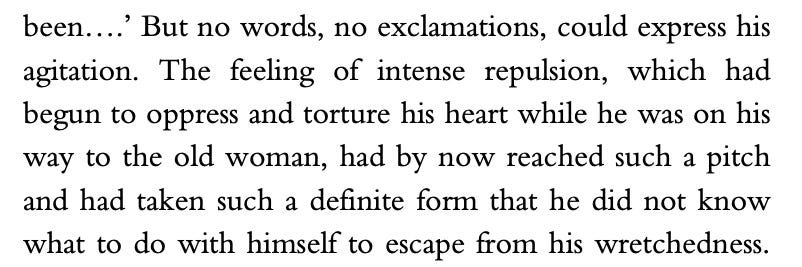
Pevear & Volokhonsky:

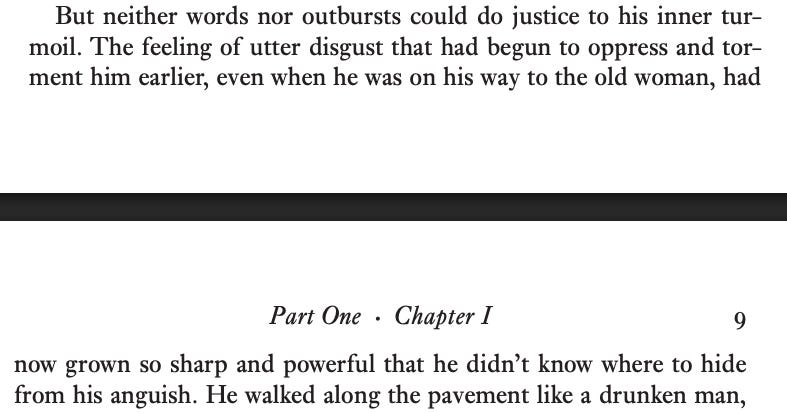
Nicolas Slater:
Oliver Ready:

Taken together, these translations paint a remarkably consistent picture of a man consumed by both agitation and anguish. In each of these English versions, therefore, we sense that Raskolnikov is in a frenetic and almost manic state. Reading these English versions of Crime and Punishment, I picture a character standing in the middle of the street ready to tear his hair out or perhaps break into a panicked sweat; I imagine a man collapsing under the weight of the world without any means of escape.
But let’s take a look at the passage in Russian:

If you speak Russian, you’ll immediately read Raskolnikov in a completely different light. The word that most translators render as “agitation” (волнение) comes from our word for “wave” (волна). We typically use “волнение” to express a certain torment of the soul, and, in fact, the Russian dictionary defines the word as “душевное беспокойство,” which literally means “worry of the soul.” In other words, Raskolnikov feels a sort of spiritual disturbance rather than a sense of agitation or frustration.1
Yet the second of the two key concepts in this paragraph—“anguish”—is even more perplexing from a translation perspective.
The Russian word for Raskolnikov’s supposed “anguish” is тоска (toska). It appears six times in the first four chapters alone in reference to our protagonist’s early mental state and is therefore crucial to understanding the nature of his psychological disturbance.
To fully apprehend the meaning of toska, let’s turn to our friend Vladimir Nabokov. Despite his infamous hatred for Dostoyevsky, Nabokov perhaps understood his literary predecessor better than any other writer of his time:
No single word in English, writes Nabokov, renders all the shades of toska. At its deepest and most painful, it is a sensation of great spiritual anguish, often without any specific cause. At less morbid levels it is a dull ache of the soul, a longing with nothing to long for, a sick pining, a vague restlessness, mental throes, yearning. In particular cases it may be the desire for somebody or something specific, nostalgia, love-sickness. At the lowest level it grades into ennui, boredom.
Toska, then, is not the sort of anguish that denotes a disturbed or frenzied state; rather, it connotes a deep spiritual yearning perhaps closer to nostalgia.
I like to think of toska in the following terms.
Imagine you’re sitting at your kitchen table staring out the window. It’s raining, and you see a little bird flapping its wings yet struggling to fly. Maybe it’s a Friday night, and you have no plans for the evening, and suddenly, you start to empathize with that bird—before realizing, of course, that it cannot understand you, and you cannot understand it. Yet despite this fundamental disconnect, the bird, you grow convinced, is somehow your kindred spirit. You get up from the table and brew yourself a cup of tea before resuming your seat, watching the raindrops sliding down your windowpane for the next twenty minutes. You don’t know what in particular has upset you, but you know that the rest of the evening—and perhaps the rest of your week—is ruined.
You fall into a muted melancholy before retreating to bed.
That’s toska in a nutshell.
Raskolnikov, therefore, isn’t alarmed or upset—he is, above all, spiritually homeless.2
In fact, toska itself is couched inside the phrase “он не знал, куда деться от тоски своей.” Contrary to what several of the above translations may suggest, this phrase doesn’t necessarily mean that there was “no escape” from his anguish, which points to a certain inevitable doom, but rather that Raskolnikov doesn’t quite know where to go or what to do with himself. Dostoyevsky therefore paints a portrait of a man who has grown nauseated in the Sartrean sense, burdened by the weight of his own existence.
Of the four translations above, only Garnett’s accurately captures the spirit of the original: “he did not know what to do with himself to escape from his wretchedness.”3 While the other translators render the phrase in terms of “no escape,” suggesting an uncontrollable external force at play, Garnett manages to convey the internal nature of Raskolnikov’s conflict, emphasizing one of Crime and Punishment’s core ideas: Raskolnikov has trapped himself inside a conflict of his own making. He is not merely suffering but estranged from his own self. The difference may seem subtle, but it amounts to the difference between a man driven by panic and one driven by existential homelessness. The former is manageable; the latter is catastrophic.
So while no translation will ever perfectly capture the meaning of toska, perhaps that’s just the point of Dostoyevsky’s great work. Some words resist translation because they emerge from a particular culture’s way of experiencing the world. In this case, Russian gave Dostoyevsky a word for a feeling that does not exist in English.
Perhaps that’s precisely why translators keep returning to Crime and Punishment: buried inside that untranslatable “toska” is a more universal truth about an entire subset of people.
So how do we translate toska?
I propose the following solution.
Future translators ought to render тоска as “toska” in the English text and leave a footnote with an explanation of this untranslatable Russian word. Whenever it appears in the text thereafter, readers will not only be familiar with the connotation of the word but will also attain a unique window into the nature of the Russian soul.
But until someone comes out with such a translation, I suppose the Constance Garnett version will have to do.
Enjoyed this post? You can Buy Me a Coffee so that I’ll be awake for the next one. If you are a starving artist, you can also just follow me on Instagram, YouTube, or “X.”
Slater’s “turmoil” is thus closer to “волнение” than the “agitation” in the other three translations.
A Mahler Lied captures this feeling best in German: Ich bin der Welt abhanden gekommen (I have been lost to the world).
As an anthropologist, this essay resonated deeply with me.
What struck me is that the difficulty of translating toska is not simply a problem to be solved. In fieldwork, I’ve often found that the places where translation fails are the places where understanding begins.
When a word translates easily, we learn relatively little. But when speakers keep reaching for examples, metaphors, stories, and approximations—and still feel that something essential has been missed—we may have encountered a concept embedded in an entire way of experiencing the world.
Anthropologists often discover that the challenge is not finding the right word in English. The challenge is that the word exists within a larger semantic and cultural structure that has no direct equivalent. A translation can capture the dictionary meaning while losing the world that produced it.
What I especially appreciated about your discussion of toska is that it points beyond Russian literature to a broader question: what do we learn from concepts that resist translation? Sometimes those “untranslatable” words are among the most valuable clues a culture gives us about itself. They reveal distinctions, experiences, and forms of life that our own language may not have taught us to notice.
In that sense, the translation failure is not an obstacle. It is ethnographic data.
Thank you for a thoughtful piece.
What an excellent discussion that covers so much ground. So much of this novel is about the humiliation of despair which remains alienated even from the person, much like that bird and the tear-like rain streaking the window.