


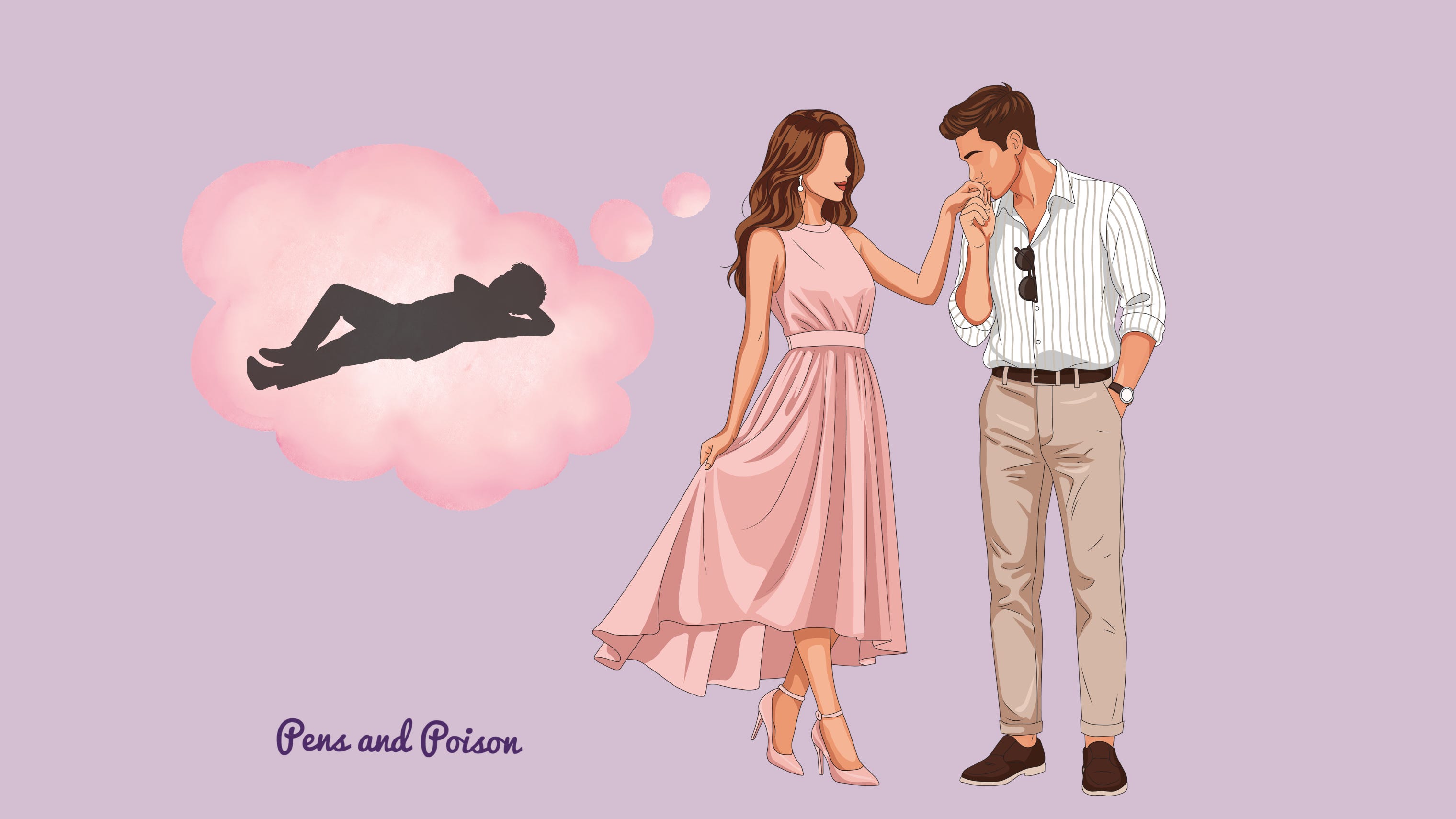
“The secret to a great marriage,” says E.J. Dickson in a viral The Cut article from earlier this month, is having “crushes on other people.”
I’m going to go out on a limb here and say that I don’t think it is.
I’m still young and unmarried (though that’s changing in a few months), so while I may not have the authority to comment on the “secret to a great marriage,” I’m the same age as several of the women Dickson cites in her piece.
So if these morons are out here womansplaining relationships to other people, I see no reason to sit this one out.
So let’s go through why Dickson is completely delusional—and why having “crushes on other people” while you’re married is most certainly a bad idea.
Dickson begins her piece with an anecdote about an office crush named Phil. She describes sprucing herself up for Zoom calls and the “little frisson of nervous energy” she experiences whenever she’s around him, comparing him to a “swarthier Jake Gyllenhaal.”
Her husband not only knows about all of this but sees no issue with her behavior.
“I did not, and do not, know Phil well,” Dickson writes, “by the time we stopped working together, we’d maybe exchanged 40 words in total, the vast majority of which were about Steely Dan. But my husband, to whom I have been married for almost ten years, heard about him every once in a while.”
I don’t know what I hate more—this woman’s choppy writing style or her deplorable outlook on human relationships.
Worse still is her conviction that having a crush on someone while married is some sort of entertaining hobby.
“If your partner has a face with eyes and ears, and has not been chemically castrated,” she says, “of course they’re going to find other people attractive. Why be dishonest about it — especially when it provides an opportunity to talk about anything other than this week’s grocery list or parent-teacher-conference schedules?”
Are these people crazy? Were they born yesterday? Are we supposed to share our every intrusive thought with every person around us? On the contrary, it is our duty as civilized human beings to develop intuitions that help us discern which thoughts are worth putting into words and which thoughts we are better off keeping to ourselves. In this case, not every thought or impulse is equally as valid as the next—and some may even hurt the people closest to us.
But Dickson doesn’t seem to care about hurting someone close to her—in fact, I would venture to say that it doesn’t appear that her husband is close to her at all: she describes him as “the sexiest person on the planet” but does not once comment on the redeeming factors of his character. It is no wonder that she feels the need to develop attachments to other people—her marriage is ostensibly based on lust. Just take a look at her line about groceries and parent-teacher conferences: she is so emotionally distant from her husband that their conversations have little substance. Of course she’s excited to fantasize about Phil—she doesn’t realize that there could ever be a middle ground between grocery shopping and “I want to schtup my coworker.”
But perhaps we shouldn’t expect much else from a woman who proceeds to craft her foibles into an adultery manual for women—and who somehow thinks that this is a good idea:
“The ideal crush should be someone from whom you have a fair amount of emotional distance (e.g., the local barista/diner waiter) but who still gives you “butterflies.” (If it’s someone you interact with regularly, or text on the side, or who actively threatens the parameters of your relationship, then that’s probably something you need to assess.)”
Don’t worry, guys—it’s okay if it’s someone at a reasonable distance!
Is it, though?
As adults, we rarely fixate on someone who barely knows we exist—this isn’t middle school, after all. In the majority of cases, we develop crushes in the wake of some baseline emotional connection or mutual exchange—and therein lies the danger. Any emotionally charged interaction—even at some “distance”—always runs the risk of turning into something more. Literature, for one, abounds with such examples—Anna Karenina, Ethan Frome, and Madame Bovary—and the result is almost always that someone gets hurt.
But the most telling piece of Dickson’s article is the following prescription:
“A crush should be like writing something vulgar in the condensation of a car window on a chilly day. It’s juvenile. It’s ridiculous. It reminds you not to take yourself too seriously.”
Therein lies the greatest issue both with Dickson’s worldview and our society at large: we have completely stopped taking things seriously.
Marriage was once the most important decision every one of us would ever have to make. Today, however, when fake diamond rings can now be purchased for $50 a pop and when almost every other marriage ends in a divorce, marriage proposals no longer hold much weight, and matrimony has lost its solemnity. It’s no wonder that everything has to be a reminder “not to take yourself too seriously”—serious commitment itself has become nothing more than a farce.
Furthermore, there’s nothing “ridiculous” or “juvenile,” about infidelity—and there’s nothing amusing about engineering crushes for yourself because you and your husband have nothing else to say to one another.
That’s quite sad, actually.
I do not mean to suggest that extramarital crushes never happen to good people or that we should shame anyone who has ever experienced unexpected butterflies. These initial feelings are often beyond our control, and at the end of the day, we all make mistakes. What matters, however, is what we choose to do with those feelings. Rather than celebrating them, we should feel guilty about them. Because at the end of the day, guilt is simply there to save and protect us. It’s the surest way, after all, to renew your loyalty to your spouse and become a better person after having experienced conflicting yet very human feelings.
So while there is no shame in experiencing extramarital desire on its own, spinning that desire into a virtue—like Dickson does in her article—creates an amoral “everything-goes” mentality where nothing means anything anymore. And in a society where everything has to be “explored” or “celebrated,” we’ve forgotten that marriage used to mean a lot to a whole lot of people, and that there is a reason that monogamy requires choosing one person and renouncing all others. Marriage is holy precisely because of its exclusivity: we do things with our spouses that we would never dream of doing with anyone else—and it is that very scarcity that makes us feel loved.
The response, then, to developing an illicit crush should not be to run to your spouse and to tell them all about your fantasies but to remember why you fell in love with your special person in the first place. If they are no longer special to you, then by all means abandon your marriage—but don’t pretend that there’s anything virtuous about seeking validation from another person. And if you simply can’t restrain yourself, then it is your duty to remember the vows you made on your wedding day and to renew your allegiance to both your spouse and to your own self. Because marriage is not only a continual series of sacrifices for the greater good of two people but also a bond whose magic lies in loyalty.
The quicker we learn to take these bonds seriously, the quicker our society will heal.
As for E.J. Dickson, it sounds like she may need to find some hobbies that do not appear in the letters of her name.
Enjoyed this post? You can Buy Me a Coffee so that I’ll be awake for the next one. If you are a starving artist, you can also just follow me on Instagram or “X.”
As someone coming close to their 40th wedding anniversary, I can say with some confidence that the secret to a good marriage is to look after each other. It is really as simple as that. How you feel about each other will differ from time to time, but if you remain consistent in simply looking after each other, regardless of your feelings of the moment, your feelings will follow your actions reliably and consistently.
The problem with most advice about marriage these days, and that seems to include the article you are describing, is that it thinks a good marriage means living in a state of perpetual courtship. Courtship is great fun, of course, full of happy hormones and heightened emotions. But it is inherently unsustainable. It is too expensive of resources, and your body will inevitably return to its normal physical and emotional state, no matter what you do.
What you want is that the person who makes your blood pressure rise during the courtship phase should become the person who makes your blood pressure drop throughout the length of your marriage. Perpetual excitement is not sustainable. Perpetual contentment is, and all you need to do to maintain it, and to restore it if it falters, is to look after each other.
“And in a society where everything has to be “explored” or “celebrated,” we’ve forgotten that marriage used to mean a lot to a whole lot of people, and that there is a reason that monogamy requires choosing one person and renouncing all others”. This is the condensing of countless ages of wisdom. Well said.