


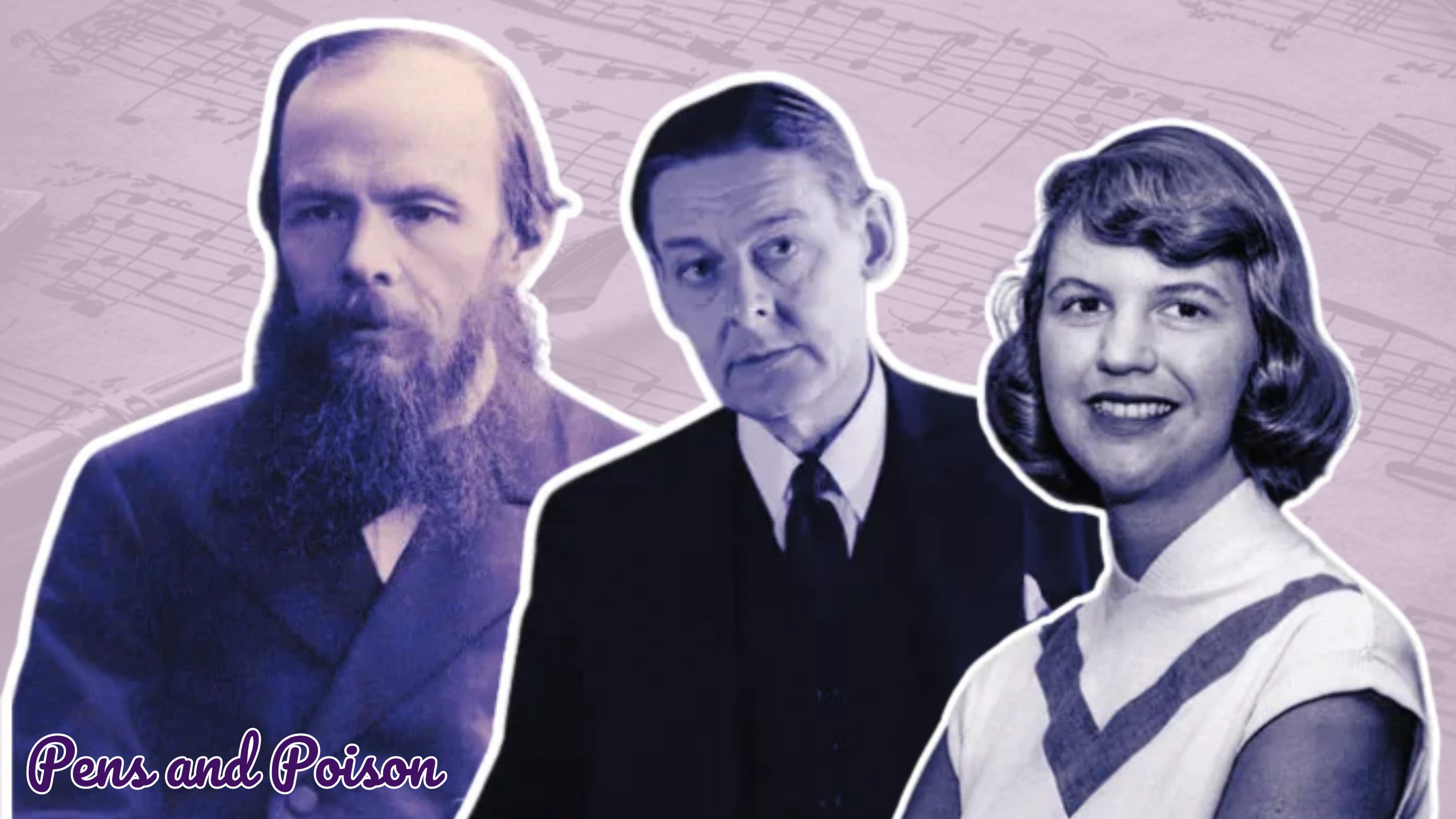
The best writing teachers are dead.
There’s a common misconception in the Substack world and certain other literary circles that the best way to learn to write is by enrolling in an expensive creative writing program, but I beg to differ. At the end of the day, writing is an art form, and like any art form, it can’t be taught in a classroom setting—at least not if your goal is to create an original work of art. After all, MFA programs and other creative writing classes are notorious for teaching students to all write in the same way.
But while I believe that writing can’t be taught in a university course by a jaded writing professor, I do believe that you can hone your existing writing skills by reading the literary greats.
Here are the writers who have been the most pivotal in my writing education—and what I learned from each.
1) FYODOR DOSTOYEVSKY
HOW TO PHILOSOPHIZE (WITH OR WITHOUT A HAMMER)
Dostoyevsky is undeniably my biggest literary influence, and it’s regrettable that he’s often written off as a poor stylist by MFA snobs because the absence of Dostoyevsky in MFA classrooms is perhaps the biggest reason that contemporary novels have stopped chasing big ideas.
In my view, most great novels aren’t great because of style (though style can certainly be a plus!) but because of the philosophical ideas embedded in their pages.
When it comes to philosophizing, no one beats Fyodor Dostoyevsky, who explores big ideas by assigning distinct philosophical movements or systems of morality to each of his characters. In Crime and Punishment, for instance, Raskolnikov represents the materialist rationalist, while Razumikhin embodies classical humanism; from there, they engage in a battle of big ideas.
In many ways, Raskolnikov’s mind is the antithesis of Dostoyevsky’s own, yet what makes Dostoyevsky so brilliant is his unique ability to inhabit a mind completely unlike his own. In a world where “write what you know” prevails, Dostoyevsky reminds us that the best writers create novels that challenge their own worldviews.
2) T.S. ELIOT
A MASTERCLASS IN LITERARY ALLUSION
T.S. Eliot’s The Waste Land is rife with literary allusions—references to other works of literature that deepen our understanding of the greatest poem of the twentieth century.
Eliot wasn’t afraid to challenge the minds of his readers by peppering his manuscripts with obscure allusions because he recognized that these allusions not only enhanced his readers’ experience of his poems but also created a dialogue with other great minds of the Western literary tradition.
Eliot always reminds me to drop little references to other works of literature in my novels. Chapter 6 of my latest novel, The Brodsky Sisters, in fact, is one giant allusion to The Waste Land.
Read my Waste Land deep dive here.
3) SYLVIA PLATH
THE ART OF THE METAPHOR
Remember the fig tree metaphor from The Bell Jar? It’s one of literature’s most famous conceits and an elaborate case study in the power of figurative language.
In The Bell Jar, Plath’s Esther Greenwood imagines a fig tree. She writes,
I saw my life branching out before me like the green fig tree in the story. From the tip of every branch, like a fat purple fig, a wonderful future beckoned and winked. One fig was a husband and a happy home and children, and another fig was a famous poet and another fig was a brilliant professor, and another fig was Ee Gee, the amazing editor, and another fig was Europe and Africa and South America, and another fig was Constantin and Socrates and Attila and a pack of other lovers with queer names and offbeat professions, and another fig was an Olympic lady crew champion, and beyond and above these figs were many more figs I couldn’t quite make out. I saw myself sitting in the crotch of this fig tree, starving to death, just because I couldn’t make up my mind which of the figs I would choose. I wanted each and every one of them, but choosing one meant losing all the rest, and, as I sat there, unable to decide, the figs began to wrinkle and go black, and, one by one, they plopped to the ground at my feet.
Plath doesn’t explain her metaphor, nor does she shy away from somewhat obscure allusions; nevertheless, her message could not be clearer: the fig tree represents not only Esther’s personal indecision but also the terrifying experience of standing paralyzed in the face of choice.
In other words, Plath’s metaphor is powerful precisely because it’s universally recognizable.
I’ve seen literary agents actively discourage authors from populating their manuscripts with metaphors, but Sylvia Plath insists that we must capture our world in whimsical terms; in Plath, every literary moment is a poetic phenomenon, and every word takes on a double meaning as we enter the mind of her protagonist.
She’s my favorite poet-turned-novelist with a knack for unique descriptions.
4) THOMAS MANN
TURNING IDEAS INTO CHARACTERS
Though he’s not frequently compared to Dostoyevsky, Thomas Mann is perhaps the writer closest to the Russian literary giant when it comes to exploring big ideas. It’s no accident, then, that Mann is perhaps my favorite novelist after Dostoyevsky.
Thomas Mann is most famous for writing novels of ideas—a literary subgenre that explores philosophical questions, often through debates between characters.
Mann is sometimes criticized for writing ideas rather than characters (Nabokov famously called his books “topical trash”), but I believe that Mann’s characters are more brilliant and memorable because they each represent discrete philosophical ideas.
In many ways, my latest novel, The Brodsky Sisters, is structured like Mann’s The Magic Mountain in that each of my characters represents a distinct idea. The Brodsky Sisters explores the virtues and pitfalls of religious practice, and each of its three main characters—the three sisters—embodies a different intellectual strain: religious orthodoxy, agnosticism, and atheism. Like Mann, I explore different approaches to some of life’s biggest questions—such as whether meaning is inherent or manufactured—through the novel’s labyrinthine plot and discussions between characters.
Thanks, Mann!
5) J.D. SALINGER
ON THE POWER OF VOICE
My third novel, Blue Snow, was directly inspired by Catcher in the Rye—not necessarily thematically (though there is some thematic overlap) but certainly stylistically.
I’ve read Catcher in the Rye four times now, and every time I read it, I hear Holden’s voice playing in my head for weeks after I put the book down. I kept wondering why that was and concluded that J.D. Salinger is a master of literary voice—that nebulous term that always gets thrown around in publishing circles.
I like to think of “voice” as the translation of your character’s inner monologue to the pages of your novel; in this regard, we can define “voice” as a mode of writing that’s uniquely yours.
Given that everyone in the MFA world sounds exactly the same, it’s clear that for all the talk of voice, no one’s figured out how to write with voice after all, but you can.
Read J.D. Salinger and pay attention to the features that sound “Holden-esque.” You’ll be creating characters that sound distinctly like themselves in no time.
6) F. SCOTT FITZGERALD
SYMBOLS, SYMBOLS, SYMBOLS
What’s the greatest and most memorable symbol in all of Western literature? You probably said either Holden’s hunting hat (Salinger is also a master of symbolism) or Gatsby’s green light.
In literature, symbolism is a type of figurative language that uses objects, characters, or actions to illustrate a core idea. Symbols might not necessarily move the plot along, but their recurrence deepens our comprehension of a novel’s themes.
Accruing meaning through repetition and association, symbolism goes hand in hand with poetic language—such as in this beautiful example from The Great Gatsby:
Possibly it had occurred to him that the colossal significance of that light had now vanished forever. Compared to the great distance that had separated him from Daisy it had seemed very near to her, almost touching her. It had seemed as close as a star to the moon. Now it was again a green light on a dock. His count of enchanted objects had diminished by one.
Although the novel is filtered through Nick Carraway’s first-person narration, Fitzgerald’s gorgeous use of figurative language in this passage gives us a brief glimpse into the consciousness of Jay Gatsby. The diction surrounding the green light swells with longing, revealing Gatsby’s yearning for Daisy through metaphor (“as close as a star to the moon”).
Every time you encounter an object in The Great Gatsby, therefore, you know it’s going to mean something—and that’s why Fitzy is a master of symbolism. Gatsby’s yellow car, T.J. Eckleburg’s blue eyes, or the green light all represent values, desires, and psyches that enhance our experience of the Great American Novel.
Fitzgerald also has a way with colors.
7) HENRY JAMES
IT’S OKAY TO BE EXTRA
The average length of a sentence in contemporary literary fiction is 15–20 words.
The average length of a Henry James sentence is about 35–40 words.
In a society obsessed with terseness, Henry James is the welcome antidote to literary minimalism. His favorite punctuation mark is the comma, and he never shies away from interruptive subclauses.
Take this sentence, for one:
His cousin was a very brilliant girl, who would take, as he said, a good deal of knowing; but she needed the knowing, and his attitude with regard to her, though it was contemplative and critical, was not judicial.
There’s perhaps a more “straightforward” way to render this sentence, but the beauty of Henry James’ writing is that it accurately captures the non-linear machinations of the human mind: we don’t always think in straightforward sentences, nor should we write in that way.
James’ writing reminds us that the most straightforward approach is not always the best one—sometimes, the greatest literary feats are, indeed, the most convoluted. Because so is the human mind.
8) VLADIMIR NABOKOV
THE BEAUTY OF LANGUAGE
Vladimir Nabokov is undeniably the greatest stylist to have ever walked this planet.
Take this sentence from Pale Fire, for example:
“Would he ever come for me?” I used to wonder waiting and waiting, in certain amber-and-rose crepuscules, for a ping-pong friend, or for old John Shade.
I could write you an entire essay on why that one sentence is so brilliant (and maybe I will), but in the meantime, I’d like to simply call your attention to the sheer beauty of “certain amber-and-rose crepuscules.”
I’m still learning how to write like that, but the more I read Nabokov, the more I’m inspired to seek beauty in every sentence I write—and to push the boundaries of the English language to create something extraordinary.
9) LEO TOLSTOY
TEACHING WITHOUT PREACHING
If you’re a Tolstoy fan—and I mean a real Tolstoy fan—you’re probably either a conservative or a traditionalist, and that’s because the primary feature of Tolstoy’s greatest novels is morality.
In other words, Tolstoy’s novels—especially War and Peace and Anna Karenina—all have something to teach us. After all, great literature shouldn’t just tell a story but also cause us to reflect on our own lives.
But the beauty of Tolstoy is that he doesn’t shove his messages down our throats, nor does he pander directly to his audience. Instead, Tolstoy invites us to follow the lives of his characters—and to judge them for ourselves.
10) WILLIAM FAULKNER
HOW TO BREAK THE RULES
The reason that the MFA world drives me so crazy is that there are all these rules you learn to follow: “show don’t tell,” “don’t use a long word where a short one will do,” or “don’t use the passive voice.”
The brilliance of Faulkner is that he didn’t care about rules. He wrote exactly how he wanted to write and ended up creating some of the most brilliant works of Western literature.
The truth is there’s no one set “formula” that will yield a Great American Novel—or any other great novel, for that matter. On the contrary—the best writers always dare to play with form, experiment with style, and break all the rules in the book.
WANT TO LEARN TO REALLY WRITE?
While you might spend eons discussing “style” in your MFA seminar, you’ll rarely discuss big ideas, and that’s why contemporary literature is broken—and why it’s so important to learn from the literary greats.
The greatest novels, after all, aren’t just the books that are the most well-written but the books that prompt us to ask big questions about human existence.
That’s why the only way you’ll ever learn how to write is by reading classic literature.
So get to it!
Enjoyed this post? You can Buy Me a Coffee so that I’ll be awake for the next one. If you are a starving artist, you can also just follow me on Instagram, YouTube, or “X.”
What an outstanding essay, maybe your best yet, and that is saying a lot. Honest, thoughtful, enlightening and perceptive. Thank you for putting so much time and effort into this.
👏👏👏 Your best essay in a long time, Liza! This was very enlightening as someone who is far from being an expert on literature or writing like myself. All ten of these authors bring something special to the table one can learn from them. Indeed, if you want to be a good writer going to useless and silly MFA classes that will bore you to death and you won’t learn anything from. What you should do is read the greats of literature and pick out the things that made them great and their work immortal. Contemporary literature is largely awful because it is bland, formulaic, politically correct, generic, and doesn’t allow for anyone to be different. Literature today lacks creativity, originality, innovation, or daring. This is why Beowulf, The Odyssey, The Iliad, Romeo & Juliet, The Adventures of Huckleberry Finn, The Great Gatsby, Moby Dick, The Old Man and the Sea, The Raven, The Bell Jar, War of the Worlds, Dracula, Frankenstein, Twenty Thousand Leagues Under the Sea, The Sound and the Fury, Crime and Punishment, Pride and Prejudice, To Kill A Mockingbird, 1984, Brave New World, Fahrenheit 451, Anna Karenina, The Red Badge of Courage, All Quiet on the Western Front, and Monster will still be read a millennia from now and garbage like Yesteryear, Where the Crawdad’s Sing, Normal People, The Hunger Games Series, The Twilight Series, Bad Feminist, Between the World and Me, How to Be An Anti-Racist, White Fragility, and Hood Feminism will be forgotten and discarded into the bargain bin of human history!
A lot has changed over the past couple months since Liza’s account blew up. With her talking to the likes of Peter Boghossian, Eric Metaxas, James Klug, and Andrew Klavan, writing articles for the Daily Wire and attending a Free Press event recently with other creators and influencers. I will be honest that I considered quietly leaving Pens & Poison. I’m a huge fan of Pens & Poison but I wondered if I was even needed anymore given Liza’s great success but I stay because I believe in Liza’s mission. We need people like her now more than ever in the literary world. On another note, I miss when we would get to personally interact in a way with Liza in the comments. It just isn’t the same without her personally reading comments or liking them even though I know what’s really hard to do because there are 100+ on her articles. That’s the thing about Liza’s success it has been both a blessing and a curse in my personal opinion. Is it wonderful to see Liza succeed so much? Of course. But at the same time, you can’t really have the deeper connection to the creator anymore because an avalanche of new people have arrived. In closing, I noticed Liza’s poetry collections aside from Girl Soldier aren’t available on Amazon anymore and are out of print. I hope someday it will become possible to purchase them again.