


Russian literature has a bit of a reputation problem.
You’ve been told that Dostoyevsky is too depressing, Tolstoy is too dense, and Chekhov is too dull.
As we say in the Motherland—chto za huinya (what rubbish)!
I’m a native Russian speaker, and I’ve been reading Russian literature my entire life. I might be biased, but the Russians have produced some of the most profound literature ever to grace our world, and it’s time we all gave it a chance.
But in a sea of Ivan Ivanovich Ivanovs, where does one even start?
I’ve made this nifty guide to take you through Russian literature across the ages—from imperial ballrooms to Soviet labor camps—and to hopefully give you a tour of my people’s most insightful literary creations.
And trust me—Russian lit isn’t scary.
(Well, maybe a little.)
I’ve also made these cute little graphics to go along with your reading experience. The graphics took me longer than the article itself (though this might be because I am a better writer than I am a graphic designer), so please enjoy the fruits of my labor.
The Foundations
Before we get to existential agony (don’t worry, it’s coming), let’s take a trip through satire and society.
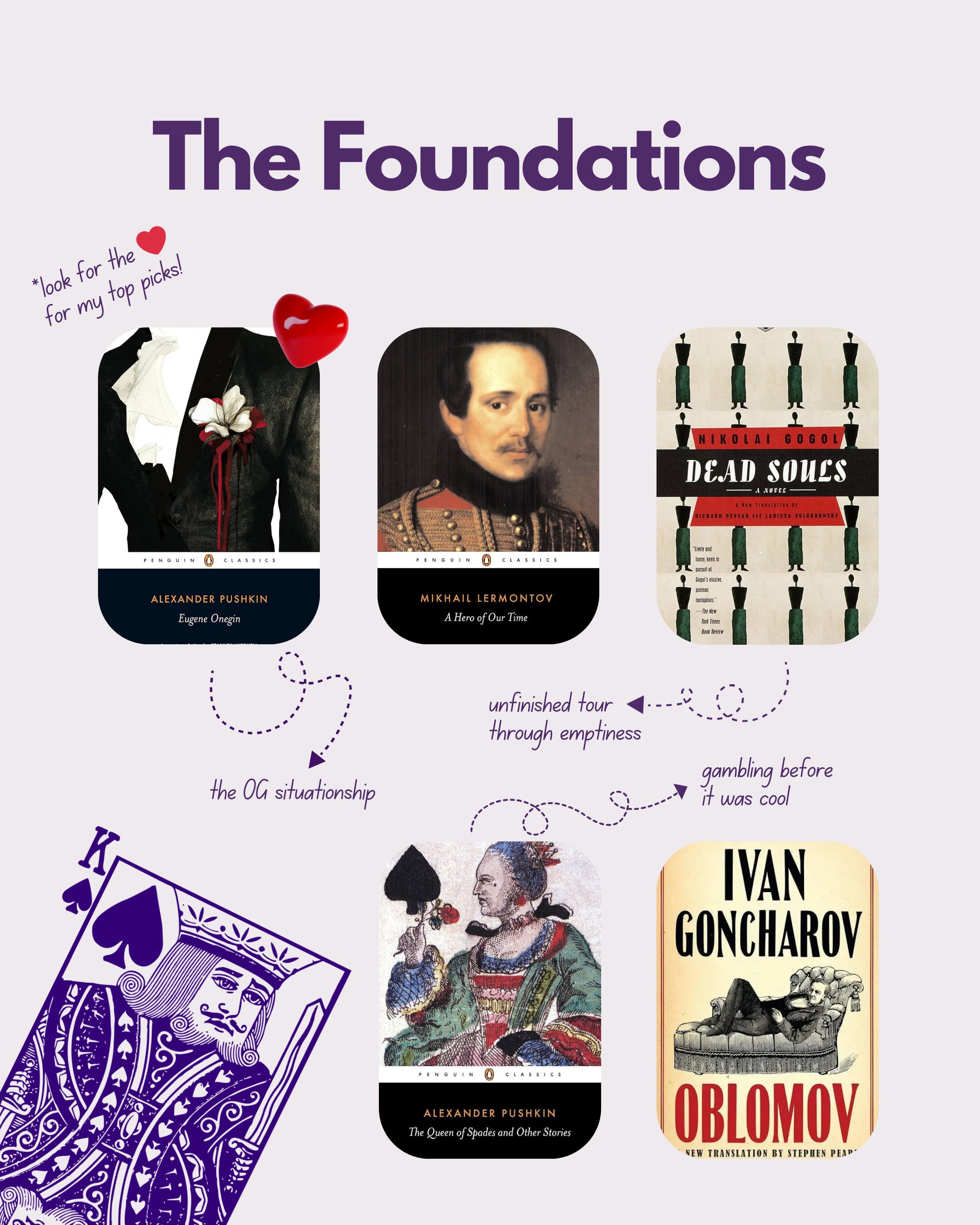
Alexander Pushkin — Eugene Onegin, The Queen of Spades, The Bronze Horseman
We begin our journey with Pushkin—the father of Russian literature himself. I grew up memorizing Pushkin poems, and it’s a rite of passage for every Russian child to commit his words to memory. I still have many of his poems memorized, but my two favorite Pushkin works are Eugene Onegin and The Queen of Spades.
I like to think of Eugene Onegin as the original situationship story, and The Queen of Spades as the precursor to Dostoyevsky’s The Gambler. I also have a soft spot for The Queen of Spades because the protagonist is named Liza.
Pushkin’s The Bronze Horseman is another favorite. I used to think that the statue in St. Petersburg was put up as an homage to the poem. Apparently, it’s the other way around (Pushkin wrote his poem as an homage to the statue), but my version is dreamier.
Nikolai Gogol — Dead Souls
Gogol’s most famous novel reminds me a bit of Kafka’s The Castle—I suppose because they’re both about the ills of bureaucracy. There are some really funny jokes in here that might get lost on English speakers (one character is named Korobochka, for instance, which literally means “little box”), but it’s absolutely still worth the read. In fact, the first half might be one of the greatest pieces of literature ever written. Sadly, the second half doesn’t quite live up to its predecessor, and there’s a whole story here. Apparently, Gogol wrote an alternate version, but because all writers are crazy, he… burned it. Along with the rest of the book.
That’s right. Dead Souls sadly remains unfinished. If I had a time machine, I’d go back to the moment Gogol decided to burn Dead Souls and prevent him from doing so. Someone convinced Virgil not to burn The Aeneid, after all, so maybe in another world, it would have been done!
Ivan Goncharov — Oblomov
There’s a lot of sleeping and dreaming in this novel. In fact, it’s basically a novel about not getting out of bed—and why that might be a moral, philosophical, and civilizational problem. And in case you thought I was making a joke about Ivan Ivanoviches, our protagonist is named Ilya Ilyich Oblomov. (At least he’s not Ilya Ilyich Ilyichov.)
Mikhail Lermontov — A Hero of Our Time
My grandmother was always talking about this book when I was a kid, and it’s certainly one of the early Russian greats. It’s widely considered to be the first psychological Russian novel and a precursor to Dostoyevsky. There are some great Pushkin allusions in here—as well as a Byronic hero.
Alexander Griboyedov — Woe from Wit
When I was growing up, my dad would always say that I had “gore ot uma” (woe from wit). He still says it, actually, so I had to figure out where the phrase originally came from. Turns out it’s from this little comedy in verse about post-Napoleonic Moscow. The maid in this book is named Liza, and she likes to speak her mind even when she’s not supposed to.
Huh. My dad was onto something.
Dostoyevsky
I could write you an entire dissertation on Dostoyevsky. In fact, I probably would have if English departments were still sane across the country, but I’ll try to keep this short. Here are my favorite works by Dostoyevsky—in no particular order (they are all wonderful except for The Adolescent).
Dostoyevsky is probably my favorite author of all time (which tells you everything you need to know about me), so again, I might be slightly biased here.
Crime and Punishment
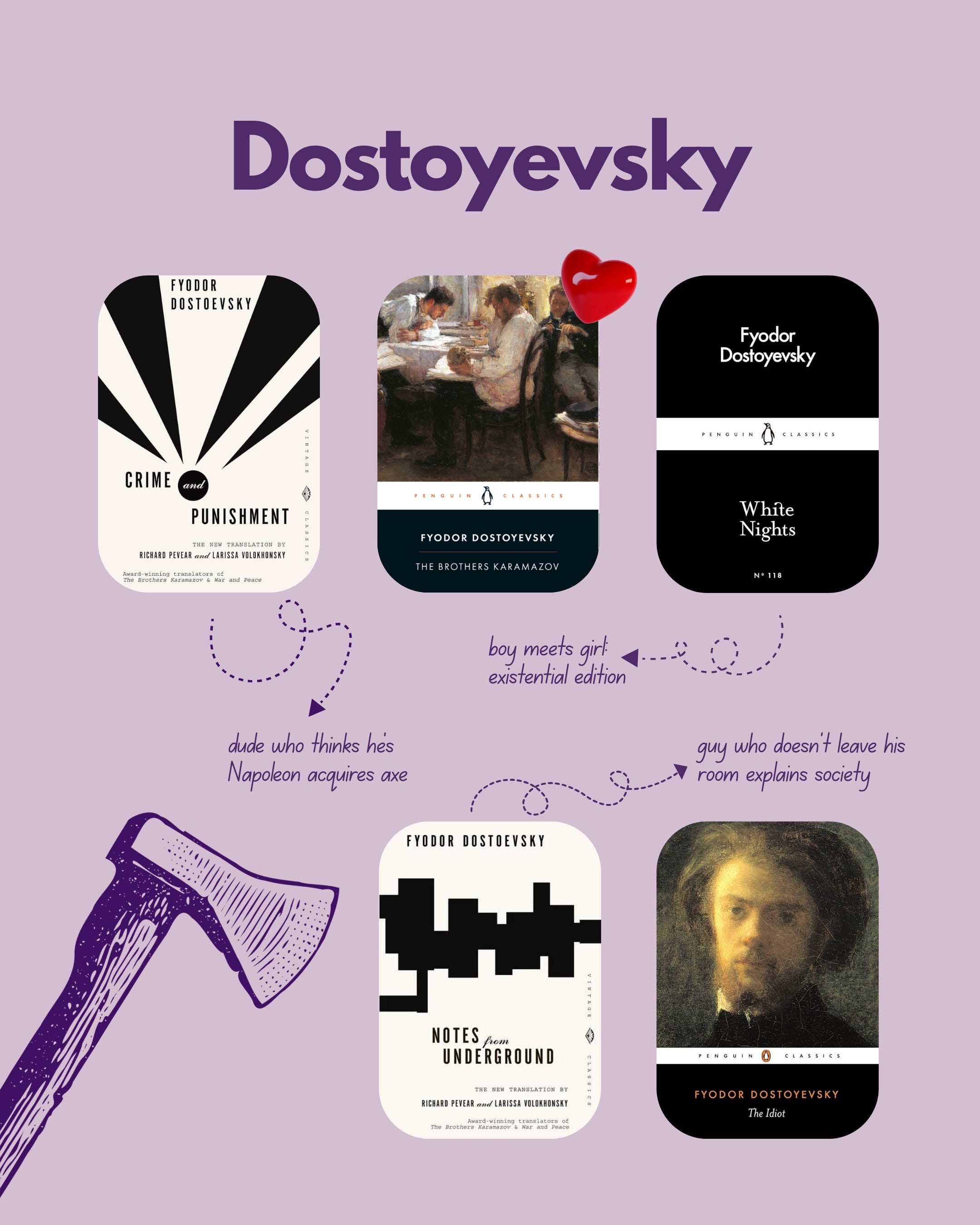
A man decides he might be Napoleon and acquires an axe. As you might expect, things don’t go so well for poor Raskolnikov.
If you’re new to Dostoyevsky, Crime and Punishment is by far the best entry point. It’s the most accessible and most famous of his major novels. It’s a deep dive into “not all ideas are created equal,” a lesson on the virtues of redemption, and a ton of fun.
A small detail that’s lost on English readers—our protagonist, Raskolnikov, is named after the Russian word for “split.” That’s all I’ll say before you dive in yourself!
The Brothers Karamazov
I don’t even know where to begin with this one, but we have a lot to get through, so I’ll keep it short.
The Brothers Karamazov is the deepest novel about the nature of religion and man ever written—and I don’t think anyone will ever beat it. I love theological dramas because religion provides us with a moral framework to ask and answer some of the most important questions known to man.
The Brothers K tells the story of three brothers—Alyosha, Dmitri and Ivan—and the investigation of the murder of their father, Fyodor Karamazov, but it’s more a philosophical meditation on life than it is a murder mystery. The most profound insight on the nature of religion occurs halfway through the book in Ivan’s story of “The Grand Inquisitor,” a tale of religion and free will. It’s this chapter that’s always stayed with me, even fifteen years since I first read the book.
Yes—I read The Brothers Karamazov in the 10th grade. This might be why I had no friends.
I need to reread this one for sure.
Notes from Underground
Wherein a man who doesn’t leave his room explains society.
This is one of my favorite Dostoyevsky novels, and I think it’s by far the most underrated one. It’s not as widely read as The Idiot, Crime and Punishment, and The Brothers K because the first 80 pages or so are basically just a philosophical treatise, but it’s a direct response to Nikolai Chernyshevsky’s What is to Be Done?, a utopian novel that would inspire many of Lenin’s philosophies in the coming century (we’ll get there). Dostoyevsky, as you can imagine, takes the opposite stance and argues that utopias are impossible given all we know about human nature.
Nabokov famously hated this novel, writing,
I would like you further to ponder ‘”Crime and Punishment” and “Memoirs from a Mousehole,” also known as the ‘’Notes from Underground’‘ (1864), from this point of view: Is the artistic pleasure you derive from accompanying Dostoyevsky on his excursions into the sick souls of his characters, is it consistently greater than any other emotions, thrills of disgust, morbid interest in a crime thriller? There is even less balance between the esthetic achievement and the element of criminal reportage in Dostoyevsky’s other novels.
Ouch. Can’t please everyone, I suppose.
White Nights
This one holds a soft spot in my heart. It’s an early Dostoyevsky novella that follows a pair of lovers as they bare their souls to one another in the span of just under a week. Again—a small detail that’s lost on English readers is that the girl in the novel immediately introduces herself as “Nastenka,” the diminutive of “Nastya,” which in itself is already a diminutive of “Anastasia.” Even today, it would be strange for a Nastya to introduce herself as Nastenka, a name typically reserved for lovers or parents. Thus Dostoyevsky sets up a paradigm in which we know that Nastenka and her unnamed lover will get too close too quickly.
White Nights is the ultimate exploration of bliss and human closeness. I read it in one sitting in a bathtub and cried for three hours after (still in the bathtub). I still cry every time I think about this book. I’m crying right now.
The Idiot
What happens when a genuinely good man enters a corrupt society? Spoiler—society does not look kindly on him. The Idiot builds on many of the themes from White Nights, asking what is “socially acceptable” for us humans, who are at once too shallow and too deep (depending on who you ask). Once again, we have Dostoyevsky’s clever name play. Our protagonist, Prince Myshkin, is named after a мышь (mysh’) or “mouse” in Russian.
Demons
This is Dostoyevsky’s most political novel and the least well-known of his four major novels. It’s an epic takedown of Russian nihilism (which we’ll get to a bit later) and a story about finding meaning in our society. I’ve also included it in my nihilism section and will explain it a bit more in depth once we get there because there’s some context you’ll need to know first.
The Adolescent
You can honestly skip this one if you want, but I thought I’d throw it in here to give a full rundown of Dostoyevsky. I’ve actually read it twice (I thought maybe I missed something the first time) and I can still barely remember the plot because it’s so much duller and less profound than his other novels. A mark down for Dostoyevsky with this one, but even the world’s greatest geniuses have their lows.
The Double & The Gambler
These two novellas are usually published in pairs. The first of these is consciously influenced by Gogol’s Dead Souls and tackles the uncanny nature of Russian bureaucracy; the second was inspired by Dostoyevsky’s own gambling addiction and echoes the themes in The Queen of Spades.
Tolstoy
I’m a Dostoyevsky girl rather than a Tolstoy girl, but Anna Karenina is still one of my top ten novels of all time, so, actually, I’m also a Tolstoy girl.
Let’s get into it.
Anna Karenina
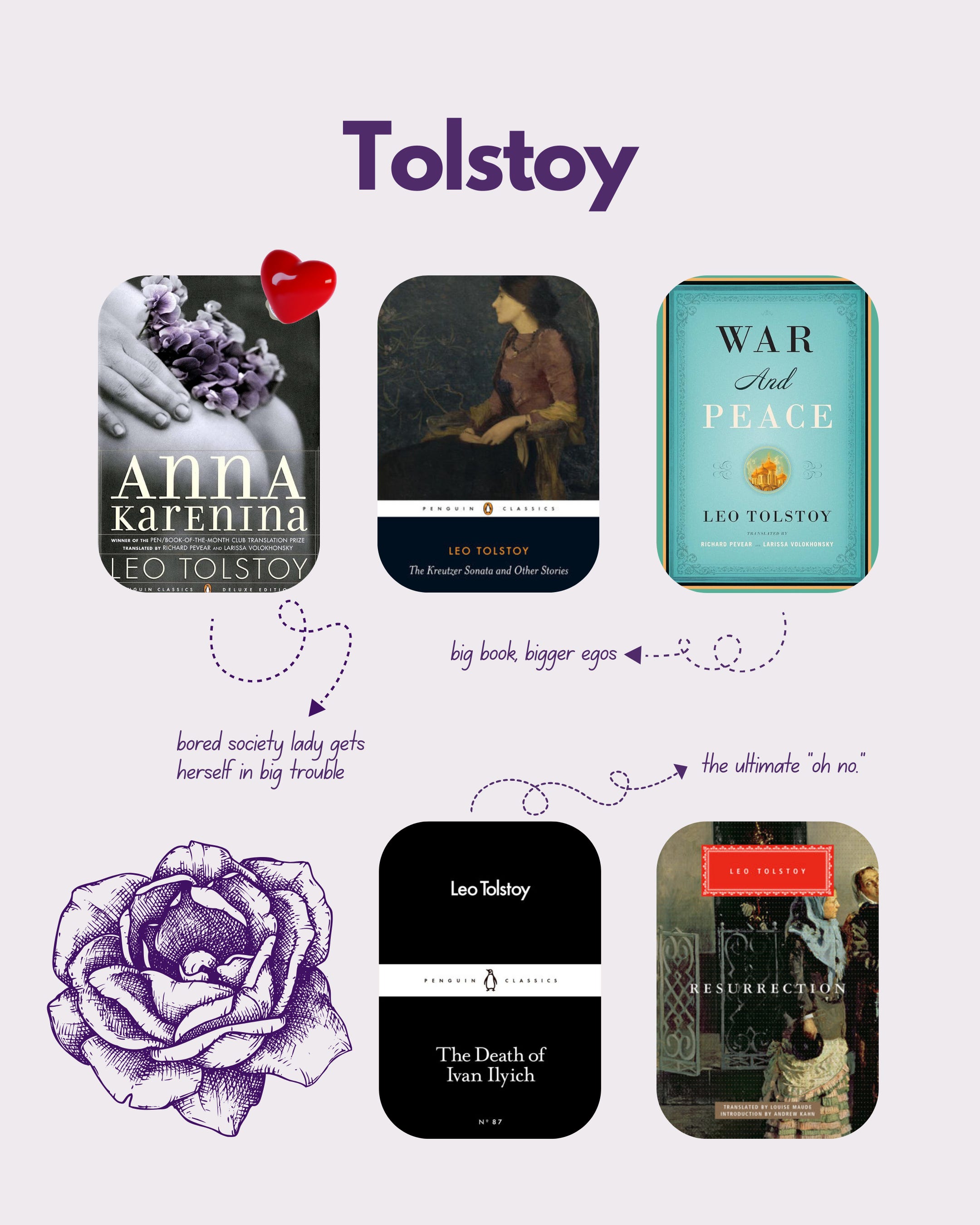
A bored society lady gets herself into big trouble.
We’ve all had a Count Vronsky in our lives—or, at least, we’ve met him. But most of us aren’t as stupid as Anna.
Or are we?
Anna Karenina is Tolstoy’s masterful work of literature on domestic life. At the center of the novel, of course, lies the affair, but through the character Levin and his eventual marriage to Kitty, we’re also asked to consider themes of Christianity and death—two philosophical topics that are hallmarks of Tolstoy’s overall work.
Anna Karenina explores what constitutes “the good life” and what duty we owe to our families. It’s the ultimate work of great literature because, unlike the morally ambiguous crap being published today, it actually arrives at an answer.
War and Peace
I distinctly remember reading War and Peace over winter break in the 10th grade (I had a Russian literature phase at fifteen that I’m still in to this day) and imagining that I was Natasha Rostova dancing in a ballroom. I definitely resonated much more with the “peace” sections than the “war” sections, and I still don’t quite understand Tolstoy’s random treatise on military strategy at the end of the book, but there’s something for everyone in this behemoth of a novel. In fact, one of the scenes in my most recent novel Blue Snow was directly inspired by Tolstoy’s ballroom scenes with Natasha.
There’s a War and Peace film starring Audrey Hepburn that I absolutely don’t recommend, and I usually love Hepburn. Just read the book.
The Death of Ivan Ilyich
I actually didn’t like this one until the very last page. Then it all clicked together, and I cried for an hour. That’s all I’ll say about this novella. It’s Tolstoy at his best.
The Kreutzer Sonata
I’m also still not over this one. I’ll do a lot of audiobooks during the day when I’m running around meeting with clients or filming content for the Pens and Poison Instagram, and I did this one on audiobook. The cool thing about Russian books and movies is that everything is always available online for free. I guess there are a few good things that came out of the USSR.
The Kreutzer Sonata was Tolstoy’s most controversial book when it came out. I can’t tell you why without giving it away, but hopefully that intrigues you enough to pick it up. Don’t worry—unlike War and Peace, this one won’t take you more than a few hours.
The Nihilists
All right. It’s time to talk about Russian nihilism—and, no, it’s not just the belief that nothing means anything. Russian nihilism was as political as it was philosophical—and a lot more complicated than the nihilism we associate today with, say, postmodern theory.
Russian nihilism was a fundamentally anti-tsarist movement that rebelled against the old order of society—against the tyranny, hypocrisy, and artificiality that this group of young revolutionaries believed was irrevocably intertwined with everyday Russian life. The movement gained popularity in the 1860s and culminated in the eventual assassination of Tsar Alexander II in 1881. It was this revolutionary fervor that would later inspire the Bolsheviks.
Nihilism makes quite an appearance in Russian literature.
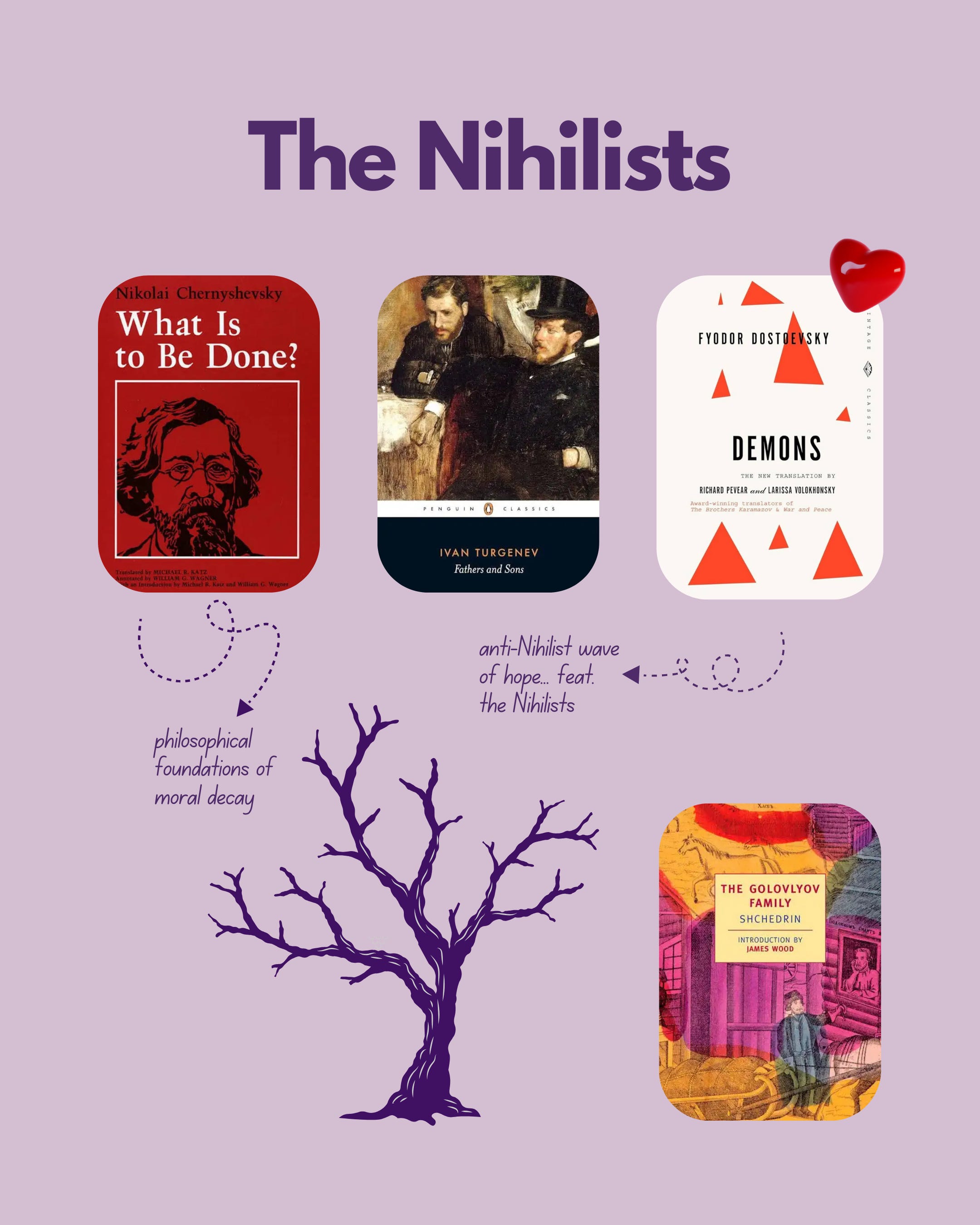
Nikolai Chernyshevsky — What Is to Be Done?
I don’t like this book. It’s an attack on marriage, traditional family structures, capitalism, and everything else you can attack if you’re a bum who takes his personal problems out on society. Nevertheless, this is one of the most important works of Russian literature not as a standalone piece but because it inspired Dostoyevsky’s Notes from the Underground (Dostoyevsky was not happy with this book, as you can imagine), and that’s a win in my book (no pun intended).
Ivan Turgenev — Fathers and Sons
Fathers and Sons is about the nihilists, but it certainly isn’t a nihilist book itself. In fact, through the characters Arkady and Bazarov, Turgenev critiques the nihilist movement and advocates for a return to humanity. It’s one of the most moving pro-tradition novels in the Russian literary canon, and I highly recommend it.
Mikhail Saltykov-Shchedrin — The Golovlyov Family
The Golovlyov Family isn’t exactly a nihilist novel either (in fact, What Is to Be Done? might be the only actual pro-nihilist novel in the Russian canon), but Saltykov-Shchedrin certainly explores some of the “hot nihilist themes” in this family saga, which tackles the ills of spiritual rot.
Fyodor Dostoyevsky — Demons
All right. Now we can explain Demons in the context of the nihilists. I took a whole class on Demons, and I’ve read the novel twice, but I’m sure I still don’t understand the full extent of the political complexities woven into this novel—it’s really that complex! Nevertheless, I’ll do my best to give you a quick run-down.
Dostoyevsky was apparently a leftist revolutionary in his youth. He went to prison for it, and on the brink of death, had a sudden epiphany about the meaning of life, and became deeply conservative (or so the story goes). Demons was inspired by both his early revolutionary days and the real-life Nechaev affair, where a group of revolutionaries murdered one of their own in the name of “ideological purity.”
Never heard that one before…
Unlike Turgenev, who takes a more sober stance on nihilism, Dostoyevsky paints spiritually hollow characters who meet their demise precisely because they reject everything that gives us meaning: God, family, morality, and love.
Chekhov
Chekhov was a doctor before he was a writer, but we remember him today more for his writing than his contributions to the medical field (though I’m sure he was a great doctor as well). Most people today know Chekhov for his gun—the dramatic principle that states that if a gun appears in the first act of a play, it will most certainly be used by the last—and, accordingly, Chekhov is most famous for his plays and his short stories.
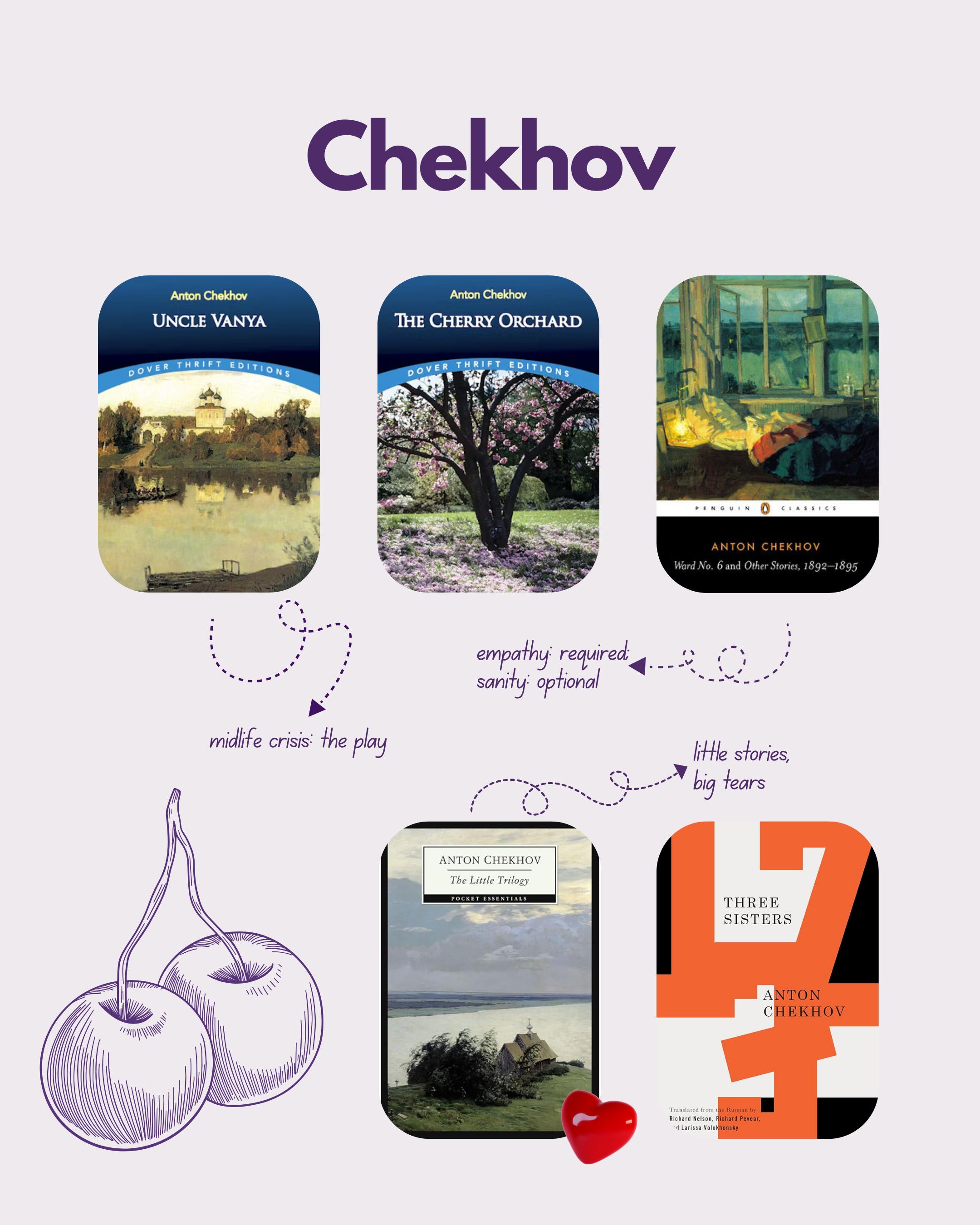
Uncle Vanya
A lot of intelligent people fall in love with people they’re not supposed to fall in love with, and no one gets what they want. Uncle Vanya is fundamentally a play about wasted potential. I think it was the play that inspired me to really do something with my life because I didn’t want to end up like any of its characters.
The Cherry Orchard
With the decay of the old social order, an aristocratic family argues about… nothing in particular. The Cherry Orchard is a lament for dying traditions and a reminder that people have their funniest moments in times of despair—at least, the Russians do.
Fun fact—there are two guns in this play that don’t serve any purpose. Chekhov did not even follow his own advice.
Three Sisters
Three society women spend years dreaming of a better life in Moscow while—you guessed it—doing absolutely nothing to get there. Three Sisters is Chekhov’s foray into longing and dying ambition—as well as the horrors of the passage of time.
Short Stories (Ward No. 6, The Lady with the Dog, The Little Trilogy, A Joke)
I’ve left my favorite Chekhov stories above, and they’re all great starting points for Chekhov. A Joke isn’t as famous as his other stories, but it’s one of my favorites and demonstrates Chekhov’s mastery when it comes to the short story.
The Silver Age
Alexander Pushkin inaugurated what we know as the Golden Age of Russian poetry. Following on Pushkin’s heels, the Silver Age poets were a group of Russian poets in the first three decades of the twentieth century.
Here are my favorite poems from each of the four major Silver Age poets. Several of these poems feature prominently in Soviet films. The Soviets might have had terrible economic ideas, but a culture that puts poetry voiceovers in their movies has its redeeming qualities.
From this list, Akhmatova is a particular favorite of mine.
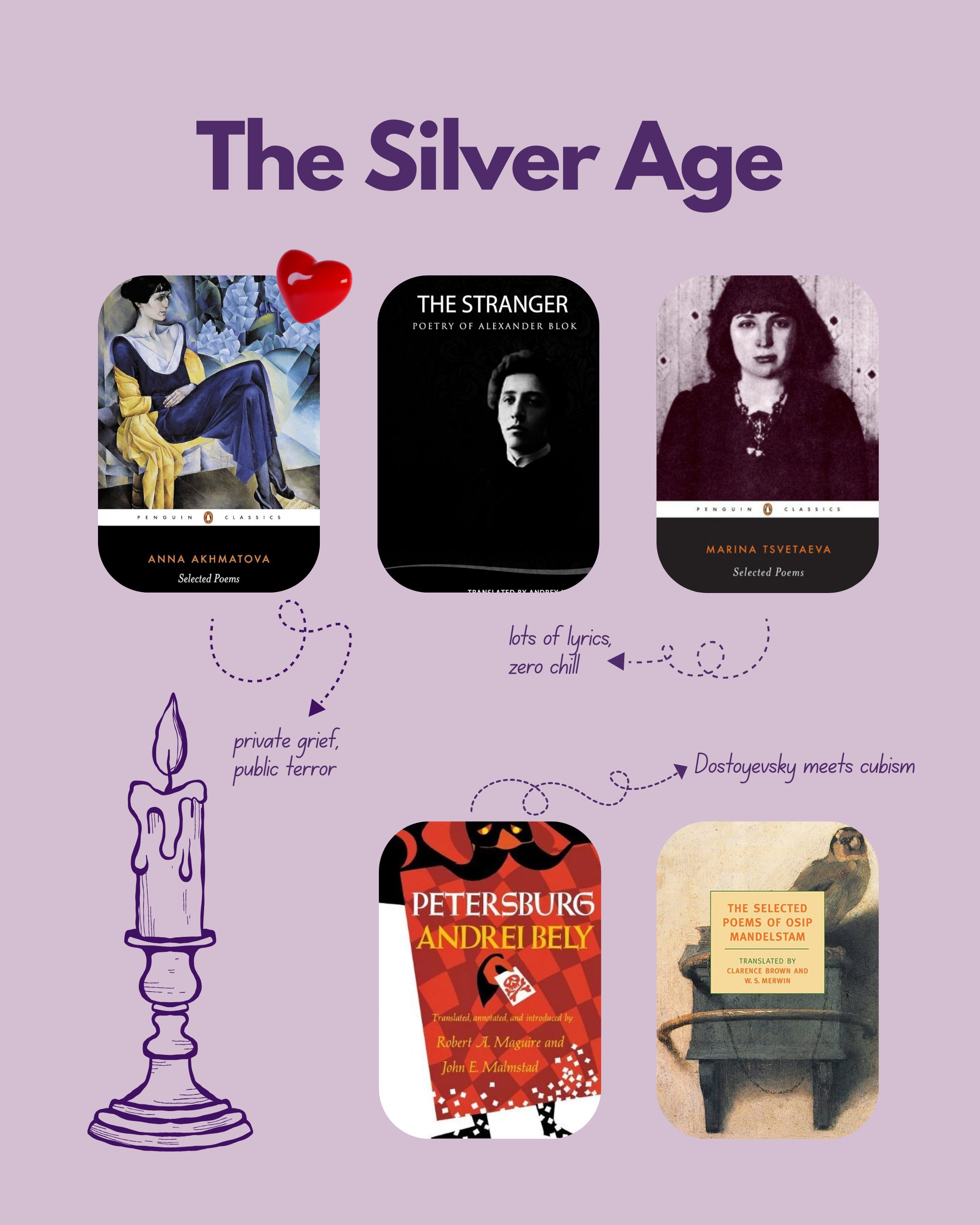
Anna Akhmatova — Requiem, I’ve ceased to smile long ago
Akhmatova’s “I’ve ceased to smile long ago…” is the first poem I read from the Silver Age poets at the age of 18. While the Brits and the Americans were writing weird, abstruse modernist poems in 1915, the Russians were still keeping it simple, observing more classical traditions of form and rhyme. I think it’s this poetic simplicity in Russian poetry that’s always drawn me to it. Even the most complex and heart-wrenching Russian poems remind me of childhood because of the lyricism embedded in their verses.
“Requiem” is Akhmatova’s most famous poem. Written over three decades, it explores the terrors of the Great Purge in Soviet Russia with beautiful linguistic precision.
Alexander Blok — On the Field of Kulikovo
Blok’s most famous poem is a simple but profound war poem and an homage to Mother Russia. There’s a recording of him reading it from 1920. As you might imagine from a 1920s recording, you can barely make out what he’s saying amidst the static, but you can hear Blok’s voice full of emotion as he reads out his glorious words.
Marina Tsvetaeva — I Like…, Homesickness
“I Like…” appears in the most famous Soviet film of all time, The Irony of Fate, where it was set to music by Mikael Tariverdiev and performed by the legendary diva Alla Pugacheva. It’s a perfect example of how literature, music, and cinema came together in Soviet Russia—and how Russian pop stars actually engage with serious poetry (unlike some fake “English teachers” in our culture). The poem itself is something of an unrequited love poem, but unlike in the typical unrequited love poem, both parties are in separate relationships. It’s one of the most touching poems in the Silver Age canon, and may have been inspired by Tsvetaeva’s affair with fellow poet Osip Mandelstam.
Osip Mandelstam — The Age, Stalin Epigram
Oh, hey. There he is!
Mandelstam died an early death in transit to a Soviet labor camp. He was arrested twice—once for insulting Stalin in his “Stalin Epigram,” and a second time for “counter-revolutionary activities.” Out of the Silver Age poets, he was certainly the most politically active, and his poems reflect deeply counter-revolutionary themes. Because of the heavy political bent to his work, Mandelstam resonates less with me personally than the other three poets do, but I love his poem “The Age,” which is less of a political poem and more of a lament for the decay of a lost era.
The Soviets
Well, well, well. It’s time to dive into Soviet Russia, where massive censorship dictated what you could or could not say in literature. The Polish writer Czesław Miłosz has a fantastic description of the nature of the Soviet-era publishing machine and the typical “Soviet writer” in his book The Captive Mind:
The intellectual of whom I speak is not one who believes in writing for the bureau drawer. He curses and despairs over the censorship and demands of the publishing trusts. Yet at the same time, he is profoundly suspicious of unlicensed literature. The publishing license he himself receives does not mean that the editor appreciates the artistic merits of his book, nor that he expects it to be popular with the public. That license is simply a sign that its author reflects the transformation of reality with scientific exactness.
Huh. That reminds me of something. I have no idea what it could be.
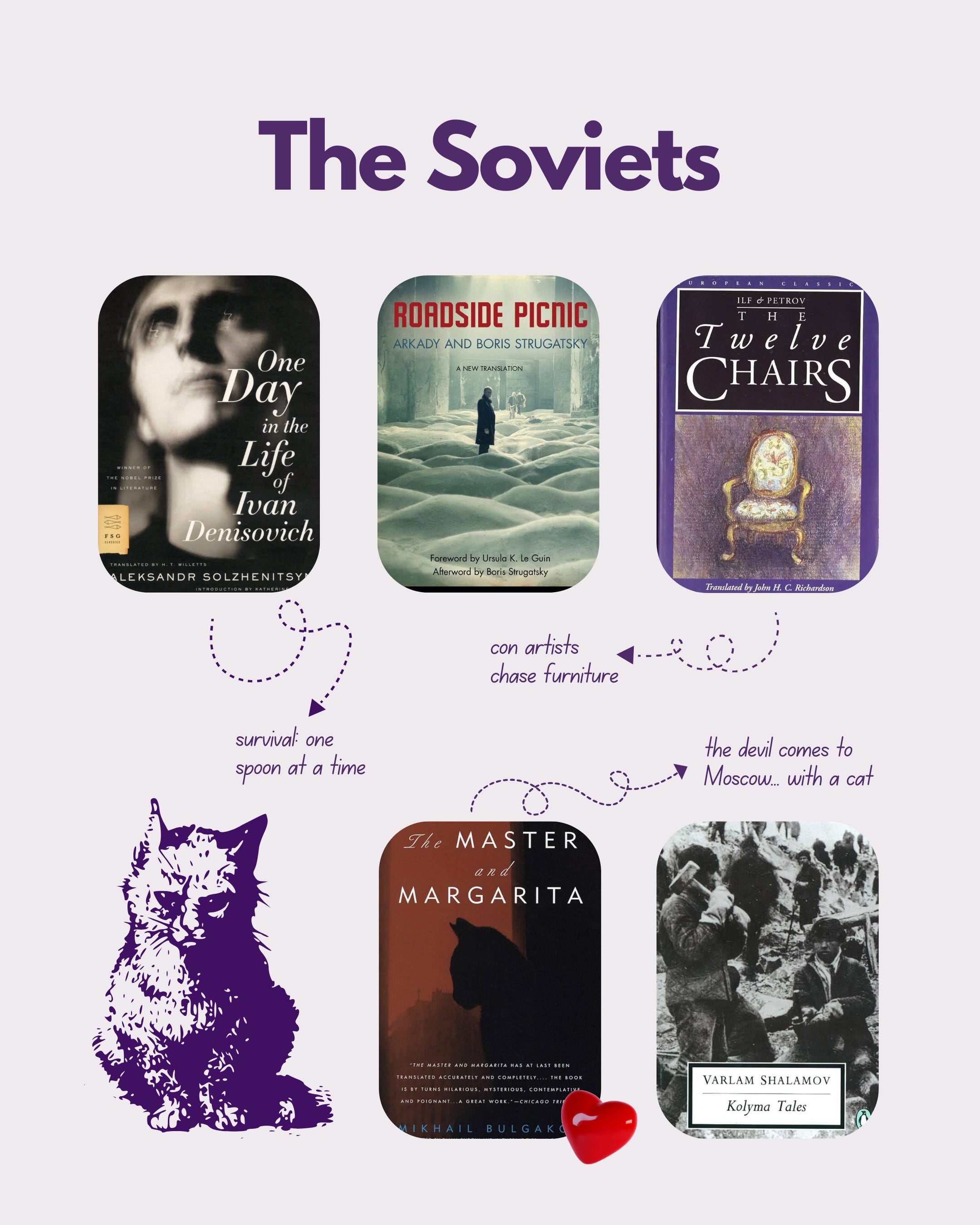
Aleksandr Solzhenitsyn — One Day in the Life of Ivan Denisovich
If you’re familiar with the Soviet gulag, you probably know it from Solzhenitsyn. I read this one not too long after I first read Frankl’s Man’s Search for Meaning, and it’s eerie to consider the parallels between the Soviet gulag and the Nazi concentration camp—even though the latter might have been marginally worse. Solzhenitsyn also has The Gulag Archipelago, which is a non-fiction series diving deeper into the ills of the gulag. I’ve been keeping this list to fiction, so I won’t go too far into it, but it’s worth reading alongside One Day in the Life.
Arkady & Boris Strugatsky — Roadside Picnic
I don’t think I’d ever pick up Roadside Picnic on my own—I typically don’t read sci-fi—but this is the book that inspired Tarkovsky’s Stalker, which might be my favorite film of all time. The book is a bit different from the film and has a lot more plot, but this might be one of the rare cases where the film is a lot better. Still, Roadside Picnic is a cornerstone of Soviet literature and absolutely worth the read.
Mikhail Bulgakov — The Master and Margarita, Heart of a Dog
The devil comes to Moscow—with a cat.
The Master and Margarita is a critique of the Soviet Union through a devil who roams the streets of Moscow and a cat named Behemoth (which is actually funnier in Russian because “behemoth” is also our word for “hippo”). Coming from a post-Soviet household, I resonate deeply with the novel’s commentary on decaying social norms in the Soviet Union, as well as its satire on Soviet life. The principal theme in the novel is the erosion of traditional Christian morals through the eradication of religion under the Soviet regime.
Bulgakov’s other famous novel is Heart of a Dog. I don’t know why I’ve never gotten around to reading it, but from what I understand, it’s worth a read, so I’m including it here. I don’t want to look up anything about it because I don’t like to have context when I dive into a new work of literature (it’s more fun that way), so you shall have to decide for yourself whether it’s worth reading. It probably is, and there’s a great Soviet film that I’ll watch one day after I’ve read the book.
After Ideology
With the ebb of the Soviet chokehold on society, Russian literature spread its wings (in the case of Nabokov, the famous lepidopterist, there was also a lot of literal wing-spreading).
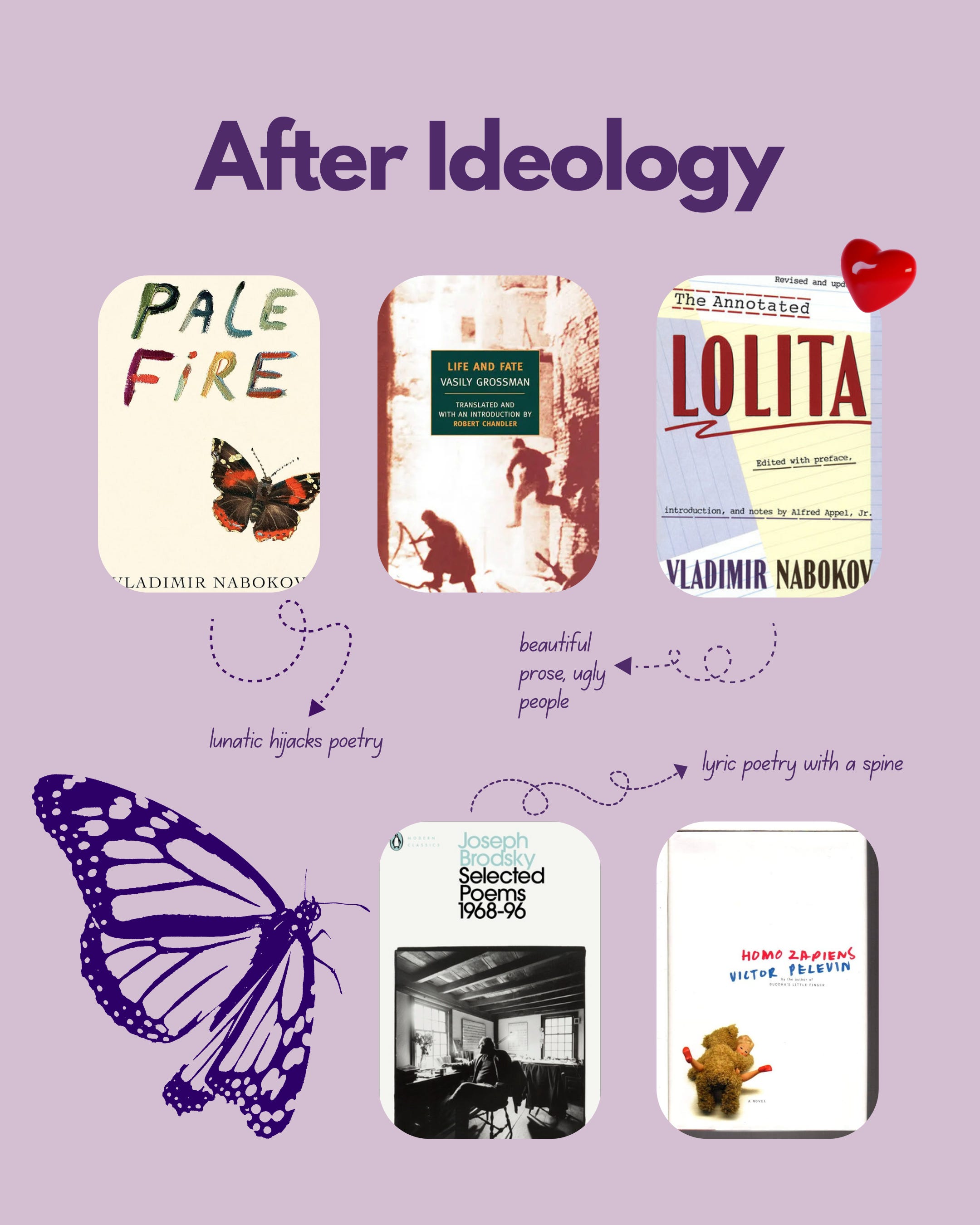
Vladimir Nabokov — Pale Fire, Lolita
Even though Nabokov hates Dostoyevsky, I forgive him because he’s certainly a better stylist than Dostoyevsky. Lucky for you, Nabokov wrote mostly in English, so you can access his original ideas in their original form. In fact, Nabokov famously left parts of Lolita untranslated when he went to translate the book into Russian, deeming certain passages fundamentally untranslatable. That should tell you everything you need to know about this literary expat.
Nabokov is such a master of his craft (English was his third language!) that he manages to create beauty with respect to one of the most vile topics known to man. Because of its subject matter, Lolita gets quite a bad rep from people who haven’t read it, but I don’t know a single person who has read Lolita and still turns away in disgust.
Pale Fire is a different beast entirely. It’s one giant footnote to a poem, but unlike DFW’s footnotes to Infinite Jest, it’s quite readable. Pale Fire is about a crazy guy named Kinbote who analyzes a series of Cantos written by the famous fictional poet John Shade. Through Pale Fire, Nabokov explores obsession and delusion as you decide who’s mad, who’s lying, and whether objective truth ever stood a chance.
Vasily Grossman — Life and Fate
I’m still reading this one, but it seems appropriate to include it here. More than one person whose intellectual opinion I trust has cited this book as an all-time favorite, so I will take the liberty of including it here. It’s about as long as War and Peace, so expect an update no sooner than six months from now. I am also biased in favor of this book because it was written by a Russian-Jew and explores the horrors of Nazism. Once I exit my non-fiction binge (I just finished a 1200-page World War II history book), I will return to this one and finish it up.
Joseph Brodsky — Selected Poems
Brodsky is one of my favorite Russian poets. He fled the Soviet Union in 1972 and, with the help of our friend W.H. Auden, settled in America, where he taught at a variety of universities. Like the Silver Age poets, he has a broad range, but I’ve done an in-depth analysis of his poem “Odysseus to Telemachus” here.
Victor Pelevin — Homo Zapiens
If you’re familiar with White Noise by Don DeLillo, this might be its Russian counterpart. We’re now in the world of post-Soviet Russian critique as we follow Babylen Tatarsky, a poet turned advertising copywriter. You can see where this might be going.
The book’s Russian title, by the way, is Generation “P”. The “P” stands for Pepsi.
A Note on Translations
Let’s talk about translations—because if you don’t speak Russian, it’s crucial to get a good one.
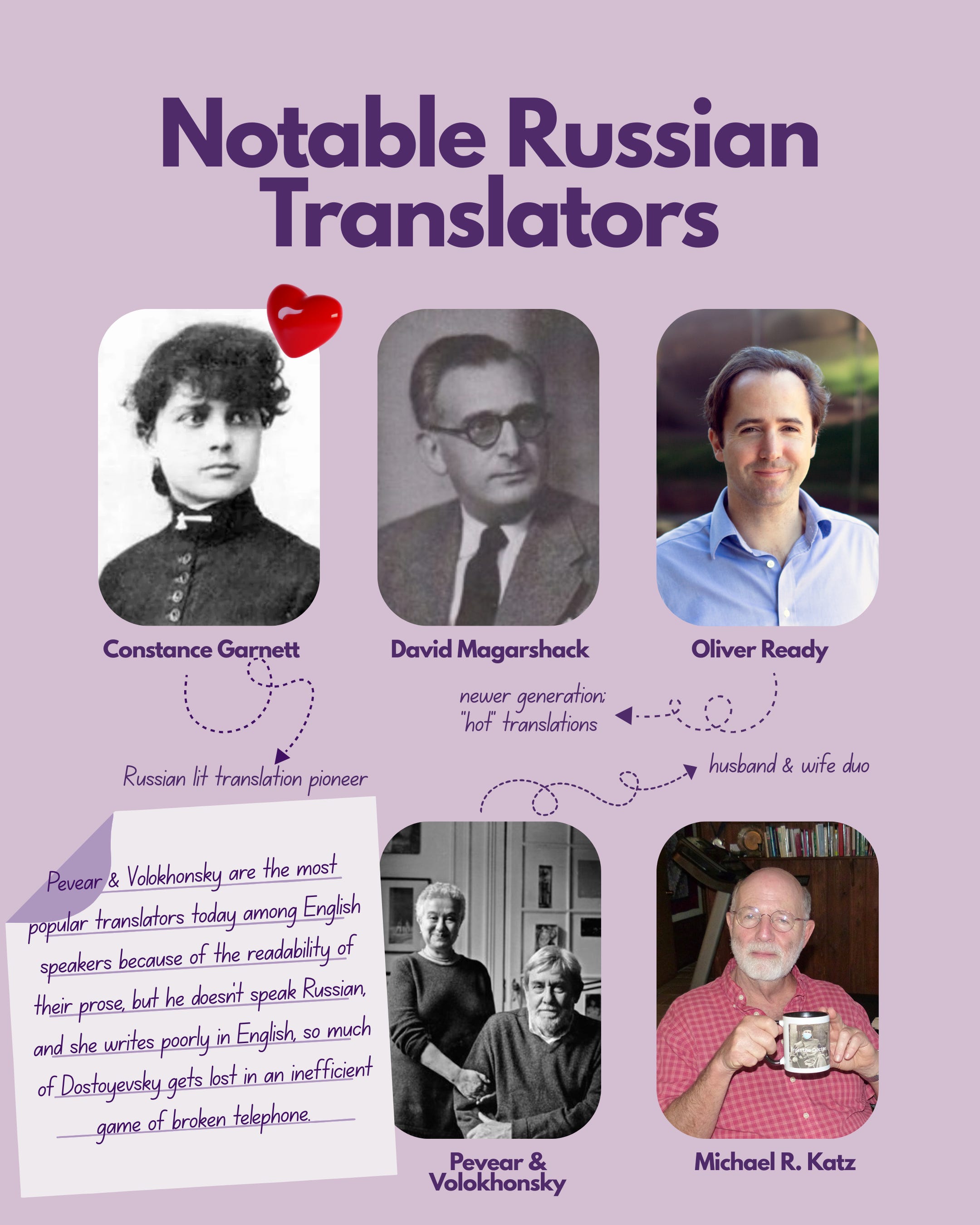
There are several notable Russian translators.
Constance Garnett — Garnett is one of the pioneers of Russian translation, and her translations are still widely read today because they’ve been in the public domain for quite some time now. Garnett gets criticized by detractors for “Anglicizing” certain moments, but I genuinely think that her translations are more spiritually faithful than any of the contemporary translations being pushed out today.
David Magarshack — An older and established Russian translator. His translations are clean and elegant. A safe choice.
Oliver Ready — Ready is part of the newer generations of Russian translators. I don’t hate his translations, but he tends to over-modernize, making Dostoyevsky sound like Philip Roth, or something.
Pevear & Volokhonsky — Pevear & Volokhonsky are a husband-wife duo and the most popular translators today among English speakers because of the readability of their prose. That said, he doesn’t speak Russian, and she writes poorly in English, so much of Dostoyevsky gets lost in an inefficient game of broken telephone.
Michael R. Katz — I haven’t looked into Katz too much, but he’s frequently cited in the world of Russian lit translation, so he might be worth the read as well.
Best translations typically have a strong command of both the original language and the target language. They must balance preserving the original tone and meaning while also making the text most fluid in the target language.
In my view, the Garnett translation reads most smoothly in English and preserves the spirit of the original Russian. Other translators tend to modernize texts in ways that don’t reflect the Russian times.
If you ask me, skip the modern trends and get the Garnett.
Whatever you do, please just don’t read Pevear & Volokhonsky.
Or better yet, start your Russian language learning journey today! I’m happy to help!
Enjoyed this post? You can Buy Me a Coffee so that I’ll be awake for the next one. If you are a starving artist, you can also just follow me on Instagram or “X.”
A great list for the pre-Soviet era and a very limited for the Soviet one. It misses so much brilliance! Babel, Platonov, Sholokhov, Pasternak (both as a poet and a novelist), Dovlatov, Yerofeev -- are all sorely missed.
Some time ago I tried to compile the "Great Russian Novels" list. It may be a companion piece to yours; a lot of similarities but a lot of differences as well.
https://tapwatersommelier.substack.com/p/the-great-russian-novel
I thoroughly enjoyed this. I’m apparently better read in Russian literature than I thought. I have read most of the works you discuss. I found your comments on Dead Souls interesting because I was baffled by the second part of that book. I enjoyed The Overcoat more.Life and Fate is a terrific novel. You might also want to take a look at Grossmans Everything Flows. Heart of a Dog is worthwhile and l quite like The White Guard . On Soviet life, Kolyma Tales gives you quite a harrowing and ultimately numbing portrait of camp life. Another interesting perspective on Soviet life can be found in Venedikt Erofev Moscow to the End of the Line.
Thank for complimenting Constance Garnett , who’s become quite unfashionable.
Did you ever read Andrei Bely’s Petersburg? I’d seen it lauded for years and read it and was thoroughly bored .
Finally , only a little off topic, I want to put in a plug for Penelope Fitzgerald’s The Beginning of Spring . It’s English with a Russian setting. It’s a good and in some respects strange novel.