


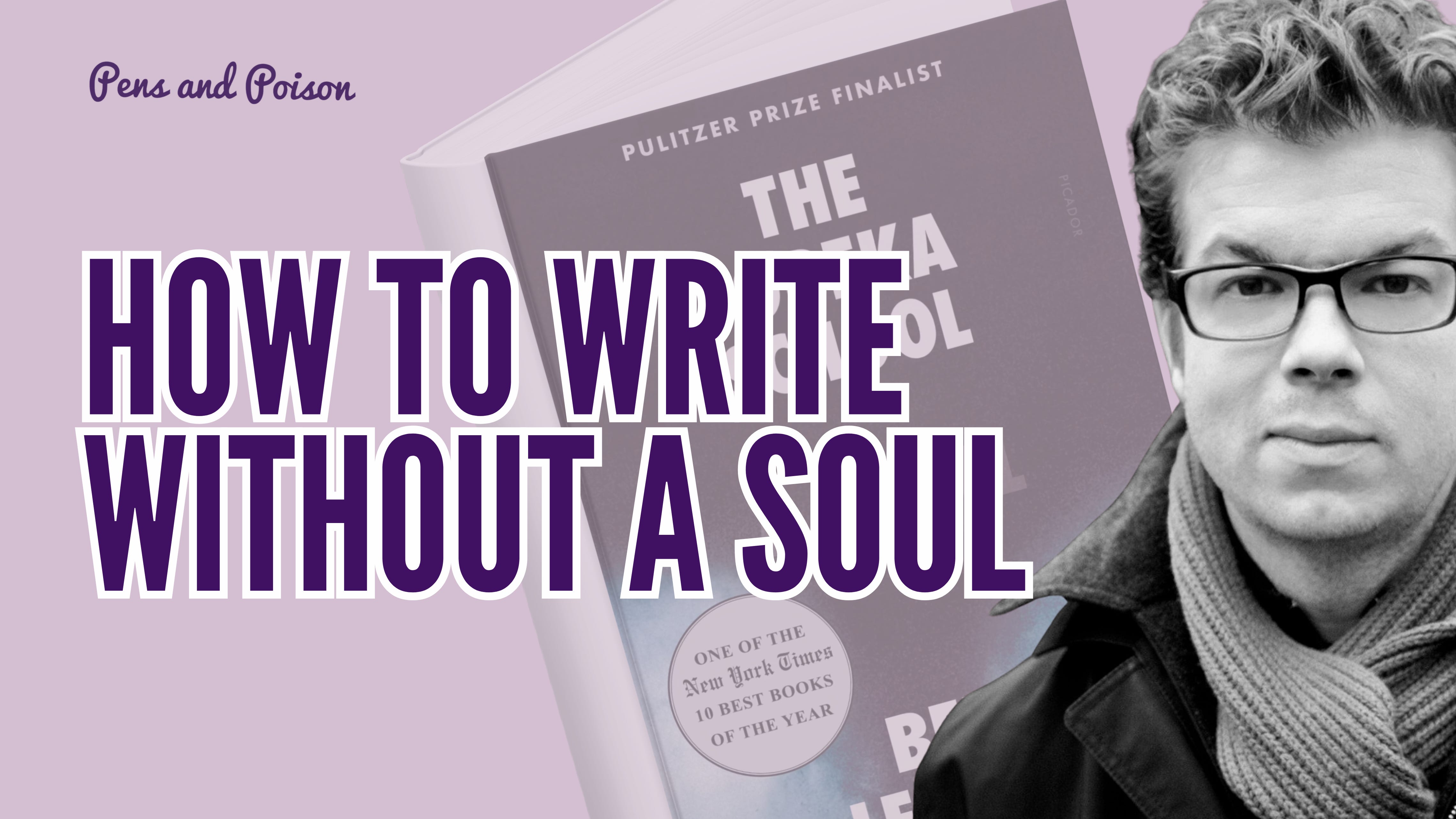
The following essay contains spoilers for Ben Lerner’s The Topeka School (though I don’t know why this should matter to anyone because I would not wish the fate of reading The Topeka School on my worst enemy).
Many of you know that I rarely subject myself to the agony of reading contemporary literature—frankly, even doomscrolling on X is a better use of my time (more people on there know how to construct a sentence than in a Sally Rooney novel), but I have fallen into the misfortune of forging a career out of critiquing contemporary “literature” and must therefore periodically survey the literary landscape and decide which contemporary “novel” to torment myself with next. I’ve previously surrendered brain cells to Normal People, Yesteryear and My Year of Rest and Relaxation, and my latest foray into our culture’s literary idiocracy comes courtesy of Ben Lerner’s The Topeka School.
I know I’m about six years late with this review, but I’m still catching up on building out my contemporary fiction literacy because prior to starting Pens and Poison in 2024, I had no reason to read this soulless slop.
And boy, is it soulless.
Let’s first get the setup out of the way. The novel follows the young Adam Gordon, a senior in high school, as he competes in various debate tournaments. His father Jonathan is a psychologist, and his mother Jane—also a psychologist—has lots of trauma from her past (wow, original). They frequently steal the narration from Adam in alternating POV chapters, though I’m not quite sure what purpose the alternating POV serves—as we’ll see in just a moment, our narrators all sound exactly the same.
To Lerner’s credit, he’s a much better writer on the syntactical level than Rooney, Burke, or Moshfegh (though that’s not a difficult bar to clear), and unlike members of the Rooney-Burke-Moshfegh coalition, he’s at least graduated from reading picture books. His sentences evince a level of smoothness that you’d be hard-pressed to find anywhere amid Rooney’s jagged phrases or Burke’s TikTok-inspired paragraphs, but Lerner’s greatest asset is unfortunately also his greatest weakness. In fact, Lerner’s sentences flow so well that reading The Topeka School felt like watching water tumble down a pipe: his prose is frictionless to the point of feeling entirely mechanical.
Let’s take a look at an example.
Then we arrived before Duccio’s Madonna and Child, where we stood for several minutes, my jaw clenching and unclenching involuntarily as we looked. Old paintings usually bored me; this one stopped me cold. The foreknowledge in the woman’s expression, as though she could anticipate a distant recurrence.

I remember rereading this passage several times because I couldn’t believe my eyes. The narrator, Jonathan Gordon, is literally standing in front of a painting depicting the Virgin Mary, and his reaction is that “the woman”—some unspecified woman, never mind who—“could anticipate a distant recurrence.” The language here is so abstract that I’m not quite sure what “could anticipate a distant recurrence” is supposed to mean in this context. We have several words strung together without actually telling us anything of substance, and while we can perhaps forgive Kamala Harris for such a sin—to my knowledge, she hasn’t been prancing around the MFA stage for the past decade—Lerner is a writer with actual awards!
Well, you’ll say, maybe that’s the point. Maybe the narrator isn’t particularly moved by the painting and therefore describes it in meaningless phrases to convey his detachment from religion and everything else that makes art worthwhile. That would be fine if we weren’t literally told later in the paragraph that he was “moved” by the painting.
But what really fascinated me, really moved me, wasn’t in the painting: it was how the bottom edge of the original frame was marked by candle burns. Traces of an older medium of illumination, the shadow of devotion. The wall text claimed the painting helped inaugurate the Renaissance because Duccio reimagined the Madonna and Christ in terms taken from life.
Do these sound like the words of someone who’s moved by a work of art?
Lerner’s language is so detached that I feel like I’m reading a corporate email rather than the experience of someone who has just been touched by a sacred experience. In fact, I’d venture to surmise that Sam Altman and his friends must have trained ChatGPT on Lerner’s writing—the latter half of the paragraph sounds exactly like the sort of word salad you’d get if you prompted an AI chatbot to give you a description of the painting.
Let’s read it again.
But what really fascinated me, really moved me, wasn’t in the painting: it was how the bottom edge of the original frame was marked by candle burns. Traces of an older medium of illumination, the shadow of devotion. The wall text claimed the painting helped inaugurate the Renaissance because Duccio reimagined the Madonna and Christ in terms taken from life.
If I didn’t know that Ben Lerner had written these words, I’d probably suspect that I’d just been handed the midnight musings of everyone’s arch-frenemy Claude Fable. The formula is surprisingly consistent with that of AI prose: “What fascinated me wasn’t [vague meaningless phrase], it was [vague meaningless phrase],” followed by “[abstract sentence fragment]” and “[word salad].”
Lerner’s prose is vague and detached to the point of eliciting no substantial emotion from his readers, but as a reader, I want to feel something from reading a work of fiction. Great writing should inspire us to feel the same emotions as our characters; when reading The Brothers Karamazov, for instance, I often find myself crying alongside Alyosha. When reading Lerner’s prose, I find myself crying over the bleak future of the human race—especially if this is our idea of great art.
I’ll admit that I was perhaps personally more offended by Lerner’s soulless word salad than his average victim because I felt I had a personal stake in The Topeka School’s Jewish themes: as someone who also frequently explores Judaism in my writing, I really wanted to feel as if I were in a Philip Roth novel or an Isaac Babel story, flung inside an overtly Jewish world without necessarily being fed an explicitly Jewish story. But The Topeka School’s few mentions of Judaism served only as pretext for Lerner’s various uninspired exegeses:
When the Nazis came to power, they sought an authentically German worldview that could supplant physics, which was tainted by Jews and their notions of relativity. Hörbiger’s theory, which already had a popular following, offered Himmler and Hitler a way to cleanse their Weltanschauung of Jewish science. The World Ice Theory was taught in schools, incorporated into textbooks.
One might imagine that such a piece of Holocaust history might have been a great way to introduce readers to Adam’s world, but instead of soulful characterization—this is the Holocaust we’re talking about!—we get arbitrary references—Hörbiger’s theory, Weltanschauung, The World Ice Theory—that tell us absolutely nothing about how any of these characters feel when confronted with their fraught history.
But “arbitrary references” is the name of Lerner’s game. The Topeka School is littered with abstruse allusions that serve no purpose beyond repeatedly demonstrating how smart Lerner thinks he is. Listen—I’m all for literary allusion. My favorite poet is T.S. Eliot, for God’s sake, and I’d go so far as to say that allusion is my favorite literary device; when done well, in fact, a literary allusion is bound to produce a work of art as great as The Waste Land. But the genius of Eliot’s monumental poem is that every single reference enhances our experience of the poem rather than detracts from it—in other words, an allusion has to mean something within the context of the story in order to earn its place there. Lerner, on the other hand, compulsively peppers his manuscript with allusions for the sake of proving that he knows some fancy names.
Here’s one such example:
In Nevada and New York, psycholinguists are trying to teach chimps to sign—believing them capable of language, although physically unable to produce a sufficient range of voiced sounds—but in Topeka, in Berlin, “a large chimpanzee blinked at him, gave him a good-natured nod, and said in a deep voice: ‘How goes it, brother?’” It’s going pretty well; ARPANET has adopted TCP/IP, enabling the Internet; Trump Tower just opened on Fifth Avenue, the first commercial cellular telephone call was made from the parking lot of Soldier Field in Chicago; Alexander Graham Bell’s great-grandson took the call in Germany, the Germany of Wilhelm II, whose newspaper picture Elke is cutting up in her small flat for a collage, his mustache replaced with a wrestler’s legs; for the only time, Freud is in America; in earnest, Proust has started La recherche, will, with the old technology of prose, describe his first phone call, first encounter with an airplane, what the motorcar does to the landscape. “Have you ever stopped to think that, through all the countless thousands of generations that preceded this century, not even the most powerful kings on earth could have owned one like it?”
I have a hunch that none of these allusions mean anything—especially not in quick succession like this—but let’s stick with the one I’m most familiar with—the work of Marcel Proust. I have no idea what the mention of In Search of Lost Time accomplishes other than to tell readers that Ben Lerner has read Proust (though he most certainly hasn’t because reading Proust teaches you how to write with emotion).
Here’s another Lerner word salad with an allusive cherry on top:
Watching Adam compete, Jonathan and I had been both fascinated and unnerved by his fluency, his dominance; the young Evanson embodied what disturbed us—the choreographed spontaneity, all in the service of manipulation, of winning. But the little gesture Evanson was trying to edit out stood for something else. It was like Glenn Gould’s humming in The Goldberg Variations. It was a sign that the artist was alongside an art that exceeded him. Except, instead of engaging Bach, these kids were arguing about the viability of a European currency.
By the time we reach the reference to the Goldberg Variations, we are so lost as readers trying to parse the “embodiment” of “choreographed spontaneity” in “the service of manipulation” that it’s difficult to envision exactly how the teenage Adam resembles Gould and his compulsive humming. Is Adam physically humming? Doesn’t seem like it. The reference seems to be telling us something about Adam’s inadequacy in the face of debate, but it isn’t quite clear what. The Goldberg Variations themselves, furthermore, never come up again in the text, and only one other mention of Bach is made in another unnecessary non-sequitur:
But also certain kinds of genius parrots. African gray parrots are as smart as anything. They can sing opera. They can sing Bach, which is classical music.
One more example of Lerner’s intellectual arrogance:
I’m going to go first to the Rawlsian framework, then to the Marxist analysis; then I’ll offer a Utilitarian counter-framework I think is superior for this debate, and from there I’m going to enumerate the consequences—moral and empirical.
Lerner’s Adam chapters get so lost in the weeds of debate rhetoric that as readers, we quickly lose interest in Adam’s quest to reach the debate championships. We simply don’t care about utilitarianism or Rawls because these ideas have no further relevance to the plot.
Speaking of plot—claiming that this book has any sort of plot is generous. Again—I’m all for plotless ramblings in literature. Dostoyevsky pulled it off masterfully in Notes from the Underground, and so did Sartre in Nausea, but plotless ramblings must either (a) cohere around several consistent themes or (b) reveal something fascinating about the character delivering them. The Topeka School gives us nothing beyond the precise sequence of leftist tropes that I would have included in a novel satirizing contemporary leftist literature: Jane was sexually abused by her dad as a kid, Jonathan is cheating on Jane, and Adam struggles with masculinity. The rest of the “plot” features an unrelated catalogue of musings lifted directly from Lerner’s own life—such as this wonderfully detached description of Adam’s migraines:
Then there were the migraines, their increasing frequency and severity. He would be looking at a page of text or a sign on a wall and suddenly find it impossible to read, letters like twigs floating away on water. Then large blind spots, as though he’d looked at a bright light. Then large tracts of peripheral vision fell away. Fast on the optical symptoms, on the sudden illiteracy, would be numbness in the hands, parts of the face, sometimes the tongue, which would cause him to slur his speech. Photosensitivity so severe that a little sun entering around the blackout blinds was a flashlight in his eyes, phosphenes loosed upon the world. He would have the sensation that his limbs were out of joint, that he could not control them; he would reach for a glass of water and miss it by a few inches or knock it over. When he pressed the Imitrex cartridge against his leg to give himself an injection, he could not tell leg, hard plastic, and hand apart; they were all dumb alien objects; the medicine did very little, maybe nothing.
I quote this passage because I, too, suffer from this exact variation of migraine, and as someone who has felt the unadulterated agony of beating my fist against my pillow in the hopes that something—anything—would make the pain of feeling like you’re being hit in the head with a mallet go away, I wanted to experience what it was like for Adam to live through the terror of his neurological affliction. Instead, I don’t give two shits—in fact, if I didn’t suffer from migraines myself, I wouldn’t have felt anything reading these descriptions because I can read them all on WebMD. Lerner’s description of human pain is so painless and emotionless that I feel like I’m reading the diary of someone the day after their lobotomy.
Thomas Mann has a much better depiction of migraines in Doktor Faustus:
“The stomach, my dear, is mostly not the stomach at all, it’s the head, the delicate, overtaxed head, that has such powerful influence over the stomach, even when there’s nothing wrong with it,” as everyone knew from seasickness and migraine headaches .... Aha, so he had the migraine sometimes, and right nasty, too? She had thought so! She had indeed thought so just now up in the bedroom, when he had checked the shutters to see how dark he could get the room; for darkness, lying in the dark, night, black, with no light whatever in the eyes, that was just the thing, as long as the misery lasted, plus real strong tea, made real sour with lots of lemon.
See the difference? Mann’s prose is far less detailed on the symptomatic level, but we feel as if we’re there with Adrian Leverkühn in that dark room—and we immediately apprehend his misery!
It’s ironic to think that Adrian is actually the character that’s traded his soul to the devil—when held up to Adam Gordon, he’s the most soulful character you’ve ever met.
And it’s not just Adam who’s soulless—his parents are equally as robotic. In fact, Lerner makes no attempt to differentiate between the distinct souls of his characters, nor does he seem to comprehend that there are people in the universe who aren’t Ben Lerner. Every character is so clearly a stand-in for his own psyche that it’s a wonder he even felt the need to switch between them in the first place.
Here’s what Jane and Jonathan’s narration looks like side by side, for instance:
Jane:
She and I went on talking about our fathers in particular and fathers in general, but it wasn’t until a couple of years later that the deep past reasserted itself. My father had a stroke in Phoenix and we flew out there; I guess you were five or six—you were in Randolph, not Bright Circle. I remember you were really freaked out by how his face was a little paralyzed, the right side, by how he looked the same but different as a result of that, like he’d been replaced by his doppelgänger; you wouldn’t go near him at first, not that he was the kind of grandparent a kid would ever run toward. The stroke turned out not to be that severe, but it was the beginning of the long process of trying to figure out how to deal with aging parents, so there was a lot of tension in the air. And then these two things happened with my mom. Nobody used the word “triggering” back then.
Jonathan:
Jane and I went to the Met. The odor and taste of Sima was in my sinuses, would not be dislodged. I was aware my speech was manic; I kept telling myself to slow down or shut up. I found myself describing to Jane the only existing film of my mom. Kodachrome, 1960. She was on horseback, or maybe it was a pony. It was at some kind of festival or carnival outside of Taipei. I remembered shooting this film very clearly, I explained to Jane. It was the first time I ever held a camera. I remembered it as the origin of my interest in the medium. But just a few months before, I told her, I’d found the reels in the attic and brought them to the Foundation to watch. It was just as I recalled, except in washed-out color, not in black-and-white; silent, of course. She was smiling, a little off balance, wind blowing her hair into her face, the bored pony or small horse being led around by a long purple ribbon.
Though these two narrators tackle different subjects, they sound exactly the same when they talk. The closest we get to pathos in Jane’s memory of her father suffering from a stroke is “I remember you were really freaked out,” which tells us nothing about how Jane herself feels about the misfortune. Similarly, when Jonathan tells Jane about the only existing film of his mother, we have no idea how he feels about it! Swap out the biographical details, in fact, and the texture of the prose—bland and clinical—remains exactly the same. Every character, in other words, is just Ben Lerner writing in his detached water-pipe style.
Great art is supposed to move us—often to tears!—and inspire us to feel something for characters oftentimes unlike ourselves. The only thing I felt from reading The Topeka School is that Ben Lerner wants you to know how awesome he is, and that’s not surprising—soullessness and egoism often go hand in hand.
I mean, just look at this!
Given that I was famous in Topeka (Jonathan said “Famous in Topeka” would be a great name for a band), that I was outspoken about gay and lesbian rights, given that I was Jewish, that I worked at the Foundation, I should have been one of the Phelpses’ primary targets… And yet when they recognized me—if they saw me at an event or spotted me in the car at a corner where they’d gathered—their way of mocking me was strangely gentle, almost flattering. “Oh, here is the Brain,” they would say sarcastically. (They had preprogrammed chants and taunts for particular “fag-loving” Topekans.) “Here is the brilliant Dr. Gordon.”
The level of arrogance in this passage is truly unparalleled by anything I’ve ever seen in my life except, perhaps, in Bluesky posts. And that’s no accident—Ben Lerner is the exact sort of person—the morally self-righteous liberal—you’ll typically find on Bluesky—and I can’t believe how perfectly he embodies the stereotype. Look at me! I’m outspoken about gay and lesbian rights, so I should be the target of evil homophobes! But I’m not! Because I’m Smart! I’m the Brain!
This is the first time we’ve gotten any sort of emotion from any of these passages, by the way—when Jane tells us how smart and morally righteous she is.
Wow, how deep!
“But maybe the book is written like this on purpose!” Lerner defenders will scream (or rather, say, because the only people defending Lerner are robots who have never felt an ounce of passion in their lives). “Maybe the reason that the language is ‘clinical’ is to prove a point about the world Adam comes from with his psychologist parents and their emotional detachment.”
Fair enough, but in that case, we’d expect such an idea itself to be embedded in the fabric of the novel itself—and we’d expect Adam to want to escape that world by the novel’s conclusion. But the language remains consistent even after Adam has escaped the world of Topeka—even when he moves out to New York and lands himself at a protest in 2019.
This brings us to the novel’s overall message (if such a thing can be said to exist in this completely pointless book). The message, of course, is that conservatives are bad, and the only reason anyone would ever possibly become a conservative is because of alienation and trauma.
Darren, the weird kid who’s a patient of Adam’s father, appears towards the end of the novel in a MAGA hat:
Now I am going to show you a picture of one of the protesters. Darren is heavier than the last time you saw him, bearded, almost certainly armed, although no printing is visible in the photograph; he is wearing the red baseball cap, holding his sign in silence. If your eyes were to meet, only the little mimic spasms would indicate recognition.
And it’s no accident that this paragraph comes on the heels of another paragraph where Adam refers to himself as a “well-known poet.” The contrast is clear: Adam has done the Morally Good Thing™ of becoming a “well-known poet” (not just a poet but a well-known one), and his classmate Darren—because of his trauma—turns to the dark side and becomes MAGA.
Come on.
Then the book segues into its final scene and ends on—I kid you not—an anti-Trump ICE protest. And in case you haven’t gotten The Message™ by now, Lerner makes sure to deliver it to you on a silver platter in the novel’s final two paragraphs:
“The protesters nearby started cheering as the group that had occupied the building emerged. Luna stopped drawing and pulled on my shirt: Let’s go clap for Mom. The younger boy also stopped and joined us. Then they held their chalk out to the cop as though he’d been asking for a turn.
We found Natalia, and Luna hugged her and asked her to lift her up onto her shoulders, which Natalia did. One of the organizers stood on a stone bench and yelled, “Mic check,” and we all yelled it back. The “human microphone,” the “people’s mic,” wherein those gathered around a speaker repeat what the speaker says in order to amplify a voice without permit-requiring equipment. It embarrassed me, it always had, but I forced myself to participate, to be part of a tiny public speaking, a public learning slowly how to speak again, in the middle of the spread.”
So what have we learned? Cops—and specifically ICE agents—are bad, and the voice of the people is good. We’re hit over the head with the classic New York Times commentary on an über-specific political moment: when the police threaten to silence us all, progressives must learn “how to speak again” to save us.
In other words, The Topeka School reveals a problem that is not exclusive to Lerner’s auto-fictional creations but pervades nearly every single work of “literature” thrust onto our shelves today: contemporary “literature” addresses the weeds of hyper-specific cultural moments rather than daring to explore universal human truths.
I have always said—and I will continue to maintain—that great literature should tell us something universal about the human condition. Reading Ben Lerner’s novel, however, I came away learning nothing about anyone around me other than Donald Trump (who is evil) and Ben Lerner (who is good).
I have the same complaint about The Topeka School that I did several months ago about Yesteryear—these novels are so self-righteous and topical no one is going to care about them in a decade. I mentioned at the beginning of this piece that I’m six years late to critiquing this novel, and that mentality itself points to a greater problem with the way that we’ve begun to treat our literature—we review books as they come out (every other review I could find of The Topeka School was from 2019 or 2020 at the latest), and then we discard them by the following news cycle. That’s not to say that we shouldn’t discard these particular books—the faster we discard them, the better, I say—but the problem is that the newest generation of fiction is written precisely to be discarded! They tell us nothing about anything beyond the latest drama in The Washington Post.
In many ways, these books are like newspaper articles in their own right, and, indeed, they often read like newspaper articles—or, to be more generous, like think pieces in The New Yorker. Indeed, many of these novels are written as fodder for New Yorker reviewers—such as this recent review of Rachel Cusk’s The Life of M—rather than as works of literature in their own right. The fact is that few writers today actually care about preserving a rich literary tradition or contributing to a longstanding discussion about what it means to be human—instead, they care only about acting morally superior to everyone else while jerking off to one another’s stories. That is why you probably haven’t read Ben Lerner or Rachel Cusk and why no one outside of MFA circles has ever heard of these people either. Their books create a self-referential dialogue with each other but have no bearing on the general human population because these books simply aren’t human—they’re soulless, detached, flat, and robotic, and, frankly, I would rather doomscroll on X than read another one of these contemporary “literary works”—because at least on X you only encounter the occasional bot rather than having to endure back-to-back sentences by one!
Like Lerner’s other novels, The Topeka School will sink into oblivion—and, indeed, it already has. I’m probably the only person who reviewed it this year, and I’m probably the only person to have read it in the last six months. Because you can’t just throw leftist tropes and robotic sentences into a cauldron and expect to concoct an enduring commentary on the human condition. Maybe Lerner thinks so, but I don’t even believe he does—even a terrible attempt to comment on the nature of humanity would have had more soul than these lobotomized paragraphs, and even ChatGPT knows more about what it’s like to be a human being than Ben Lerner ever will.
Well, that was painful. I’m off to read The Brothers Karamazov to remember what it’s like to read a sentence that is capable of moving you to tears. If you have any other godawful “literary” novels that you’d like me to review, drop them in the comments—I probably won’t read them, but if I do, expect another wrathful essay soon.
Enjoyed this post? You can Buy Me a Coffee so that I’ll be awake for the next one. If you are a starving artist, you can also just follow me on Instagram, YouTube, or “X.”
Excellent commentary and examples. The examples moved me deeply - to grab some Pepto Bismol.
I love your reviews you've saved me from reading a lot of terrible fiction, and this one made me laugh out loud. Especially this line, "Lerner makes no attempt to differentiate between the distinct souls of his characters, nor does he seem to comprehend that there are people in the universe who aren’t Ben Lerner." 😭😭 But I think that pretty accurately describes modern man, not just modern authors...