


In 2014, I jumped into the “querying trenches” for the first time.
Ambitious, brazen, and seventeen, I had written a novel with a lofty Shakespearean title that explored the moral decay of contemporary adolescence. I wasn’t expecting to make it too far at that age, but none of the thirty agents I contacted so much as responded to my email, and I was left with a polished manuscript collecting metaphorical dust on my computer.
Yet as I moved out to New York City to study English at Columbia University—and to chase my publishing dreams in the literary capital of the world—I looked back on my high school novel with some embarrassment. Surely, I could write a better book.
And I did.
By the end of my sophomore year, a second novel had materialized on my laptop. I leapt back into those querying trenches but was soon informed that my book was too niche to gain a substantial audience. Disappointed, I enrolled in a creative writing class the following semester to see if I could hone my writerly craft as I prepared to draft my next novel. I rolled into the classroom with my pink leather Moleskine notebook and a fountain pen, excited to read Ernest Hemingway’s Hills Like White Elephants or Flannery O’Connor’s A Good Man Is Hard to Find—short stories we’d analyzed in my high school creative writing class.
Instead, the professor dropped a poem shaped like a vagina in front of us.
I thought it was a joke.
The poem was from an MFA grad who had “liberated herself from the male gaze” by “reclaiming her vagina.”
The next two hours were an arduous exercise in dispelling the sardonic smile that kept creeping onto my face.
After weathering several more lackluster creative writing courses, I gave up my quest to learn to write from my professors and headed to the library to learn from a different sort of teacher: the literary masters.
By senior year, having cruised through almost the entirety of the Western literary canon, I had come up with yet another novel, and I was determined to graduate from form rejections and secure one of those mythical manuscript requests that would get my book in front of an agent.
I had to.
So when I got my first ever full manuscript request on the third query I sent out for my newest novel, I was elated.
The year was now 2023. My fingers no longer trembled every time I hit “send” on those cold queries. I was now twenty-six, and after countless Dickens novels and Salinger short stories, I had finally trained myself to write a good book. My newest creation, The Lilac Room, received glowing praise from beta readers, and months later, I found myself with no fewer than twenty-four full manuscript requests.
I sat tight until one bleak January morning, when I received the following email from a literary agent:
Liza—I finished the manuscript of THE LILAC ROOM, and I did so fairly rapidly because the narrative held my attention. That happens with less than 5% of the novels or memoirs queried to me. You are clearly a significant talent with a distinctive style and a versatile mind.
The agent wanted to set up a call to discuss next steps.
That was it, I thought. I was finally going to be a novelist!
But the agent wanted me to implement some “minor edits” before proceeding with a contract.
Over the next few months, I worked tirelessly through several more drafts of my manuscript. However, despite claiming at odd intervals that we were going to “make literary history together,” the agent soon expressed doubt about the viability of my novel on the current market.
One hundred thousand words might be too dense for a Gen Z novel, he wrote to me one morning.
A Gen Z novel?
I’m not writing just for Gen Z, I insisted.
Yes, but we’re going to have to market it as a Gen Z novel, the agent wrote back.
After I pushed back, insisting that my novel would resonate with readers of all ages—like any piece of literature—he vanished.
Squeezing my knees to my chest in the corner of my room several weeks later, I felt a tear dampen my cheek. My dreams were not yet shattered, I told myself, but how many more “better” books would I have to write?
Nevertheless, I stood up, wiped my tears, and dove into bed, resolving to write yet another book.
Manuscript requests on my next novel, The Leverkühn Quartet, flooded in once more—followed by the typical wave of rejections. Agents were excited about the premise but thought the novel was too “slow and philosophical.”
Then came the rejection email I’ll remember for the rest of my life:
I wondered if the story might benefit from a sharper lens on Elise’s privilege. She returns to her art on her own terms, surrounded by emotionally supportive men and buffered from real fallout. In today’s climate, readers are quick to pick apart depictions of class and access.
Depictions of class and access? Privilege? I had written a novel about the meaning of beauty and the cost of artistic obsession, and the agent wanted more about privilege?
The Leverkühn Quartet was a loose retelling of Thomas Mann’s Doktor Faustus, itself a twentieth-century retelling of Goethe’s famous Faust. I had penned the work with my general philosophy of literature in mind; literature’s purpose, I believed, was to create a centuries-long dialogue about what it meant to be human. I’d always written novels with the Western literary canon in mind, but maybe, I realized, I was missing a piece of the puzzle. Perhaps I needed to see more of the great work of our time. Sure, I’d read a lot of “contemporary” literature—Kazuo Ishiguro, Philip Roth, David Foster Wallace, Paul Auster, Donna Tartt—but none of those authors, whose books were now as old as I was, were considered “contemporary” by publishing standards.
I needed to figure out what was getting published today.
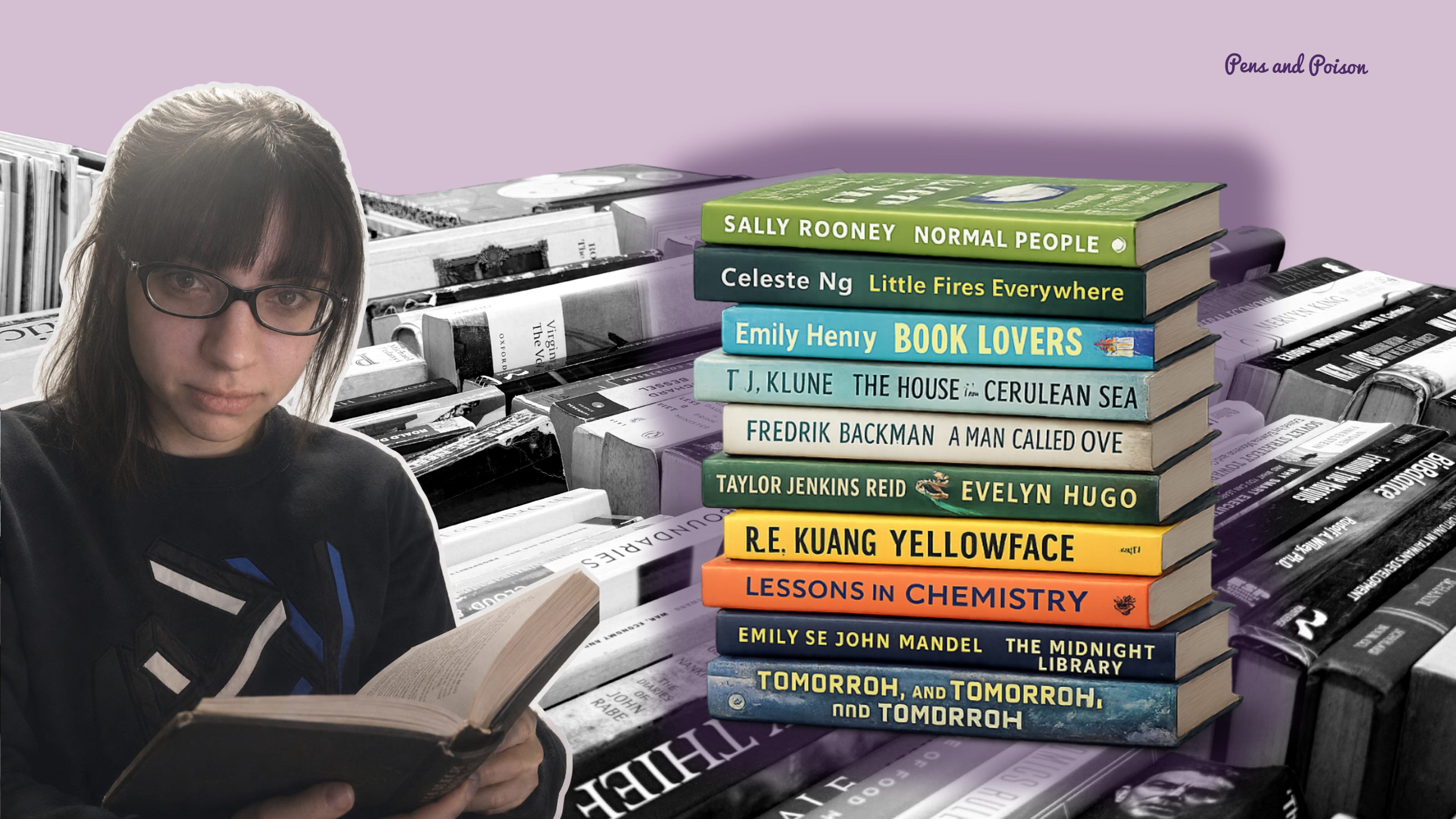
After an afternoon at Barnes and Noble, I shuffled into my East Village apartment with about ten literary fiction titles published within the last several years, among them Sally Rooney’s Normal People and Ottessa Moshfegh’s My Year of Rest and Relaxation. Flipping to the first page of Rooney’s most famous work, I couldn’t wait to be dazzled by a contemporary “Call me Ishmael” or “All this happened, more or less.”
Instead, I couldn’t believe what I was reading.
Marianne answers the door when Connell rings the bell. She’s still wearing her school uniform, but she’s taken off the sweater, so it’s just the blouse and skirt, and she has no shoes on, only tights.
Oh, hey, he says.
Come on in.
She turns and walks down the hall. He follows her, closing the door behind him.
I closed the book and stared at the cover, making sure I hadn’t accidentally picked up a picture book. But there was the neon blue and green cover with Rooney’s title, its minimalist facial sketches staring at me mockingly.
#1 INTERNATIONAL BESTSELLER.
That couldn’t be right. To be an international bestseller, one presumably had to learn storytelling techniques beyond monosyllabic dialogue and juvenile descriptions of a girl’s outfit. Surely, Rooney couldn’t be considered one of the great stylists of our era.
I was in some sort of cruel dream—and everyone seemed to be in on it.
Flipping through the other books I had brought home, I began to pick up patterns. The prose was minimalist and flat. The stories frequently revolved around racial identity and female empowerment. The sex was gratuitous.
This was what was getting published?
After about a dozen contemporary novels, I turned to Pale Fire by Vladimir Nabokov—one of the masters who had taught me how to write.
I can only describe the experience of reading Nabokov after slogging through “contemporary literature” as like eating a gourmet steak after months of McDonald’s meals.
Finishing Kinbote’s manic introduction to John Shade’s cantos, I burst into tears.
This was literature—and there was a whole group of people out there who would never know what it was like to cry mid-chapter because a beautiful sentence had been written!
Suddenly, my creative writing classes at Columbia started to make sense. How could those professors use great literature to teach students to write if their perception of “great literature” was limited to a narrow repertoire of marketable trends?
Meanwhile, inspired by Pale Fire, I was once again visited by the literary muses.
The result was my most recent novel, Blue Snow—and the rejections came pouring in as usual. At this point, however, I was nearly immune to the critiques that my novels were “too philosophical” or “too slow.” After all, I had received countless comments from a randomized group of beta readers—real readers—who didn’t seem to think so.
“It’s such a change of pace to read something deep for once!” one of my Gen Z readers wrote.
But literary agents didn’t seem to think so:
As a reader of literary fiction, I’m all for introspective characters who plumb the depths of their own psyche, page after page, to better understand the inner workings of their still-developing mind. But as a literary agent, I run screaming from that stuff as if I’d just emptied an entire can of Aqua Net on my head and lit a cigarette… Should you eventually choose to write something genre-specific and commercially viable, perish the thought, then feel free to send it my way.
Setting his unprofessionalism aside, I deduced that the agent’s primary complaint was that my writing was not “commercially viable”—and that I needed to try out genre fiction. But weren’t hundreds of new literary fiction titles being published every year, and didn’t “commercially viable” just mean that there would be readers who would want to read the book?
I had already sold hundreds of copies of my self-published poetry chapbooks—and novels typically had a much higher readership than poetry. I had had scores of people DM me expressing their interest in beta-reading my completely unpublished Blue Snow manuscript after skimming the pitch I’d posted to my Instagram story. Surely, my book was “commercially viable”—at least by the literal definition of the term. And sure, I could always write something “better”—any author could—but what happened when “better” was never good enough?
Something was wrong.
Over the next few months, I reflected on my experiences in both the Columbia English department and the query trenches. I read more contemporary literary fiction and poked around on Substack to see what other authors were saying about the state of fiction in the publishing industry. I quickly learned that I was not alone—and after some more research, I went public with my critique of publishing, on Substack and Instagram.
Soon, my DMs abounded with the words of jaded authors—many with even bigger platforms than mine—expressing their disillusionment with an industry that routinely turned away dense prose and philosophical musings. I listened to accounts from straight white men who felt shunned by an industry that looked down on stories depicting role models for young boys. I scheduled Zooms with Jewish authors who reported having their novels dropped by agents who claimed that the current climate would make it difficult to sell “Jewish stories.” I read messages from young women in creative writing programs who lamented the reign of buzzwords in their departments, and from older scholars of literature who had given up on contemporary fiction because the industry had lost sight of the broader literary tradition.
When my article on the soullessness of contemporary literary fiction became the third-most-read article on my Substack, I realized that my story was just one of many like it.
Every day, thousands of immensely talented novelists are shut out by an industry that pushes out the same type of novel produced by the same institutional pipeline because they dared to say something different.
While it might be tempting to blame the homogenization of fiction on literary agents or editors or even publishing houses, I believe the issue is not institutional but cultural—and our famed institutions are only succumbing to a uniquely fraught cultural moment.
To understand how we got here, we must first revisit the original purpose of the humanities.1
Traditionally, the humanities were about asking life’s biggest and most important questions: What is love? What is the nature of suffering? What is the purpose of my existence on this planet if I shall one day fade into nothingness? One can answer such questions through listening to a piece of music or reading a philosophical treatise, but I believe that there is no art form that more directly explores these ideas than literature, which poses questions through the stories we share and the words we all connect to.
We can call this concept of asking such questions as “humanistic inquiry” because these are the questions that make us human. Today, when we face an existential reckoning in the dawning age of artificial intelligence, I believe these philosophical questions are more important than ever.
But if publishing professionals routinely label incoming literary fiction submissions as “too philosophical,” how can we have these conversations in the context of contemporary literature?
It has become clear that contemporary literature has strayed far away from the tradition of humanistic inquiry.
But maybe we can fix that.
There are three main “issues” with the fiction in the publishing industry today. They are the following:
1) Aesthetic Standardization
Because the majority of literary fiction writers must pass through an MFA program to have a shot at publication in the genre, their writing style often conforms to the teachings of MFA professors, many of whom glorify minimalist sentences and emotional restraint. The result is a literary ecosystem where many writers, rewarded by our institutions for aesthetic and ideological alignment, sound more or less the same.
More about aesthetic standardization below.
The Rise of the Soulless Novel

New York Publishing has lost its soul, said Ted Gioia last week on his Substack, The Honest Broker. Gioia, one of my favorite Substackers, laments the decay of originality in the publishing industry, pulling up an assortment of books with virtually identical covers:
2) Moral Flattening & Ideological Conformity
Traditionally, literature was meant to help us learn how to understand ourselves and the world around us. But in the latter half of the twentieth century, university English departments began to reject this tradition and instead embraced the postulates that a) meaning is relative, b) authorial intention is irrelevant, and c) universal truths are oppressive. Taught to analyze literature through these “postmodern” lenses, English department graduates—many of whom go on to hold positions of power in publishing or become writers themselves—believe that literature should passively observe rather than teach. Within this framework, literature is understood not as a vehicle for moral and humanistic inquiry but as a site for presupposing ideological conclusions without proper justification. Readers are therefore no longer asked to consider what a work of fiction means; they are asked to consider whether it signals the “right” kind of meaning. As these assumptions have spread from the academy into the publishing industry, novels themselves have increasingly abandoned moral seriousness in favor of ideological conformity.
More about moral flattening here:
How Postmodernism Killed Great Literature

This essay was originally written for The James G. Martin Center for Academic Renewal.
3) The Commercialization of Sex and Eroticism
The retreat from aesthetic and moral seriousness, in turn, created fertile ground for the commercialization of sex. Today, the publishing industry encourages the inclusion of explicit sexual content in literature not because it operates as a meaningful artistic device but simply because it captures attention and drives sales. As a result, literary fiction has become gratuitously hypersexualized, and reading has become an erotic rather than a literary endeavor. Such excess reflects a market-driven literary culture that privileges immediate gratification over patience and thought.
I discuss the eroticization of literature here:
“Sex-Positivity” Broke Contemporary Literature

Last week, I wrote about the plague of soulless writing that has infested the publishing industry. But there’s an equally—if not more—disturbing trend in publishing today, and that is the obsession with “sex-positivity.”
Read virtually any work of literary fiction published within the last ten years with these three pillars in mind, and you, too, will begin to pick up on these trends. But good literature is not “trendy”—nor is it gratuitous, morally bankrupt, or stylistically minimalist; instead, good literature explores the complexity of human nature through chaotic phrases that express the inner depths of human feeling and messy characters who prompt unexpected revelations about the human psyche.
To me, literature has always been about humanistic inquiry, and if there is any hope for our species to find meaning in an age that increasingly strips us of our human element, then it is imperative that we restore literature to its rightful place in the humanistic tradition.
Enjoyed this post? You can Buy Me a Coffee so that I’ll be awake for the next one. If you are a starving artist, you can also just follow me on Instagram, YouTube, or “X.”
The word “humanities” itself comes from the Latin humanitas, a concept encompassing both “human nature” and “culture, refinement, and civilization.” The Romans derived this understanding of humanistic study from their friends the ancient Greeks, who conceived a holistic liberal arts education system called the paideia that prepared students for rewarding lives as citizens. In other words, our civilization developed the study of the humanities to understand human nature through the liberal arts. To be a good citizen—and, indeed, a fuller human being—was to be not just educated but also cultured. Because it is through culture that we can best answer the questions that help us understand what makes us human.
I've been reading you. I'm sorry you had to go through all that. I never even tried to find an agent because I'm old and don't have time for their BS, I don't have a voice that is "commercial," and I am "privileged" enough to be able to afford to self publish. It's going well. No complaints. No one (except my editor) asks me to change anything. I think you will continue to do great things. You already are. You don't need publishing to tell anyone that. We can all see it (read it) for ourselves. Congratulations!
Liza, your literary path sounds a lot like mine, and hundreds of other talented writers that I know or have encountered in my years in the business. I think what bothers me most about the publishing industry is the smugness of agents and editors who clearly don't know very much about what makes good literature, and instead substitute social politics as the yardstick for the measurement of quality.