


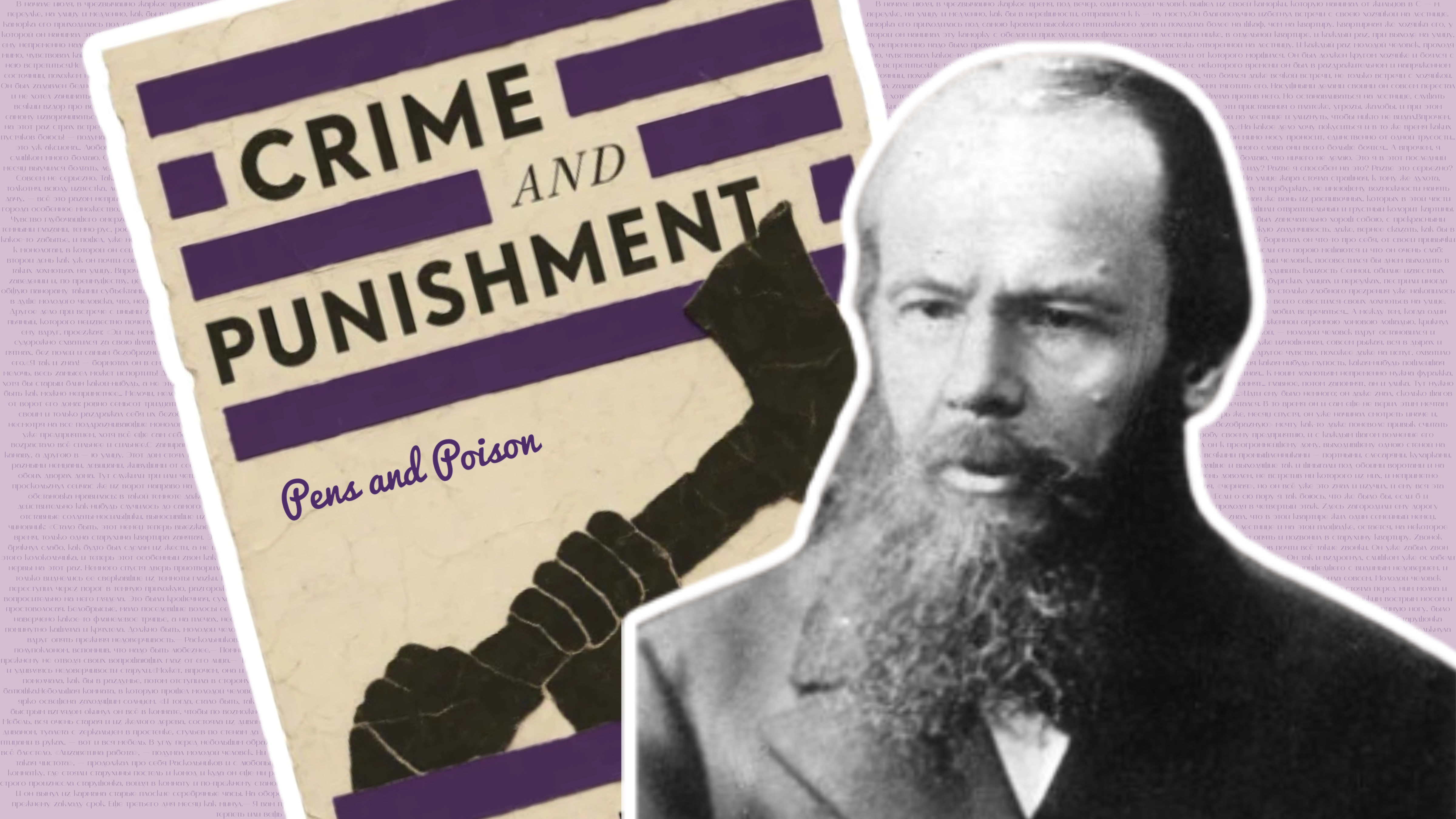
Dostoyevsky might just be the greatest novelist ever to have walked this earth—and I can prove it.
I’ve previously written about how to choose the best Dostoyevsky translation, what you might be missing in your reading of Crime and Punishment, and what most people get wrong in their interpretation of Raskolnikov. But today, I’d like to discuss why I believe Crime and Punishment is the second-best novel ever written (after The Brothers Karamazov, of course).
Before we dive into Crime and Punishment’s philosophical underpinnings, we must first understand Dostoyevsky’s roots.
Dostoyevsky’s Early Days
As a child, Dostoyevsky attended a French boarding school, where he developed a penchant for both French literature and philosophy. His first major literary project, in fact, was not a novel of his own making but a translation of Honoré de Balzac’s Eugénie Grandet. One can imagine that Dostoyevsky’s interest in the French intellectual world made him a natural candidate for the Petrashevsky Circle, a literary group composed of progressive intellectuals not unlike today’s New Yorker crowd. Of particular interest to both young Fyodor and his intellectual compatriots were Charles Fourier and Pierre-Joseph Proudhon—a leading utopian socialist and the father of anarchism, respectively. The young Fyodor, in fact, was so taken by Fourier and Proudhon’s missions to create a better and more just world that he spent his days debating political reform in Petrashevsky’s home, and, eventually, joining a more radical and bloodthirsty offshoot of the organization.
That is, of course, until his actions caught up to him.
In 1849, Tsar Nicholas I, alarmed at the possibility of a revolution, arrested the members of the Petrashevsky Circle and sent them to Semyonov Place for execution. But as the prisoners stood before the firing squad, praying for a miracle, a messenger ran in with notice of a reprieve, and Dostoyevsky was granted life.
The entire execution, of course, was a set-up, but for young Dostoyevsky, that moment meant everything.
There’s a passage in The Idiot where Prince Myshkin recalls the experience of a man sentenced to death by firing squad. One can imagine that it accurately sums up Dostoyevsky’s own brief encounter with death:
“What if I were not to die! What if life were given back to me—what infinity! And it would all be mine! then I’d turn each minute into a whole age, I’d lose nothing, I’d reckon up every minute separately, I’d let nothing be wasted!”
After staring death right in the face, Dostoyevsky found a new meaning in his life—and an extraordinary sense of meaning, at that. We know from a letter written to his brother on the day of his pardon that Dostoyevsky developed not only a renewed sense of gratitude but also an intense spirituality that would stay with him for the rest of his life:
When I look back at the past and think how much time has been wasted in vain, how much time was lost in delusions, in errors, in idleness, in ignorance of how to live, how I did not value time, how often I sinned against my heart and spirit, — my heart bleeds. Life is a gift, life is happiness, each minute might have been an age of happiness. Si jeunesse savait! Now, changing my life, I am being reborn into a new form. Brother! I swear to you that I shall not lose hope, and shall preserve my spirit and heart in purity. I shall be reborn to a better thing. That is my whole hope, my whole comfort!
Dostoyevsky went on to spend the next decade in Siberian exile, but like Raskolnikov, he didn’t seem to mind it much—in fact, it was in exile that Dostoyevsky revised many of his left-wing convictions and began to ask what really gave human beings meaning.
These musings gave birth to several of the Western world’s greatest literary creations.
Demons was inspired by Dostoyevsky’s early revolutionary days; Notes from Underground, written shortly before Crime and Punishment, challenges utopianism by arguing that human beings deliberately act against their own interests. In fact, one might trace Dostoyevsky’s lifelong interest in psychology to his determination to debunk the radical left-wing ideologies that had led him astray as a young man: turning to the darker side of human psychology, Dostoyevsky created one of the first-ever novels to probe the depths of the human psyche.
That novel was Crime and Punishment.